The Dutch company Damen Holding BV, the previous operator of the ailing Mangalia shipyard in Romania, has challenged in court the tender through which German defense manufacturer Rheinmetall won the auction for the shipyard on October 9, 2026, offering EUR 138 million, according to Romania Insider.
Damen is the main creditor of the Mangalia Shipyard. The company challenged the court ruling that allowed the starting price to be reduced as part of the shipyard’s sale procedure, paving the way for its acquisition by Rheinmetall earlier this month, after four unsuccessful attempts.
The sale price of EUR 138 million is equivalent to 75% of the initial starting price of EUR 184 million.
The court’s decision to allow the starting price to be reduced was justified by the lack of bidders in the first four tenders held. Judicial liquidator CITR asked the insolvency judge on May 14, 2026, to approve the application of the provisions of the Civil Procedure Code, which allowed the price to be reduced to 75% of its initial value. A few hours later, Damen Holding BV filed a request proposing a different strategy: holding six consecutive monthly tenders without reducing the starting price.
However, the Creditors’ Meeting, in which Damen Holding holds 70% of the total claims, approved the strategy proposed by the liquidator. After the first three tenders held under this strategy attracted no buyers, the insolvency judge subsequently allowed the price to be reduced in accordance with the Civil Procedure Code, and Rheinmetall won the fifth tender.
In the challenge it filed, Damen Holding argued that applying the legal provisions concerning the price reduction is erroneous in light of recent legislative amendments.
“The law no longer refers to the maximum 12-month period for the sale of assets, and the notion of a ‘reasonable period’ remains undefined,” the document consulted by News.ro stated.
Meanwhile, representatives of the 2 May naval shipyard, which is controlled by the Romanian state and is the majority shareholder in Damen Mangalia, with a 51% stake, accused Damen Holding of obstructing the sale process. They claimed that the Dutch company was allowed to attend Creditors’ Meeting sessions to approve the proposed sale strategy, but was absent or opposed it, thereby contributing to delays in the process. They also stressed that the accumulation of current debts during the bankruptcy period reduces the chances of recovering claims.
The case will be examined by the Constanța Tribunal on November 4. Rheinmetall announced on Monday, October 19, that it intends to develop a “dual-use” production center at Mangalia, for both military and civilian purposes, in partnership with Swiss shipping company MSC.
“Following the acquisition, we plan to expand and upgrade the shipyard comprehensively. We aim to further develop the existing infrastructure, improve production conditions and adapt capacity to meet future requirements. This will enable the site in the long term to play a key role in the implementation of our strategic activities in South-Eastern Europe and to strengthen our industrial presence in the region,” said Tim Wagner, CEO of the Naval Systems division.
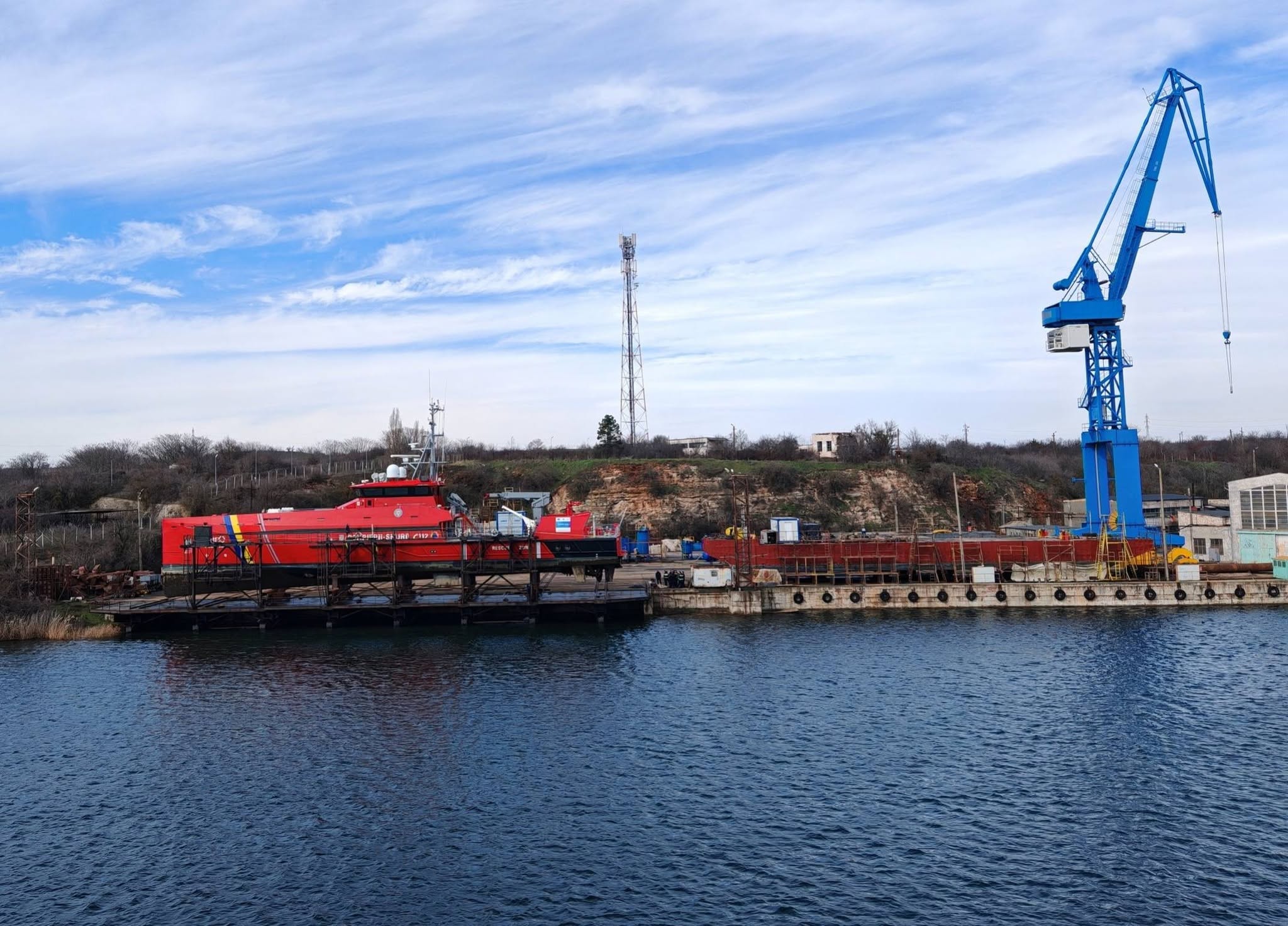
Situated on the Romanian Black Sea coast, the Mangalia Shipyard (Șantierul Naval Mangalia) stands as one of the largest and most strategically vital shipbuilding complexes in Southeastern Europe. Boasting extensive dry docks capable of accommodating large-tonnage commercial vessels and specialized maritime structures, the yard has long served as a cornerstone of Romania’s heavy industrial capacity and coastal employment.
Over the past decade, however, the facility has found itself at a critical crossroads. Navigating shiftings in global maritime trade, intense competition from East Asian shipbuilders, and corporate restructuring, Mangalia is actively redefining its operational model to secure long-term commercial viability.
Facility Overview and Industrial Capacity
| Strategic Metric | Operational Profile |
| Geographic Location | Mangalia, Constanța County (Black Sea Coast) |
| Core Infrastructure | Large-scale dry docks, heavy gantry cranes, deep-water berths |
| Historical Capabilities | Construction of ultra-large container ships, bulk carriers, and tankers |
| Current Operational Focus | Ship repair, vessel conversions, specialized offshore structures, green refits |
| Strategic Importance | Key industrial employer in southern Dobrogea; vital maritime asset for the EU’s eastern flank |
Navigating Restructuring: From Mass Production to High-Value Niches
Historically known for constructing large commercial vessels under various international partnerships—most notably Daewoo Shipbuilding & Marine Engineering (DSME) and later Damen Shipyards—the Mangalia yard faced financial and operational headwinds driven by volatile global shipping markets and rising energy costs.
To adapt to contemporary market demands, the shipyard’s strategy has increasingly shifted from standard commercial vessel construction toward higher-margin, specialized maritime engineering:
-
Ship Repair and Complex Conversions:
Capitalizing on its vast dry-dock infrastructure, Mangalia remains a primary hub for retrofitting, repairing, and lengthening existing commercial fleets navigating Black Sea and Mediterranean trade routes.
-
Offshore and Renewable Energy Infrastructure:
As energy transition initiatives accelerate in the Black Sea region, the yard is uniquely positioned to fabricate components for offshore wind farms, substations, and offshore gas extraction platforms.
-
Decarbonization and Green Maritime Refits:
International Maritime Organization (IMO) environmental mandates have created strong demand for retrofitting vessels with scrubbers, ballast water treatment systems, and alternative fuel propulsion systems—a niche where Mangalia’s technical workforce holds substantial expertise.
Economic Impact and Geopolitical Significance
The health of the Mangalia Shipyard extends far beyond corporate balance sheets. As one of the primary industrial employers in Constanța County, the yard supports thousands of direct and indirect jobs, sustaining a regional supply chain of engineering firms, logistics providers, and technical contractors.
Furthermore, given the evolving security architecture in the Black Sea, maintaining robust shipbuilding and repair capacity on European Union and NATO territory carries undeniable strategic weight. The yard provides crucial industrial backing for dual-use maritime logistics and fleet maintenance in the region.
Looking Ahead
The future of the Mangalia Shipyard hinges on sustained capital investment, effective public-private governance, and a steadfast commitment to technological modernization. By embracing green maritime technology and diversifying into specialized offshore construction, Mangalia aims to ensure that its historical legacy as a titan of Black Sea shipbuilding translates into a sustainable, competitive future.
A10 Sebeș-Turda has had lane closures for months due to ground instability