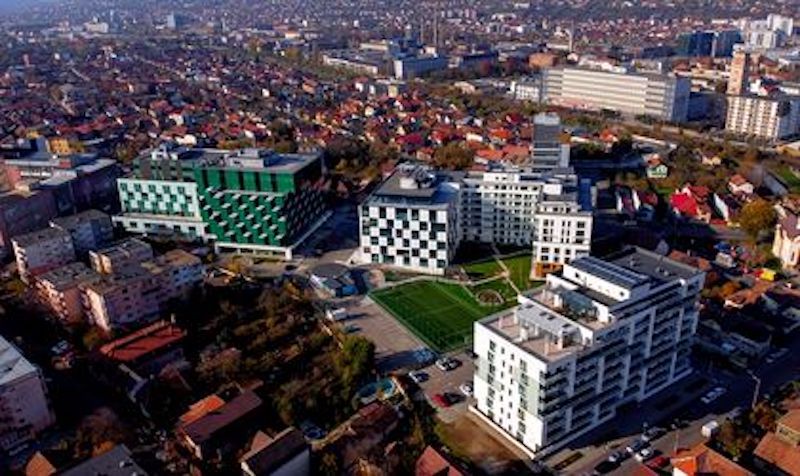
Cluj Business Campus (CBC), an urban real estate and workplace experience project being developed in Cluj-Napoca, is entering a new phase of development, with nearly half a million euros in investments allocated for 2026. These investments aim to enhance the quality of the work experience, upgrade the campus infrastructure, and align with international standards for sustainability, safety, and well-being, according to Business Review.
The campus is built on the One Minute City philosophy (services for work and daily life—from sports, education, and health to relaxation—all integrated within a maximum of one minute from the office) and supports a direction that is increasingly relevant to the office market: the office as an experience, in a project where companies can build their organizational culture and employees have real reasons to come to the office.
These investments are part of a multi-year development plan and are aimed at enhancing the quality of the workplace experience, operational efficiency, safety, and the integration of services that support the day-to-day operations of tenant companies. The CBC vision is built on three main pillars: Future of Work, Work-Life Balance, and Smart Hospitality, through which the campus connects offices, services, technology, community, wellness facilities, and social spaces into a cohesive experience.
One of the most important projects set to be completed in 2026 is the modernization of the CBC 1 building and the transformation of the common areas into a hospitality concept applied to the office environment, developed in collaboration with architect Cosmin Todor. The project brings a warmer, more elegant atmosphere to the office space, one that feels closer to the experience of a hotel or an urban club, while maintaining the functionality required of an office building.
“In 2026, investments allocated to Cluj Business Campus are aimed at establishing the campus as a space where the office becomes a complete experience. Companies use the office as part of their strategy for organizational culture, retention, well-being, and employer branding, and employees need real reasons to return to the office regularly. Our goal is to develop a campus where the infrastructure, services, community, and day-to-day amenities support this new role of the workspace,” says Vlad Buzoianu, CEO of Cluj Business Campus.
This year’s investments include projects focused on technical infrastructure and safety, such as upgrading remote meter reading systems and emergency lighting, modernizing certain interior spaces, and implementing measures to improve the campus’s operational quality. These are complemented by projects with a direct impact on the employee experience, such as the on-campus physical therapy clinic, designed for people who spend a lot of time at the office, and the reopening of the Rooftop Garden, in collaboration with the La Piovra team, in an expanded format featuring social events, culinary experiences, and activities dedicated to the CBC community.
The campus operates on the “One Minute City” philosophy, whereby essential services for the workday are integrated within walking distance of the office. Employees have quick access to a restaurant, specialty café, fitness center, medical services, physical therapy, event spaces, a rooftop, private park, sports facilities, an international school, and a kindergarten, which reduces time spent commuting and transforms the campus into a tangible tool for enhancing the workplace experience for companies. These facilities are complemented by the CBC App, which gives the campus community access to services, benefits, reservations, communication with the facility management team, and community-focused events and programs.
CBC is preparing a major new phase of modernization for 2027
This year’s investments are paving the way for the next major phase of the campus’s development. For 2027, the modernization of the CBC 2 building is planned, through a project estimated at approximately €1 million. The work will focus on modernizing common areas and developing interaction zones, as well as enhancing the building’s technical and technological capabilities.
CBC’s strategy aims to ensure that each building is periodically updated through refurbishment projects, so that the campus remains aligned with evolving work practices, corporate requirements, and current standards for operations, sustainability, and safety.
“Modernizing an office building today encompasses design, infrastructure, efficiency, sustainability, safety, and the user experience. In the case of CBC, these areas are connected through a long-term development strategy. Investments are designed to ensure that each building remains relevant to tenant companies and to the employees who use the campus every day,” adds Vlad Buzoianu.
BREEAM and WELL certifications are becoming important criteria for international companies
In parallel with operational investments and projects focused on the workplace experience, CBC continues the process of aligning with international standards relevant to large companies. The campus holds BREEAM Very Good certifications for CBC 1 and CBC 2, and BREEAM Excellent for CBC 3, with the goal of upgrading to BREEAM Outstanding for the entire campus and obtaining WELL certification.
BREEAM certification evaluates building performance against criteria for sustainability, energy efficiency, responsible use of resources, environmental impact, and operational quality. WELL certification, on the other hand, evaluates buildings from the perspective of the health and well-being of their occupants, using criteria related to air quality, light, comfort, physical activity, nutrition, and indoor environmental quality.
For large companies, particularly international ones, such certifications have become key criteria in the process of selecting office spaces. Real estate, ESG, and sustainability departments seek verifiable standards that demonstrate that the spaces they occupy are aligned with the organization’s global policies. In this context, BREEAM and WELL serve as concrete tools through which companies can validate the quality, sustainability, and impact of the spaces they use.
For CBC, these certifications confirm the long-term development direction: an efficient, healthy, responsible campus adapted to the requirements of global companies. Investments allocated to the campus aim to modernize spaces and increase comfort, as well as improve building performance, indoor environmental quality, and the integration of international standards into operations.
Cluj Business Campus is an urban real estate and workplace experience project by Felinvest, a real estate development company. The campus is being built in Cluj-Napoca based on the “One Minute City” philosophy, whereby services for work and daily life are integrated within a maximum of one minute’s walk from the office. The campus, with a total area of approximately 30,000 square meters, includes three office buildings, service spaces, a restaurant, a café, a fitness center, a medical clinic, physical therapy services, a sports field, a rooftop, a private park, event spaces, and an international school and kindergarten.
Two decades ago, the commercial real estate landscape in Cluj-Napoca was virtually non-existent. Businesses operated out of converted residential apartments, communist-era administrative buildings, or improvised villa offices. Fast forward to 2026, and the skyline of Transylvania’s historical capital tells a radically different story.
Today, Cluj-Napoca stands as a premier regional tech and business hub, boasting a modern office stock that exceeds 350,000 square metres. The evolution of this market is not merely a story of glass and steel; it is a direct reflection of the city’s economic metamorphosis from a quiet university town into the “Silicon Valley of Romania.”
The Three Waves of Growth: From Pioneers to Tech Clusters
The trajectory of the Cluj office market can be divided into three distinct phases, each aligned with the shifting demands of the global corporate tenants driving the local economy.
1. The Fragmented Beginnings (2006–2012)
The market’s infancy was marked by local developers taking their first cautious steps. Projects like Maestro Business Center and Amera Tower proved that Class A office spaces could find a clientele in Cluj. This era was defined by small to medium-sized floor plates, catering to early-stage IT outsourcing companies and banking back-offices that were just discovering the city’s highly skilled, multilingual academic talent pool.
2. The Institutional Consolidation (2013–2019)
This period witnessed the arrival of institutional-grade business parks that completely reshaped corporate standards. Projects like The Office (developed by NEPI Rockcastle and Mulberry Development) and Iulius Congress Hall / United Business Center introduced international Class A specifications to the heart of the city.
With sprawling floor plates, green building certifications (BREEAM/LEED), and integrated retail amenities, these developments allowed global giants such as NTT Data, Porsche Engineering, Cognizant, and Genpact to scale their local operations to thousands of employees.
3. The Regenerative and Hybrid Era (2020–2026)
In recent years, the market has entered a phase of urban maturity. Driven by post-pandemic hybrid work models and stricter ESG (Environmental, Social, and Governance) criteria, developers have shifted focus toward mixed-use urban regeneration projects.
The focus is no longer just on providing a desk, but on creating vibrant ecosystems. This era is epitomised by large-scale transformations of former industrial platforms into green, walkable districts where modern office spaces coexist with residential areas, parks, and cultural venues.
Market Radiography: Key Office Indicators
The structural maturation of the market is best understood through its underlying operational data, showcasing how Cluj-Napoca has maintained high occupancy rates despite rapid expansion.
The Evolution of Class A Office Space in Cluj-Napoca
| Market Indicator | Situation in 2006 (Estimates) | Consolidated Situation (2026) | Strategic Market Impact |
| Total Modern Stock | Under 30,000 sq m | Over 350,000 sq m | Solidified Cluj as the second-largest office market in Romania after Bucharest. |
| Dominant Office Profile | Class B/C, standalone villas | Class A, Eco-Certified Business Parks | Attracted premium multinational tenants requiring strict environmental compliance. |
| Average Rent (Prime) | €10 – €12 / sq m / month | €14.5 – €16 / sq m / month | Reflects steady yield growth while remaining highly competitive on a European scale. |
| Primary Tenant Sector | Local trade & logistics | IT & DeepTech, Shared Services (GBS), R&D | High-value-added sectors dictating bespoke corporate interior designs. |
Driving Forces: Clusters, Innovation, and Accessibility
The unprecedented demand for corporate space in Cluj-Napoca has been systematically supported by the city’s unique economic architecture.
A pivotal role belongs to institutional facilitators like Cluj IT Cluster, a European “Gold Label” innovation network that has fostered collaboration between over 85 tech entities, universities, and public bodies. Furthermore, initiatives like DIH4Society (Digital Innovation Hub for Society) have actively accelerated the digital transformation of regional small and medium-sized enterprises, boosting the local entrepreneurial ecosystem and feeding the demand for flexible office solutions and co-working spaces.
The geographic distribution of the office hubs has also evolved strategically to combat urban congestion:
[Downtown Hub] ───────> Premium Class A (The Office, Iulius) -> Target: Headquarters & Prestige
[Western Hub - Florești/Manăștur] ─> Accessible, tech-heavy spaces -> Target: R&D & High-Volume Teams
[Northern Industrial Zone] ──> Mixed-use regeneration (Mărăști/Iris) -> Target: Hybrid Ecosytems & Living
Future Challenges: Sustainability and the “15-Minute City”
As the market looks toward the horizon, developers face a fresh set of challenges. Corporate tenants are no longer looking at buildings in isolation; they demand seamless integration into the transport infrastructure.
The upcoming Cluj-Napoca Metro project and the expansion of metropolitan train networks are already dictating the positioning of future office pipelines. Buildings that do not offer carbon-neutral operations, advanced air filtration systems, and direct access to green mobility are rapidly facing obsolescence, forcing landlords to heavily invest in retrofitting older stock.
Fitch upgrades Romania’s Banca Transilvania to ‘BBB’, CEC Bank to ‘BB+’