

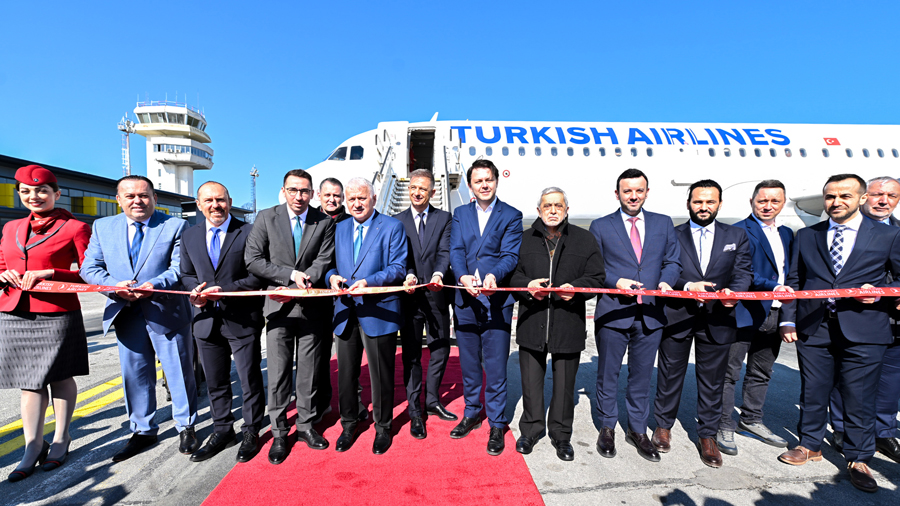
Turkish Airlines launched a new route between Istanbul and Timișoara on April 1. The carrier operates five round trips per week on Tuesdays, Wednesdays, Fridays, Saturdays, and Sundays, using Boeing 737 aircraft. Flight time is 1 hour 45 minutes from Istanbul and 1 hour 50 minutes from Timișoara, according to Traicy.com.
Timișoara becomes the fourth destination served in Romania, following Bucharest, Cluj-Napoca and Constanța.
Located along the Bega River in western Romania, Timișoara is a tourist city with a rich historical heritage and multicultural appeal. Often referred to as “Little Vienna,” it is known for landmarks such as Union Square and Victory Square, as well as its vibrant and distinctive culture. In 2023, it was selected as a European Capital of Culture, solidifying its status as one of the region’s leading cities for both business and tourism.
■ Schedule
TK1013 Istanbul (07:40) → Timișoara (09:25) / Tue, Sat
TK1014 Timișoara (10:15) → Istanbul (12:05) / Tue, Sat
TK1015 Istanbul (19:25) → Timișoara (21:10) / Wed, Fri, Sun
TK1016 Timișoara (22:00) → Istanbul (23:50) / Wed, Fri, Sun
From its strategic hub at the crossroads of East and West, Turkish Airlines has transitioned from a regional carrier to the world’s most connected airline. In 2026, the national flag carrier of Turkey stands as a titan of the skies, leveraging Istanbul’s unique geography and a massive fleet expansion to dominate long-haul transit markets.
Walking through the terminals of Istanbul Airport, the scale of operations is immediately apparent. As of April 2026, Turkish Airlines maintains its position as the airline flying to more countries than any other carrier. Its growth strategy has turned the “Global Gateway” of Istanbul into a primary rival for traditional hubs in the Middle East and Europe.
The “Mega-Order” and Fleet Modernization
The defining story of Turkish Airlines in the mid-2020s has been its unprecedented fleet expansion. Following historic commitments to acquire hundreds of new aircraft from both Airbus and Boeing, the airline has successfully lowered its average fleet age while significantly increasing fuel efficiency.
| Strategic Metric | Status in April 2026 | Impact on Operations |
| Network Reach | Over 340 destinations in 130 countries. | Unrivaled connectivity for business and leisure. |
| Fleet Composition | Integration of A350-1000 and 787 Dreamliner aircraft. | Ultra-long-haul capability, including non-stop flights to Australia. |
| Sustainability | Increased investment in Sustainable Aviation Fuel (SAF). | Alignment with international aviation decarbonization goals. |
| AJet Evolution | Successful spin-off of the low-cost subsidiary. | Capturing the budget-conscious traveler segment in the region. |
The Istanbul Hub: A Fortress of Connectivity
The success of the carrier is inseparable from the infrastructure of Istanbul Airport. Designed to handle massive passenger volumes, the hub allows for efficient transit traffic—passengers flying between the Americas, Europe, Asia, and Africa.
Operational efficiency at the hub is supported by advanced logistics. In 2026, the airline utilizes sophisticated algorithms to minimize connection times and ensure that its cargo wing, Turkish Cargo, remains a top-tier global player in air freight, benefiting from the specialized facilities at the SmartIST terminal.
Passenger Experience and Service Standards
While many carriers have moved toward unbundled services, Turkish Airlines has maintained a focus on full-service hospitality. The airline continues to differentiate itself through its catering program, which consistently secures high rankings in international aviation awards.
In 2026, the focus has shifted toward technological integration. The passenger experience now includes:
-
Enhanced Connectivity: High-speed Wi-Fi across the long-haul fleet.
-
Cabin Innovation: The rollout of new business class suites and refreshed economy interiors.
-
Digital Assistant: A mobile application that manages biometrics and real-time luggage tracking.
Sustainability and the Future of Flight
As environmental regulations tighten, Turkish Airlines has moved to address its carbon footprint. By 2026, the airline has expanded its voluntary carbon offset programs and participates in global initiatives to modernize air traffic management, which helps reduce fuel burn.
-
Australia Routes: The arrival of new ultra-long-range aircraft has enabled the airline to offer non-stop flights from Istanbul to major Australian cities, a milestone for Turkish aviation.
-
Global Maintenance Hub: Turkish Technic has expanded its capacity, providing maintenance and repair services for a significant portion of the global fleet.
-
Local Economic Impact: The airline remains a primary driver of the Turkish economy, supporting thousands of jobs through its sprawling ecosystem of suppliers and services.
Comments
comments


