

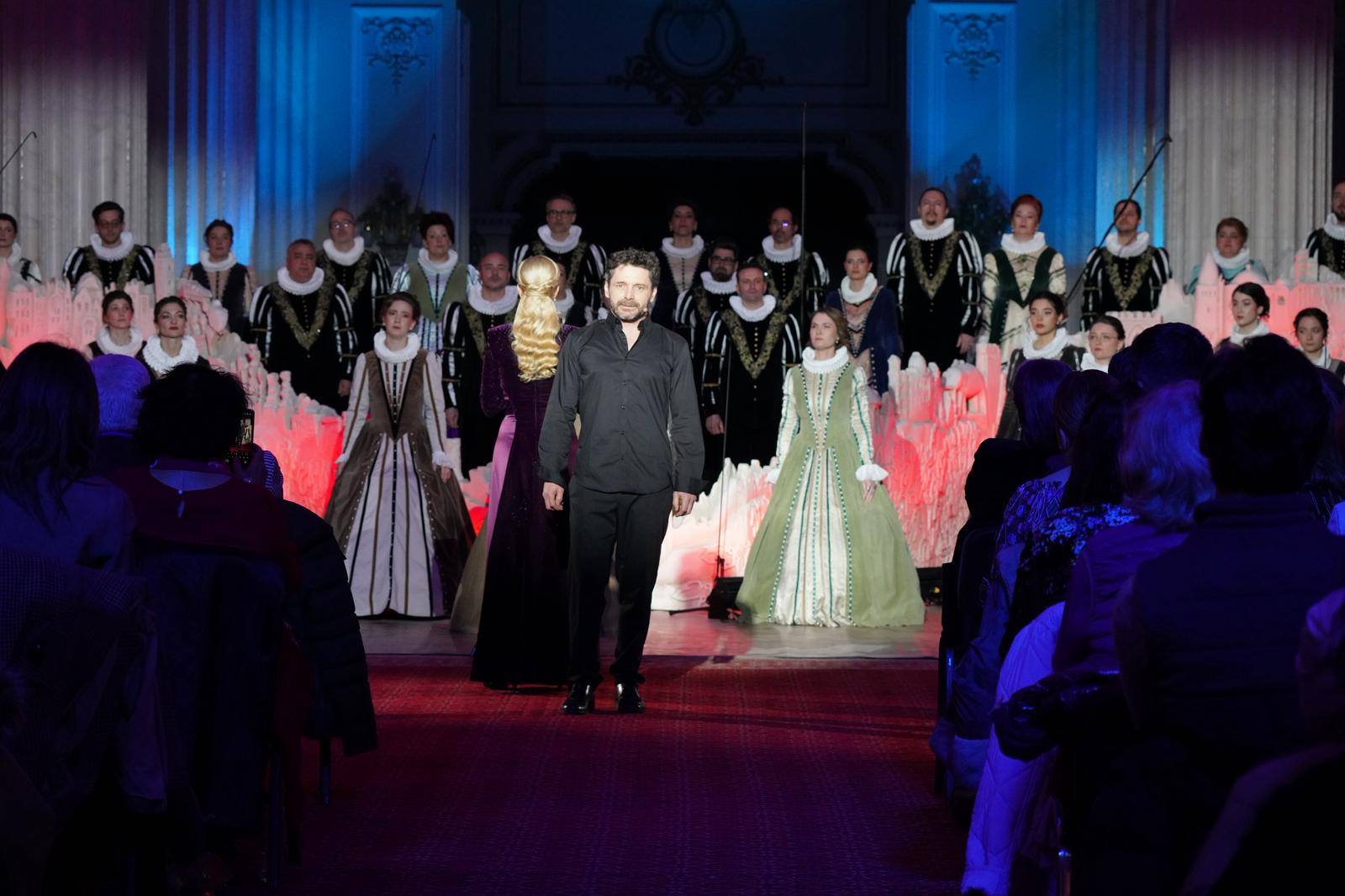
The Madrigal – Marin Constantin National Chamber Choir will hold two extraordinary performances in Bucharest during Holy Week, inviting audiences to experience a multidisciplinary interpretation of the Passion of Christ through music, theatre and scenography, according to Business Review.
The concerts, titled Holy Week, are scheduled for April 8 (Holy Wednesday) and April 9 (Holy Thursday), starting at 19:00, at the Aula Magna of the Politehnica University of Bucharest. The ensemble will be conducted by Anna Ungureanu, with pianist Mihai Murariu accompanying the performances.
The production traces the final days of Jesus Christ on Earth, moving from the joy of the entry into Jerusalem to the agony of the Crucifixion. Designed as an immersive experience, the performance blends sacred music with dramatic elements and visual storytelling. Actors Marius Turdeanu and Richard Bovnoczki will perform sacred texts, while children from the Cantus Mundi National Program choirs in Bucharest and surrounding regions will join the ensemble on stage.
The repertoire brings together Romanian and international Easter works, including excerpts from the Byzantine Florilegium, a landmark collection of liturgical music curated by the choir’s founder Marin Constantin. The program also features “The Lord’s Lamentation” in the arrangement by Nicolae Lungu and Credo from Missa in C minor by Wolfgang Amadeus Mozart, alongside other emblematic spiritual compositions.
Founded in 1963 by Marin Constantin, the Madrigal Choir is one of Romania’s most renowned cultural institutions and a global ambassador of choral music. Known for its distinctive sound, refined staging, and commitment to promoting sacred and classical repertoire, the ensemble has performed on major stages worldwide and has played a key role in preserving and reinterpreting Byzantine and Renaissance music traditions.
The Bucharest performances are part of the choir’s national Easter tour, running from March 26 to April 9, with stops in Timișoara, Oradea, Cluj-Napoca, Deva, Sibiu, and Bucharest.
Tickets are available online via the choir’s official website and ticketing platforms.

For over six decades, the National Chamber Choir “Madrigal – Marin Constantin” has stood as a pinnacle of choral excellence, weaving together the ethereal sounds of the Renaissance, the depth of Byzantine chant, and the innovation of contemporary Romanian music. In 2026, as Europe re-evaluates the role of classical arts in a digital age, the Madrigal remains not just a musical ensemble, but a living monument of Romanian identity and a bridge between East and West.
To witness a Madrigal performance is to experience a meticulously choreographed ritual of sound and light. Known globally for their distinctive period costumes and their ability to perform without a conductor’s traditional baton, the choir has moved beyond the confines of concert halls, bringing “The Sound of the Soul” to ancient citadels, industrial spaces, and digital platforms alike.
The Vision of Marin Constantin: Founding a Legend
The story of the Madrigal began in 1963, during a period of complex ideological shifts in Romania. Its founder, the legendary Marin Constantin, envisioned a chamber choir that could master the complex polyphony of the European Renaissance—a repertoire largely ignored at the time in the Eastern Bloc.
Marin Constantin’s rigorous method, which focused on “vocal chemistry” and the precise blending of timbres, created a unique sonic signature. This “Madrigal sound” earned the choir UNESCO’s “Ambassador of Good Will” title and the “Grand Prix” at numerous international festivals.
Cantus Mundi: Music as a Social Catalyst
Under its current leadership, the Madrigal has expanded its mission through Cantus Mundi, the largest social integration program through music in Romania. Launched with the goal of bringing choral singing to every school in the country, the program has reached over 60,000 children, proving that music is a powerful tool for social cohesion and psychological well-being.
| Strategic Pillar | Core Objective in 2026 | Impact |
| Artistic Excellence | Preserving the Renaissance and Byzantine repertoire. | Over 40 albums and 4,000+ global concerts. |
| Social Innovation | Cantus Mundi National Program. | Integration of children from diverse socio-economic backgrounds. |
| Cultural Diplomacy | Performing in iconic global venues (UN, Vatican, Great Wall). | Strengthening Romania’s soft power abroad. |
| Digital Transformation | Immersive VR concerts and high-fidelity streaming. | Engaging the Gen Z audience with classical roots. |
The Modern Era: Innovation and Scenography
In 2026, the Madrigal Choir, currently led by conductor Anna Ungureanu and manager Emil Pantelimon, has embraced a “total art” concept. Their performances are no longer just auditory; they are immersive experiences featuring complex scenography, 3D mapping, and theatrical elements.
Regarding the choir’s evolution, Emil Pantelimon recently noted: “The Madrigal is a bridge between the precision of the past and the uncertainty of the future. We don’t just sing notes; we curate emotions. Our challenge in 2026 is to remain relevant to a world that moves at 5G speed while maintaining the slow, profound resonance of a 16th-century madrigal. Through Cantus Mundi, we ensure that this flame is passed to the next generation”.
Repertoire: From Palestrina to the 21st Century
The choir’s versatility remains its greatest strength. A typical season in 2026 includes:
-
Renaissance Polyphony: Masterpieces by Monteverdi, Palestrina, and Orlando di Lasso.
-
Byzantine Roots: Ancient Romanian chants that highlight the spiritual depth of the Orthodox tradition.
-
The Contemporary Wave: Premieres by modern Romanian composers like Dan Dediu or Livia Teodorescu-Ciocănea, often incorporating electronic elements.
Comments
comments


