

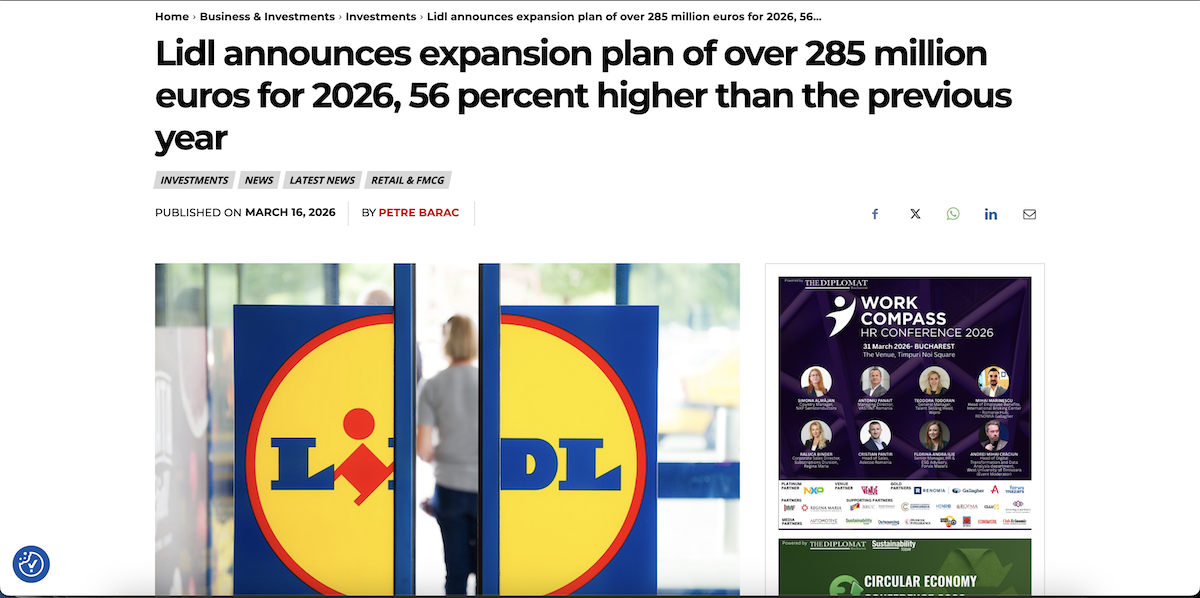
Lidl Romania has announced an expansion plan of over 285 million euros for the 2026 financial year (March 1, 2026 – February 28, 2027), dedicated exclusively to expanding its national network with more than 40 new stores. The budget is 56 percent higher than the one allocated in 2025 and supports the acceleration of the company’s nationwide growth plans, according to The Diplomat.
The investments announced for 2026 mark a new phase in the acceleration of the Lidl store network’s development, following a sustained expansion pace in recent years. The company aims to open 200 new stores by 2030, compared to the 2024 reference year. Between March 1, 2024 and February 28, 2026, the network expanded by 41 stores, reaching a total of 392 stores nationwide at the end of the financial year.
“The fact that our expansion plan for 2026 has a budget that is 56 percent higher than last year’s reflects Lidl’s confidence in the potential of the local market and our commitment to offering Romanians high-quality products at unbeatable prices. We continue to invest in our relationship with our customers, maintaining our relevance and getting even closer to them and their needs. The opening of more than 40 new stores will contribute to the local economy and to the development of the entire supply chain by creating new direct and indirect jobs,” said Alberto Chueca, CEO of Lidl Romania.
Lidl’s investments in expanding its network have a significant impact on the local economy beyond the company’s direct activity. According to an analysis conducted by KPMG, in 2024 Lidl’s activity in Romania contributed €2.31 billion to the economy’s gross value added, equivalent to approximately 0.65% of the national GDP. At the same time, each job within Lidl Romania indirectly supports the activity of around six other jobs in the economy, helping sustain nearly 90,000 jobs nationwide.
The stores that will be opened in 2026, including those developed through demolition and reconstruction projects, will comply with high energy-efficiency and sustainability standards and will be located both in large urban areas and in peri-urban zones and smaller towns. These will include large-format units with sales areas between 1,400 and 1,700 square meters, as well as more compact stores of around 1,100 square meters, in line with the company’s plan to facilitate access for as many Romanians as possible to affordable products of the highest quality, as well as to a simple and efficient shopping experience.
The expansion of the Lidl network also directly supports the development of local suppliers by increasing purchasing volumes. The company collaborates with over 500 Romanian suppliers, and according to the same study, in 2024 Lidl’s spending with suppliers in Romania exceeded €2.16 billion. Currently, Lidl’s team in Romania numbers more than 14,000 employees, and the planned expansion for 2026 will generate around 1,000 new jobs, with a positive impact on local communities.
In just fifteen years since its official entry into the local market, Lidl has transformed from a German “hard discounter” into the undisputed leader of the Romanian food retail sector. As of March 2026, the company is not only a commercial powerhouse but a vital organ of the national economy, announcing an unprecedented expansion plan that underscores its long-term commitment to the region.
A Catalyst for the National Economy
The financial impact of Lidl’s operations in Romania has reached record-breaking levels. According to recent socio-economic impact reports, the company is more than just a place to shop; it is a major contributor to the country’s Gross Domestic Product (GDP).
| Economic Indicator (2024-2025 Data) | Value / Impact | Significance |
| Gross Value Added (GVA) | €2.31 Billion | Equivalent to ~0.65% of Romania’s GDP |
| Local Supplier Spending | Over €2.16 Billion | Supporting over 500 Romanian partners |
| Export of Local Products | ~€60 Million | Romanian goods reaching 28+ EU markets |
| Employment | 13,000+ direct employees | Supporting ~90,000 jobs in the wider economy |
Sustainability and Local Sourcing: “The Lidl Way”
Lidl’s success in Romania is deeply rooted in its “Smart Discount” model, which balances quality with aggressive pricing. However, in 2026, the brand’s identity is equally defined by its sustainability milestones.
-
Local Produce First: Approximately 50% of the merchandise value now comes from Romanian suppliers. During peak seasons, the “Piața Lidl” section is almost entirely stocked with domestic fruits and vegetables.
-
Net-Zero Ambitions: Lidl Romania is ahead of schedule on its sustainability targets, aiming for Net-Zero emissions by 2050. All new stores built in 2026 follow strict LEED or BREEAM green building certifications.
-
Top Employer: For the tenth consecutive year, Lidl has been certified as a Top Employer, reflecting its investment in competitive salaries, benefits, and professional development.
Challenges in a Dynamic Market
Despite its dominance, the road ahead is not without obstacles. Lidl executives have frequently pointed to infrastructure deficiencies—particularly in road networks—as a primary bottleneck for logistics. Furthermore, navigating the “binge-inflation” of the past few years has required constant process optimisation to maintain the “Best Buy Award” status for price-quality ratio that Romanian consumers have voted for in 2025/2026.
Kurt Zouma signs for Al-Wasl following CFR Cluj contract termination
Comments
comments


