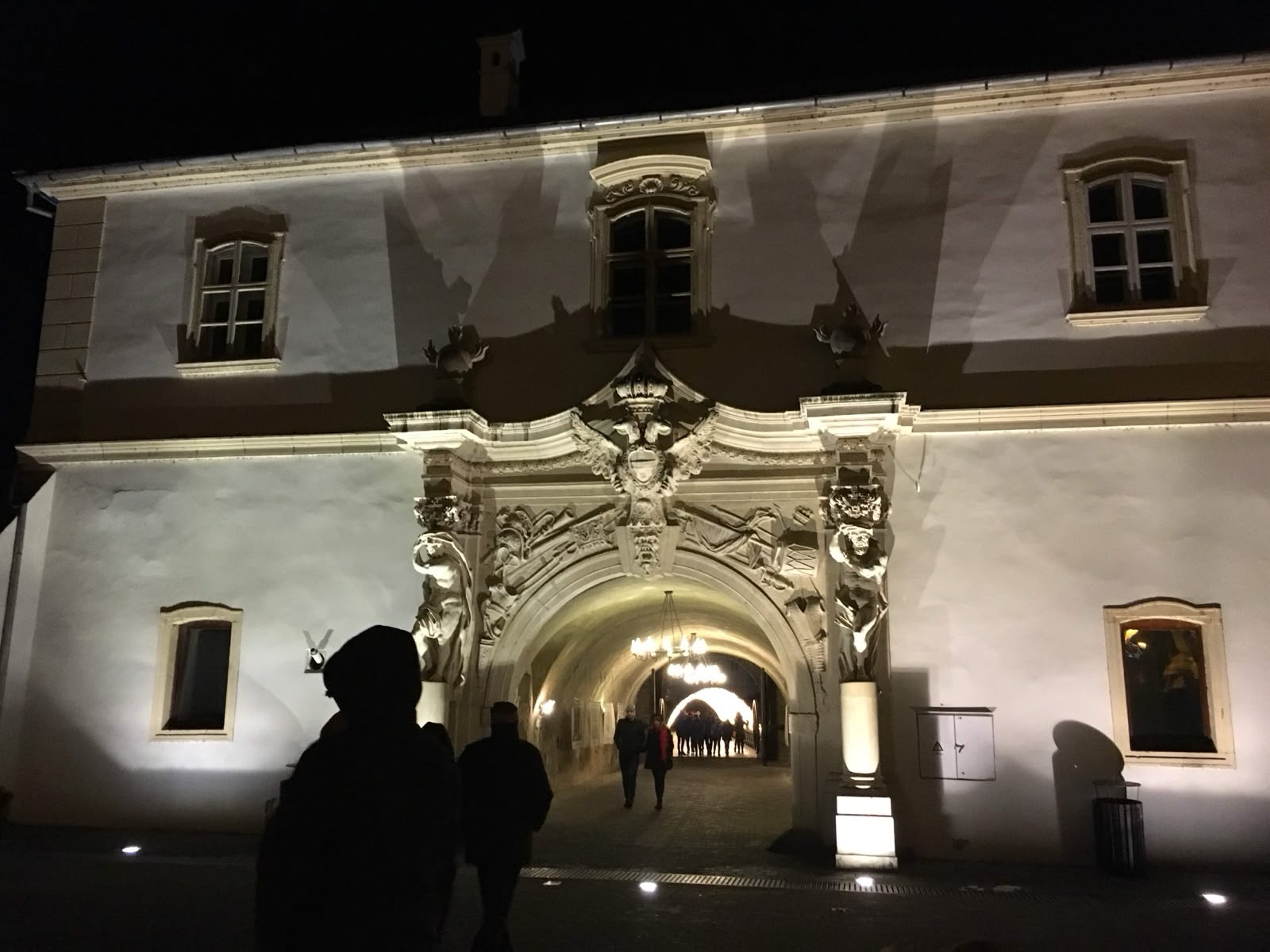
The local authorities of Alba Iulia have taken delivery of the restoration works on Gates III and IV of the Alba Carolina Citadel, carried out under a contract worth more than nine million lei that accumulated delays compared with the planned schedule. The first two gates had already been taken delivery of at the beginning of the year, and now the remaining two are being closed out after the removal of the scaffolding and panels that covered Gate IV throughout the entire tourist season, according to Foro3D.
Structural intervention and removal of scaffolding in the fortified complex
The intervention reinforces the city’s fortified heritage and returns a key monumental complex to visitors. The technical process included the consolidation of the gates’ wall faces, the treatment of the stone surfaces and the removal of the scaffolding and panels that covered Gate IV throughout the entire tourist season. The contract worth more than nine million lei accumulated delays compared with the planned schedule, although the first two gates had already been taken delivery of at the beginning of the year. Gate IV remains closed to traffic because the access bridge was demolished, so vehicular access remains pending a new infrastructure.
Heritage ready for its photo, but the car will have to wait
Gate IV looks restored and free of scaffolding, although the access bridge was demolished and vehicular traffic remains pending a new infrastructure. That is to say, the monumental complex can now be visited on foot with all its historical solemnity, but anyone intending to cross by car will have to settle for admiring the stone from a distance. The delays of the contract worth more than nine million lei are offset by the removal of the panels, although the bridge remains a memory pending a budget.
Few historical monuments in South-Eastern Europe rival the monumental scale, architectural coherence, and political symbolism embodied by the Alba Carolina Fortress. Dominating the urban heart of Alba Iulia, this star-shaped bastion fortress is not merely an engineering marvel of the Habsburg Empire; it is the spiritual and historical crucible of modern Romania.
From its origins as an ancient Roman legionary fortress to its eighteenth-century Vauban-style reconstruction and its central role in the Great Union of 1918, Alba Carolina has undergone a profound transformation. Today, following one of the most ambitious heritage restoration campaigns in Central and Eastern Europe, it stands as a premier cultural tourism destination and a vibrant center of civic life.
Alba Carolina at a Glance
| Strategic Dimension | Historical and Technical Detail |
| Location | Alba Iulia, Alba County, Transylvania, Romania |
| Architectural Style | Vauban-style star fortress (seven bastions, heptagonal layout) |
| Construction Era | 1714–1738 (during the reigns of Emperor Charles VI and Empress Maria Theresa) |
| Chief Architect | Giovanni Morando Visconti (Italian military architect) |
| Scale & Perimeter | Encompasses approximately 110 hectares with a wall perimeter of nearly 12 kilometers |
| Historic Predecessors | Castrum of the Legio XIII Gemina (Apulum); medieval Transylvanian ducal citadel |
| Core National Symbols | Coronation Cathedral (Reunification Cathedral), St. Michael’s Catholic Cathedral, Union Hall (Sala Unirii) |
The Habsburg Crucible: Engineering the Vauban Star
The fortress visible today was commissioned following the integration of Transylvania into the Habsburg Monarchy via the Treaty of Karlowitz (1699). Designed to serve both as a forward defense redoubt against the Ottoman Empire and as a headquarters to project imperial administrative control over Transylvania, construction began in November 1714 under the direction of general commander Stephan de Steinville and military engineer Giovanni Morando Visconti.
Constructed on a heptagonal ground plan, the fortress utilizes the principles developed by French military engineer Sébastien Le Prestre de Vauban:
-
The Bastion Network: Seven massive bastions—named after patron saints and imperial titles (Eugene of Savoy, Saint Stephen, The Trinity, Saint Michael, Saint Charles, Saint Capistrano, and Saint Elisabeth)—provided interlocking fields of artillery fire, rendering traditional siege tactics obsolete.
-
The Defensive Moats and Ravelins: Three concentric defensive rings and deeply recessed dry moats shielded the internal curtain walls from direct canon fire.
-
Triumphal Gates: Six monumental gates punctuated the defenses. Decorated with high-relief Baroque sculptures depicting mythological motifs, the Labors of Hercules, and imperial Habsburg heraldry, these portals transformed military engineering into theatrical civic propaganda.
Layered Chronology: From Roman Apulum to the Medieval Capital
Alba Carolina’s enduring significance lies in its multi-layered stratigraphy. Beneath the brick-and-sandstone bastions rests the legacy of over two millennia of human history:
-
Castrum of Legio XIII Gemina: In the 2nd century AD, the Roman settlement of Apulum housed the elite Legion XIII Gemina, serving as the commercial and military nexus of Roman Dacia. Excavations along the Principia route inside the fortress display Roman hypocaust heating systems and preserved legionary quarters.
-
The Medieval Episcopate: By the 11th century, Alba Iulia became the seat of the Catholic Diocese of Transylvania. The St. Michael’s Roman Catholic Cathedral, erected between the 12th and 13th centuries, remains the oldest cathedral in Transylvania. It houses the sarcophagi of legendary military commander Iancu de Hunedoara and Queen Isabella Jagiellon.
-
The Renaissance Principality: As the capital of the autonomous Principality of Transylvania from 1541 to 1699, the citadel welcomed humanist scholars, diplomatic envoys, and princely courts under John Sigismund Zápolya, Gabriel Bethlen, and George I Rákóczi.
The Altar of the Great Union (1918) and the Royal Coronation (1922)
While conceived by Austrian engineers, Alba Carolina holds an almost sacred status in Romanian collective memory:
-
Michael the Brave (1600): It was here that Prince Michael the Brave entered on November 1, 1599, following the Battle of Șelimbăr, realizing the brief first personal union of Transylvania, Wallachia, and Moldavia.
-
The Assembly of December 1, 1918: In the twilight of the First World War, over 100,000 Romanians gathered on the plateau of the citadel, while 1,228 elected delegates assembled inside the Union Hall (Sala Unirii) to vote unanimously for the unification of Transylvania, Banat, Crișana, and Maramureș with the Kingdom of Romania.
-
The 1922 Coronation: To formalize the birth of Greater Romania, the Coronation Cathedral (Catedrala Încoronării) was constructed on the western perimeter of the fortress. On October 15, 1922, King Ferdinand I and Queen Marie were crowned here as Sovereigns of all Romanians in a ceremony of pan-European diplomatic grandeur.
Heritage Restoration: A Renaissance Through European Funds
By the close of the twentieth century, decades of military garrisoning and communist neglect had left the fortress crumbling, with its moats overgrown and its Baroque stone reliefs eroded by pollution and neglect.
Between 2008 and 2018, the municipality of Alba Iulia orchestrated one of the largest municipal urban regeneration initiatives in Central and Eastern Europe:
-
Over €70 Million Invested: Drawing heavily from European Union structural cohesion funds, local authorities methodically restored the ramparts, reconstructed the wooden drawbridges, stabilized the moats, and converted disused powder magazines into art galleries and cultural spaces.
-
Public Activation: The fortress was demilitarized and handed over to citizens. The inner moats were transformed into cycling and running trails, the parade grounds became open-air venues for symphonic festivals and historical re-enactments, and the daily Changing of the Guard—featuring Austrian-uniformed equestrian and artillery troops—became a permanent civic attraction.
-
The Route of the Three Fortifications: Visitors can navigate an unbroken chronological timeline inside the citadel, traversing the remains of the Roman Castrum, the brick fortifications of the medieval citadel, and the fully restored eighteenth-century Vauban curtain walls.
An Enduring European Landmark
Alba Carolina is no longer an austere bastion designed to repel invaders, but a dynamic European public space that balances monumentality with accessibility. It stands as an open-air museum where Roman antiquity, Austrian Baroque statecraft, and the pivotal turning points of modern Romanian nation-building coexist harmoniously.
For international travelers and cultural historians alike, walking the cobbled lanes within the heptagonal ramparts of Alba Carolina is an immersive journey through Central European history—a testament to how neglected military fortifications can be successfully reimagined as enduring sanctuaries of peace, memory, and civic pride.
Damen challenges Rheinmetall’s EUR 138 mln acquisition of Mangalia shipyard in Romania