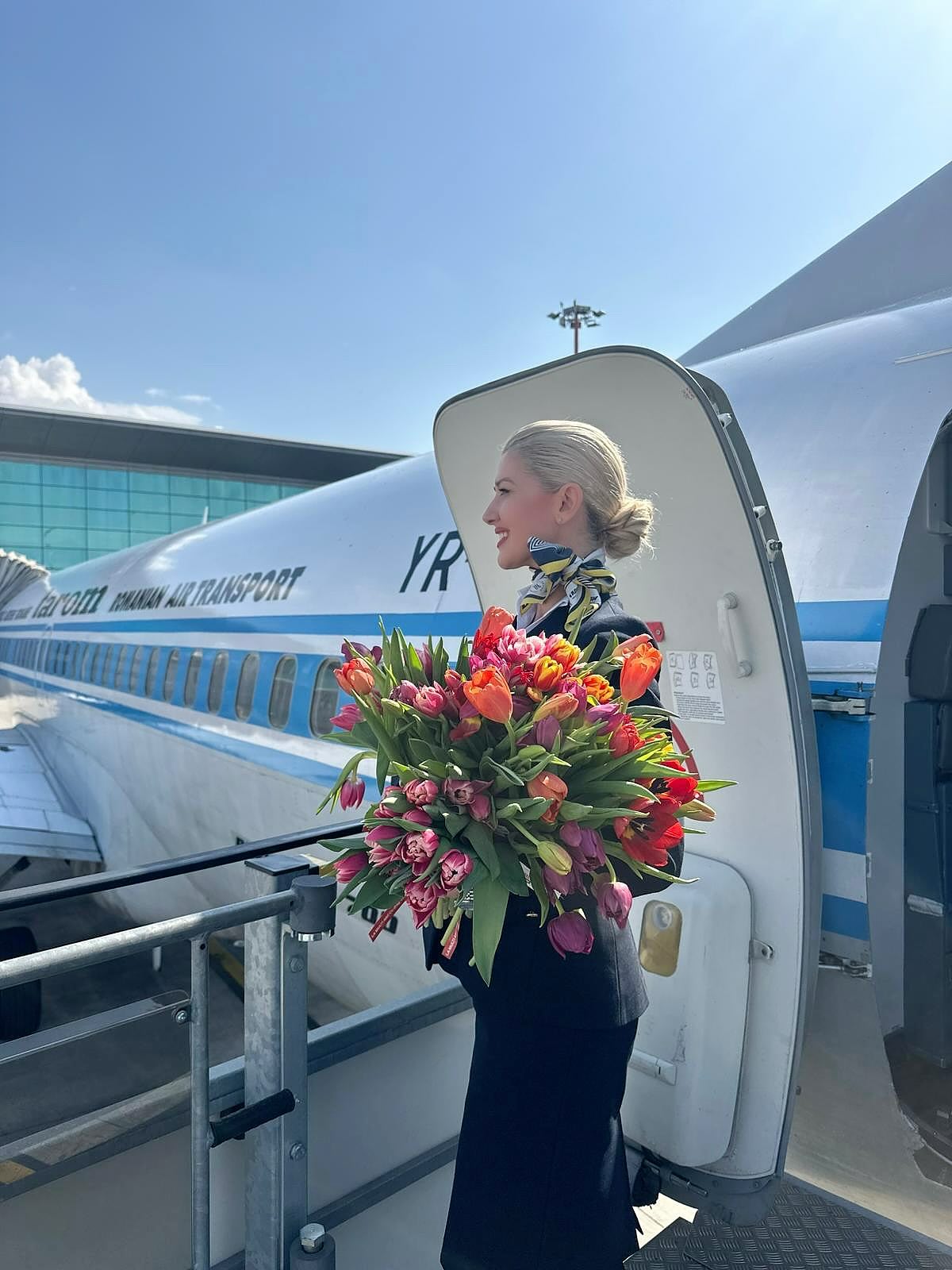
Present at the Aviation-Event conference in Cluj-Napoca in Transylvania, Romania, TAROM CEO Bogdan Costas spoke in an exclusive interview with TravelMole about the future of the Romanian national carrier and its relation with Skyteam, the alliance it belongs to.
Asked about the low visibility provided by Skyteam to TAROM, Bogdan Costas, was candid about the airline’s current position within the alliance. Membership brings definitely value, but not necessarily a much-expected visibility.
With a fleet of just 14 aircraft, TAROM remains indeed a small player compared to giants like Air France or KLM, and that size disparity directly impacts its exposure. “Of course, we are proud to be part of SkyTeam and we have codeshare agreements with key members. But realistically, smaller airlines like us have less influence and visibility compared to larger carriers”, said Bogdan Costas.
Redefining relations with Skyteam
TAROM CEO also questions the tangible benefits of SkyTeam membership. Internal assessments for 2024–2025 suggest underwhelming results, prompting the airline to seek improved cooperation and relation within the alliance. He compares the situation to global organizations where dominant members—such as Delta Air Lines or Korean Air—naturally command most of the attention, leaving smaller players in the background.
Despite this, Bogdan Costas sees opportunity rather than limitation. His strategic vision centers on transforming Bucharest into a regional hub connecting the Balkans with major European gateways such as Amsterdam, Paris and Madrid. ”We are also considering closer cooperation with regional airlines such as Air Serbia and other carriers in the region”, told TAROM CEO.
For now, growth is on hold. TAROM operates 27 destinations but is constrained by an ongoing restructuring program following EU rules that freezes expansion until early 2027. “The immediate priority is financial clarity: more than half of the airline’s routes are not generating sufficient returns beyond basic operating costs”, indicated Bogdan Costas.
Even flagship routes—such as services to Paris—fail to deliver full profitability for TAROM, highlighting the complex cost structures that differ significantly between airlines.
During the restructuring phase, TAROM’s strategy is tightly focused: strengthening domestic routes across Romania, consolidating its Balkan network, and feeding traffic into larger European hubs. Fleet optimization is central to this plan, particularly through the use of ATR turboprops on short-haul services.
Waiting to exit restructuring in 2027
In the meantime, fleet renewal is already underway. The airline is introducing new Boeing 737 MAX aircraft, with ambitions to expand beyond its current footprint once restructuring is complete. Longer-term, this could open the door to routes in Northern Africa and West Asia, supported by a gradual fleet increase.
Domestically, profitability remains elusive despite limited rail competition. Bogdan Costas points instead to competitive pressure from other airlines and signals a shift toward cooperation, including code-share agreements and coordinated scheduling. Innovative concepts such as regional “triangle routes” linking cities like Iași, Cluj and Timișoara are also under consideration, though they depend on local government support.
Last but not least, airports’ infrastructure remains also a key constraint. While traffic through Bucharest is growing, airport development is lagging behind demand. Plans for a new terminal exist but are unlikely to materialize before 2030–2035, meaning TAROM’s hub ambitions will need to adjust to airport’s development.
For Bogdan Costas, the path forward is clear: stabilize the business, restore profitability, and carve out a stronger regional role. The ambition to elevate TAROM within SkyTeam—and within Eastern Europe—is firmly in place. Now, both players need to assess the strategic benefits that they can mutually bring.
From the fall of the Iron Curtain to the cutthroat era of low-cost carriers, Romania’s national flag carrier has survived political shifts, economic crises, and a total transformation of the aviation landscape.
The post-Revolution transition (1991–2000)
Following the 1989 Revolution, TAROM faced the mammoth task of transitioning from a state-run monopoly within the Eastern Bloc to a competitive airline in a global market. The early 1990s were marked by an ambitious fleet modernization. Out went the noisy Soviet-made Ilyushins and Tupolevs and in came Western technology.
The acquisition of the Airbus A310 fleet was meant to signal TAROM’s arrival on the intercontinental stage, with direct flights to New York, Chicago and Beijing. However, this era was also marred by the tragic Balotești accident in 1995, a moment that remains the darkest chapter in the company’s history.
Survival in the age of Open Skies (2001–2015)
The turn of the millennium brought a new challenge: the liberalization of the European aviation market. As Romania prepared for EU accession, TAROM joined the SkyTeam Alliance in 2010, integrating itself into a global network of premier carriers.
Despite this, the mid-2000s saw the rise of low-cost companies like Wizz Air and Blue Air. TAROM found itself squeezed between the luxury of top-tier carriers and the aggressive pricing of budget airlines. This period was characterized by “revolving door” management, with CEOs changing frequently and a mounting deficit that started to alarm the Ministry of Transport.
Modern challenges and the path to restructuring (2016–2026)
In the last decade, TAROM has undergone several painful but necessary restructuring phases. The long-haul flights to the US and China were long abandoned to cut losses, and the fleet was streamlined around Boeing 737 and ATR models to reduce maintenance costs.
The COVID-19 pandemic of 2020 served as a “reset” button for the entire industry. For TAROM, it meant an injection of state aid approved by the European Commission, tied to a strict restructuring plan involving personnel layoffs and the sale of older aircraft.
Key milestones: 35 tears of TAROM
| Year | Milestone | Significance |
| 1992 | Fleet Modernization | First Airbus A310 and Boeing 737-300 aircraft arrive. |
| 1995 | Balotești Tragedy | The deadliest aviation accident in Romanian history. |
| 2003 | End of an Era | Discontinuation of long-haul flights (NY, Beijing). |
| 2010 | SkyTeam Integration | TAROM officially joins the global SkyTeam alliance. |
| 2018 | Fleet Renewal | Arrival of the first Boeing 737-800 NG aircraft. |
| 2021-23 | Restructuring | Massive layoffs and fleet optimization under EU monitoring. |
| 2024-25 | Digital Transition | Major investment in online booking and passenger experience. |
The evolution of the fleet
TAROM’s fleet strategy has moved from “prestige” (large, long-haul planes) to “efficiency” (regional and medium-haul jets).
| Aircraft Generation | Era | Focus |
| Soviet fleet (IL-62, Tu-154) | Pre-1990s | Political connectivity within the Bloc. |
| Airbus A310 / Boeing 707 | 1990s – Early 2000s | Intercontinental ambitions and prestige. |
| Airbus A318 / B737 Classic | 2000s – 2015 | Medium-haul European connectivity. |
| ATR 72-600 / B737 MAX | 2020 – Present | Regional dominance and fuel efficiency. |
Can Nigerian students get the Transilvania Academica Scholarship?