

Preps included aircraft over the skies of Bucharest, rehearsals for the military parade and traffic restrictions near the Triumphal Arch, according to Universul.net.
The Romanian capital has begun to prepare for December 1 National Day celebrations to mark the day when the country became a nation state in 1918.
Starting Wednesday, military aircraft will conduct low-altitude training flights in Ilfov county which is adjacent to Bucharest, the capital itself and Alba Iulia in Transylvania where Romania’s reunification formally took place.
At the end of World War I, Transylvania, which had a majority Romanian population but was part of the Austro-Hungarian Empire was handed back to Romania along with other regions such as Bukovina.
Romania traditionally holds a military parade in Bucharest on December 1 and this year will be no exception. To prepare for that, there will be traffic restrictions on the roads leading to Triumphal Arch, one of the busiest junctions in the traffic-clogged capital on November 28, 30, and December 1, the defense ministry said. .
More than 2,000 military personnel and officials from other security agencies will take part in the military parade at the Triumphal Arch. . The ceremony will begin at 11:00 and will include approximately 130 military vehicles, including 45 aircraft.
Dress rehearsals are scheduled for Saturday, between 09:00 and 16:00, and Monday, November 30, between 09:00 and 12:00, leading to traffic restrictions in the area on November 28, 30, and December 1.
Training flights by military aircraft will take place between November 25 and 30, at low altitudes, over the capital, and Ilfov, and Alba counties. During the rehearsals and the actual ceremony, cannon salvos will be fired near the King Michael I Park.
The defense ministry warns that noise from the salvos and the aircraft flyovers could cause discomfort to people and pets. Authorities asked the general public for their understanding and to follow instructions of traffic police officers.
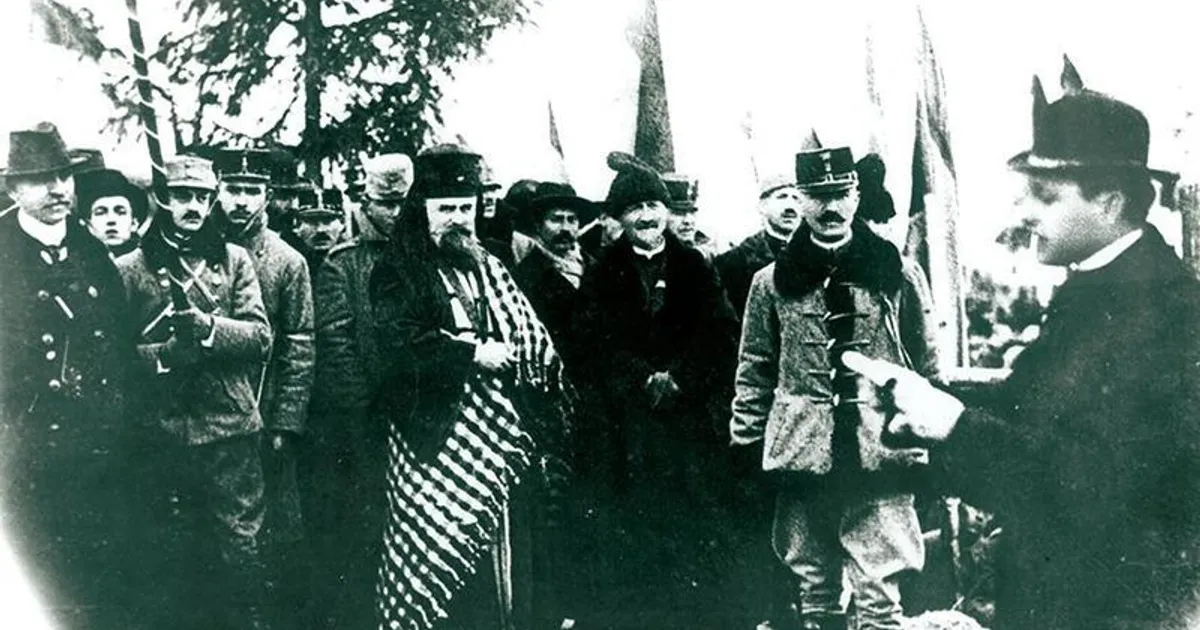
More than a century after tens of thousands of Romanians gathered on the historic plateau of Alba Iulia, December 1, 1918 remains the foundational cornerstone of modern Romanian statehood. Far more than a territorial milestone, the Great Union represented the culmination of a centuries-old aspiration for national self-determination, uniting Transylvania, Banat, Crișana, and Maramureș with the Kingdom of Romania—following the earlier unions of Bessarabia in March 1918 and Bukovina in November 1918.
Emerging from the ashes of the First World War and the collapse of the Austro-Hungarian and Russian empires, the birth of Greater Romania reshaped the geopolitical map of Central and Eastern Europe. Driven by the Woodrow Wilson principles of national self-determination, the historic assembly in Alba Iulia demonstrated that Romania’s unification was not merely the outcome of diplomatic treaties, but an act of democratic legitimacy ratified directly by the will of its people.
The Democratic Vision of the Alba Iulia Resolution
On the morning of December 1, 1918, exactly 1,228 elected delegates representing all Romanian communities across Transylvania and neighboring regions convened in the Casina Hall—today the Union Hall—where Vasile Goldiș presented the text of the Resolution, while over 100,000 citizens from every walk of life assembled outside on Horea’s Field.
Read aloud to the vast crowd by Greek-Catholic Bishop Iuliu Hossu (who would later become the first Romanian Cardinal of the Catholic Church)—standing side by side with Orthodox Bishop Miron Cristea (later Romania’s first Patriarch), who addressed the assembly and sealed the historic moment with their famous fraternal embrace—the Proclamation of Alba Iulia stood out across post-war Europe for its remarkably progressive and democratic framework. Beyond declaring the unconditional union with Romania, the document laid out sweeping constitutional guarantees for the new state:
-
Full Democratic Representation: Universal, direct, equal, and secret suffrage for both men and women aged 21 and over—a pioneering commitment in 1918 Europe.
-
Protection of National Minorities: Complete national, linguistic, educational, and religious freedom for all co-inhabiting ethnicities, ensuring proportional representation in parliament and public administration.
-
Social and Agrarian Reform: Radical land reform aimed at empowering the peasantry, alongside modern labor protections aligned with the most advanced Western European standards.
“Today, through the decision of the National Assembly, the union of all Romanians from Transylvania, Banat, and the Hungarian lands with Romania is accomplished for all eternity,” declared Bishop Iuliu Hossu before the crowd, sealing a moment that unified distinct historical provinces into a single civic and cultural body.
Crown, Diplomacy, and International Recognition
The realization of December 1 was equally the triumph of visionary statecraft. Under the leadership of King Ferdinand I and Queen Marie, alongside statesmen such as Ion I.C. Brătianu and Iuliu Maniu, Romania navigated the immense sacrifices of the war to secure international recognition at the Paris Peace Conference (1919–1920), formalized through the Treaties of Saint-Germain, Neuilly, and Trianon.
This institutional consolidation culminated on October 15, 1922, with the coronation of King Ferdinand I and Queen Marie as sovereigns of all Romanians in Alba Iulia—a symbolic gesture underscoring the continuity between the medieval legacy of Michael the Brave and the modern constitutional monarchy.
Enduring Resonance in a United Europe
Across the decades—surviving the territorial amputations of 1940 and decades of communist rule that sought to obscure its true democratic and royal dimensions—December 1 was officially proclaimed Romania’s National Day in 1990, restoring its rightful place in collective memory.
Today, as Romania stands firmly integrated within the European Union and NATO, the spirit of December 1, 1918 carries renewed relevance. The ideals championed at Alba Iulia—rule of law, civic pluralism, respect for minority rights, and solidarity across historic regions—mirror the very values of the contemporary European project. In remembering 1918, Romania celebrates not only the unity of its borders, but the enduring civic resilience that anchors its place in the European family.
Romania faces slow economic recovery as fiscal adjustment enters tougher phase
Comments
comments


