

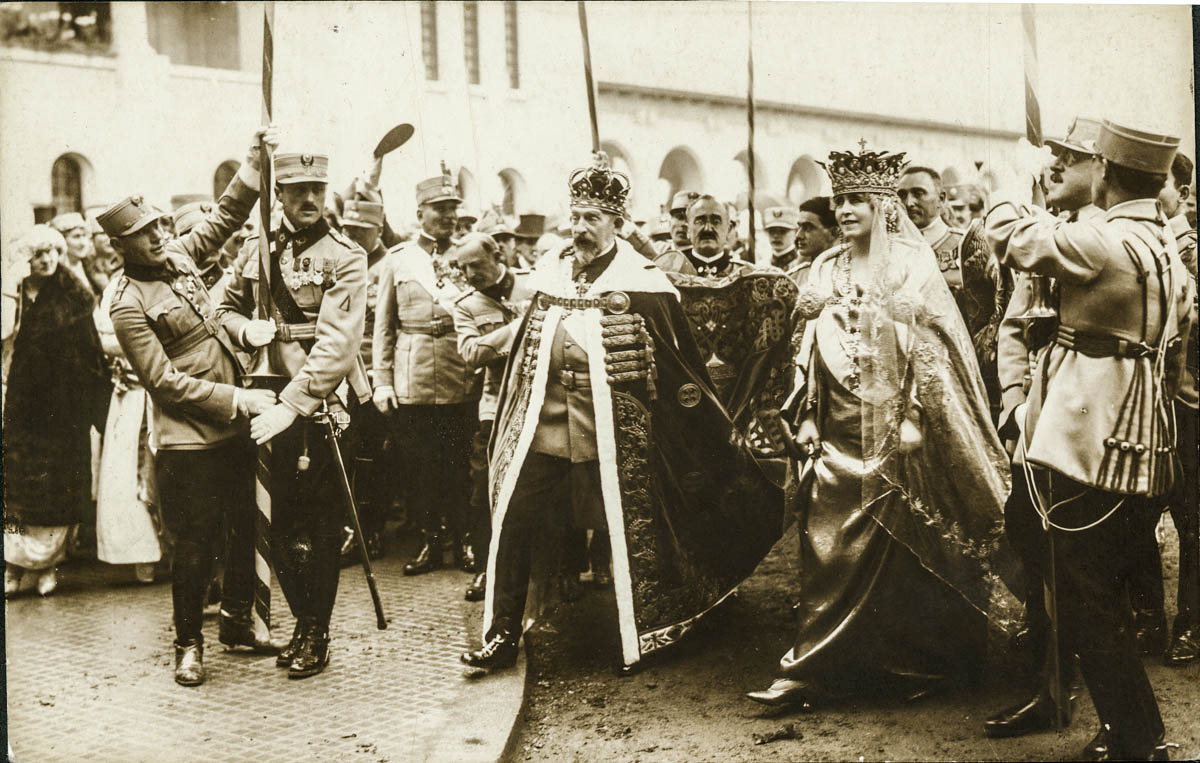
Buzău County Museum is opening, on Wednesday, the exhibition “King Ferdinand I’s Sceptre – A Symbol for Greater Romania,” bringing together hundreds of objects and documents related to the coronation in Alba Iulia and the history of Greater Romania, according to Informat.ro.
The public will be able to see King Ferdinand I’s sceptre, made in 1920 at the René Boivin jewelry house in Paris, as well as a large photograph bearing Queen Maria’s signature. The exhibits also include a menu from the day of the coronation, tickets intended for procession participants, medals, a flag of Greater Romania, 1923 model, and a rare album featuring photographs of all the mayors in the country, including those from Buzău County.
The sceptre was conceived as an artistic reinterpretation of the voivodal mace and combines gold, silver, and iron with precious stones, pearls, and enamels, in a style inspired by Art Nouveau and the neo-Romanian movement.
The exhibition is organized in collaboration with several museum institutions, the Romanian Academy, the Library of the Romanian Academy, and the National Archives. Special security measures have been taken for the transport and display of the treasury pieces. The exhibition can be visited until January 24, 2027.
In the pantheon of modern European monarchs, few figures embody the triumph of constitutional duty over personal heritage as profoundly as King Ferdinand I of Romania. Known to history as Ferdinand the Loyal (Ferdinand cel Loial) and Ferdinand the Unifier (Ferdinand Întregitorul), the second sovereign of the Hohenzollern-Sigmaringen dynasty presided over the most dramatic and defining chapter in Romania’s modern history—transforming a vulnerable Balkan kingdom into Greater Romania in the aftermath of the First World War.
Born in Germany and raised in the strict Prussian military tradition, Ferdinand faced an agonizing moral and political crossroads upon ascending the throne in 1914. By choosing the national aspirations of his adopted country over the ties of his own bloodline, he secured his place as a foundational architect of the modern Romanian state.
From Sigmaringen to Bucharest: Preparing for the Crown
Born on August 24, 1865, in Sigmaringen, Germany, Ferdinand Viktor Albert Meinrad of Hohenzollern-Sigmaringen was the second son of Prince Leopold of Hohenzollern and Infanta Antónia of Portugal. Because his uncle, King Carol I of Romania, had no surviving children, Ferdinand was formally designated heir to the Romanian throne in 1889.
Moving to Bucharest as a young man, Ferdinand immersed himself in Romanian language, history, and military affairs. In January 1893, he married Princess Marie of Edinburgh, granddaughter of Queen Victoria of the United Kingdom and Tsar Alexander II of Russia. While Ferdinand was naturally reserved, scholarly, and deeply religious, Marie brought extraordinary charisma, political instinct, and diplomatic reach—forming a royal partnership that would prove indispensable during the crucible of the Great War.
The Agonizing Choice of 1916
Ferdinand became King of Romania on October 10, 1914, just months after the outbreak of World War I. For two years, Romania maintained an uneasy neutrality as Europe tore itself apart. Despite a secret defensive treaty linking Romania to the Central Powers (Germany and Austria-Hungary) and Ferdinand’s own German birth and family loyalties, Romanian public opinion and political leadership overwhelmingly favored joining the Entente to liberate Transylvania and Bukovina from Austro-Hungarian rule.
In August 1916, presiding over a historic Crown Council at Cotroceni Palace, Ferdinand made the defining decision of his reign: Romania entered the war on the side of the Entente.
“I have defeated myself,” Ferdinand famously confessed to a close confidant, acknowledging the personal torment of taking up arms against his native Germany.
The reaction from Berlin was swift and unforgiving—Kaiser Wilhelm II stripped Ferdinand of his membership in the House of Hohenzollern and denounced him as a traitor. In Romania, however, that sacrifice earned him enduring reverence as a monarch who placed his oath to the nation above dynasty and kin.
Resilience in Exile and the Birth of Greater Romania
The early stages of Romania’s war effort brought catastrophe. By late 1916, German and Austro-Hungarian forces had occupied Bucharest and southern Romania, forcing the King, the government, and the army to retreat to Iași, in Moldavia. Amid a devastating typhus epidemic and near-total isolation following the collapse of the Russian front in 1917, Ferdinand refused to sign a separate peace.
Instead, he spent months on the front lines alongside his troops—who came to call him “Ferdinand the Soldier”—and took a decisive political step to sustain national morale: in the spring of 1917, he solemnly pledged universal male suffrage and a sweeping agrarian reform that would distribute land to the peasant soldiers defending the country. Bolstered by this promise, the reorganized Romanian Army halted the Central Powers’ offensive in the heroic summer battles of Mărăști, Mărășești, and Oituz.
By the end of 1918, the collapse of the Austro-Hungarian and Russian empires fulfilled the centuries-old Romanian ideal:
-
March 27, 1918: Bessarabia united with Romania.
-
November 28, 1918: Bukovina voted for union with Romania.
-
December 1, 1918: The Great National Assembly at Alba Iulia proclaimed the union of Transylvania, Banat, Crișana, and Maramureș with the Kingdom of Romania.
Coronation at Alba Iulia and Democratic Consolidation
On October 15, 1922, in a ceremony rich in historical symbolism, Ferdinand I and Queen Marie were crowned Sovereigns of Greater Romania in the newly built Coronation Cathedral in Alba Iulia—the same city where Michael the Brave had briefly united the three Romanian principalities in 1600.
| Milestone | Date | Historical Significance |
| Designated Heir | March 1889 | Named Crown Prince of Romania by his uncle, King Carol I. |
| Accession to the Throne | October 10, 1914 | Became the second King of Romania at the outset of World War I. |
| Entry into World War I | August 1916 | Sided with the Entente against Germany and Austria-Hungary, prioritizing Romanian unification. |
| The Great Union | December 1, 1918 | Completion of the unification of Bessarabia, Bukovina, and Transylvania with Romania. |
| Coronation at Alba Iulia | October 15, 1922 | Formally crowned King of Greater Romania alongside Queen Marie. |
| The 1923 Constitution | March 29, 1923 | Enacted a modern democratic constitution enshrining universal suffrage and minority rights. |
True to his wartime word, King Ferdinand oversaw the implementation of the 1921 agrarian reform—one of the most extensive land redistributions in interwar Europe—and promulgated the Constitution of March 1923, which established a modern parliamentary framework, universal male suffrage, and legal protections for national minorities within the enlarged state.
A Lasting Legacy of Duty
Exhausted by years of war, political turbulence, and a dynastic crisis triggered by Crown Prince Carol’s renunciation of the throne, King Ferdinand I died of cancer on July 20, 1927, at Peleș Castle in Sinaia, at the age of 61. He was laid to rest beside his uncle Carol I in the Royal Necropolis at Curtea de Argeș.
Nearly a century after his passing, Ferdinand I remains one of the most respected figures in Romanian memory—a quiet, conscientious sovereign whose moral courage in the darkest hours of European conflict transformed a national dream into constitutional reality.
Ursula von der Leyen announces EUR 10 mln for Romania’s Black Sea rescue operations
Comments
comments


