

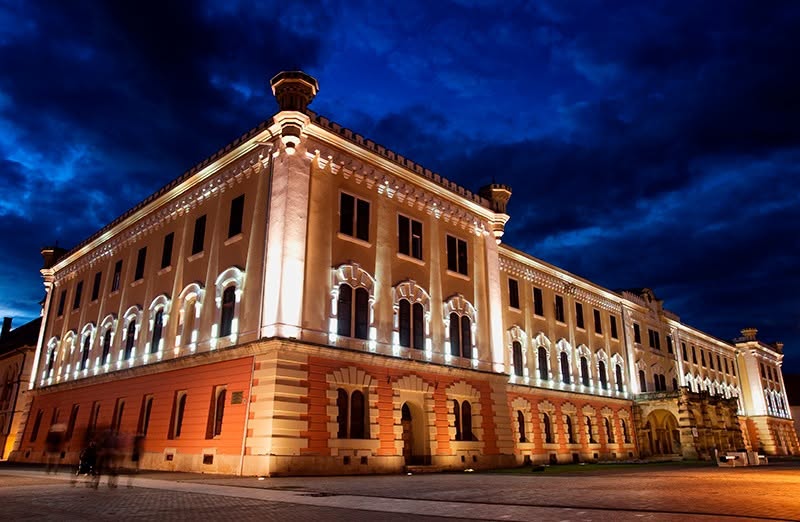
More than half a century after the permanent exhibition at the National Museum of the Union in Alba Iulia was first arranged, visitors can now explore a redesigned Prehistory gallery that uses modern interpretation techniques, including AI-generated educational imagery, to present Romania’s archaeological heritage in a more engaging and accessible way, according to Agerpres.
The museum’s permanent exhibition was organised in a form largely unchanged since 1975, with artefacts displayed chronologically throughout the historic Babylon building and the Hall of the Union. This year, however, the institution began unveiling a completely reimagined Prehistory exhibition, the first stage of a broader modernisation programme.
‘We have wanted to reorganise the permanent exhibition for many years. It has only been possible gradually because of the lack of funding for a complete refurbishment of the museum,’ archaeologist Anca Timofan, who coordinated the project together with fellow archaeologists, conservators, restorers, graphic designers and technical staff, told AGERPRES. Because the museum remained open throughout the works, most of the redesign was carried out during winter months, mornings and Mondays, when the museum is closed to visitors.
According to Timofan, the previous exhibition, dating largely from the 1970s, relied mainly on labels accompanying artefacts. The new concept places greater emphasis on visual storytelling and interpretation, combining photographs from archaeological excavations with reconstructions and AI-generated educational illustrations designed to help visitors understand prehistoric communities.
‘We consider them educational. They have helped us convey exactly what we wanted to illustrate about the lives of prehistoric communities,’ she said of the AI-generated images.
The redesigned galleries explain subjects such as the construction of prehistoric ovens, settlement architecture and everyday life through graphics and explanatory panels rather than objects alone.
‘We wanted attractive settings that would draw people in, while allowing the objects to tell stories rather than simply being displayed as they were before,’ Timofan said. She added that some visitors primarily absorb information visually, making illustrations and reconstructions an essential complement to traditional exhibits.
Archaeologist Cristian Florescu said the curatorial team had also simplified the exhibition by reducing the number of objects on display.
‘If too many artefacts are displayed together, visitors often leave with more questions than answers. We reduced the number of objects, introduced clearer explanatory panels and tried to condense the information so visitors gain an overall understanding of each historical period while following a continuous story,’ he said. English-language summaries have also been added to make the exhibition more accessible to foreign visitors.
The exhibition follows a chronological structure, beginning with human evolution and the emergence of early humans in East Africa before moving to the earliest evidence of human presence in present-day Romania around 1.8 to 2 million years ago. The Palaeolithic section highlights mammoths, the principal prey of Ice Age hunters, alongside stone tools recovered from important Romanian archaeological sites, including caves in Hunedoara and Gorj counties, as well as discoveries from Alba County. Visitors can also learn about prehistoric fauna that once inhabited the region, including mammoths, cave bears, bison, woolly rhinoceroses and elephants.
The Neolithic galleries examine the emergence of farming communities, settlements, crafts and spiritual life through reconstructed scenes and representative artefacts. One of the highlights is a reconstructed Neolithic loom together with painted pottery, stone tools and jewellery discovered at archaeological sites across Alba County.
Particular attention is devoted to Tartaria, regarded by museum specialists as one of the most important and controversial Neolithic sites in south-eastern Europe. The exhibition includes replicas of the famous Tartaria tablets bearing pictographic symbols, while explaining the long-running academic debate surrounding their discovery, authenticity, dating and significance. Recent archaeological discoveries made during systematic excavations carried out by the National Museum of the Union since 2010 are also presented.
The exhibition continues with the Bronze Age and Iron Age, presenting important archaeological discoveries from Alba County, including major bronze hoards found at Uioara de Sus, Spalnaca and Cugir, among the largest such deposits discovered in Europe. Displays also explore the presence of Scythian communities in Transylvania, where excavations uncovered one of the region’s largest Scythian cemeteries, including graves of women warriors equipped in the same manner as men, reflecting the prominent military role women played in Scythian society.
Among the exhibition’s most remarkable objects is the trepanned skull from Livezile, considered one of the most significant examples of prehistoric cranial surgery in Europe. Archaeological evidence indicates that a woman aged about 35 to 40 underwent a major operation involving the removal of part of the skull using an obsidian or flint blade. Signs of bone regeneration show that she survived the procedure for at least a year. Specialists believe the intervention may have had either a therapeutic or ritual purpose.
Museum staff say the redesign of the permanent exhibition will continue in stages with galleries devoted to the Celtic, Dacian, Roman and early medieval periods.
Nestled within the star-shaped ramparts of the Alba Carolina Citadel, the National Museum of the Union (Muzeul Național al Unirii) stands as one of Romania’s most vital cultural and historic sanctuaries. Located in Alba Iulia—a city deeply woven into the nation’s historical fabric—this museum preserves millennia of Transylvanian heritage, culminating in the monumental events of 1 December 1918, when the modern Romanian state was born.
A Tale of Two Historic Buildings
The museum complex is primarily housed across two architecturally striking buildings, each carrying its own rich historical legacy:
-
The Babilon Building (Clădirea Babilon): Built between 1851 and 1853 during the Austrian administration as a military residence for officers, this grand edifice earned its nickname “Babylon” due to its architectural complexity and the multi-ethnic blend of officers who once lived there. Today, it hosts the museum’s primary archaeological and historical exhibition galleries.
-
The Hall of the Union (Sala Unirii): Originally built between 1898 and 1900 as a military casino, this building holds unmatched emotional and political significance for Romanians. It was inside this very hall that 1,228 elected delegates gathered on 1 December 1918 to vote for the Great Union of Transylvania with the Kingdom of Romania.
Key Museum Highlights at a Glance
| Section / Highlight | Description |
| Prehistory & Antiquity | Rare Dacian and Roman artifacts from nearby Apulum (Roman Alba Iulia), including military inscriptions, statues, and coins |
| The Medieval & Early Modern Era | Relics detailing Alba Iulia’s role as the capital of the Principality of Transylvania |
| The Hall of the Union | The sacred space where the 1918 Union declaration was voted, featuring original documents, furniture, and commemorative art |
| The Union Museum Library | A valuable archive containing thousands of rare historical books, manuscripts, and period periodicals |
From Ancient Apulum to the Birth of Modern Romania
The museum’s collections—comprising over 200,000 artifacts—take visitors on a chronological journey through Transylvanian history:
1. The Roman Legacy of Apulum
During the Roman Empire, Alba Iulia (then known as Apulum) served as the military headquarters of Legio XIII Gemina and a flourishing urban center. The museum displays impressive lapidary collections, funerary stelae, intricate mosaics, and Roman weaponry that illustrate life along the imperial frontier.
2. The Transylvanian Renaissance and Medieval Governance
During the Middle Ages and Renaissance, Alba Iulia was a key administrative and religious hub. The museum showcases artifacts from the reign of Michael the Brave—who briefly achieved a personal union of the three Romanian principalities (Wallachia, Moldavia, and Transylvania) in 1600—as well as precious liturgical items, medieval weapons, and documents from the Principality of Transylvania under Ottoman and Habsburg influences.
3. The 1918 Great Union
The pinnacle of the museum experience is the Great Union exposition. Visitors can admire the original press used to print the Union manifesto, photographs taken on 1 December 1918 by Samoilă Mârza (the sole photographer present at the event), delegacies’ official badges, and personal belongings of key historical figures such as Vasile Goldiș and Iuliu Maniu.
A Living Center for Education and Research
Far from being a static repository of the past, the National Museum of the Union is a dynamic cultural center. It regularly hosts national scientific conferences, temporary art and history exhibitions, restoration workshops, and interactive educational programs for students.
The museum also actively participates in living history festivals organized within the Alba Carolina Citadel, where reenactors bring Dacians, Romans, and Austro-Hungarian soldiers back to life, offering tourists an immersive glimpse into the past.
Visitor Information
-
Location: 12–14 Mihai Viteazul Street, Alba Iulia (inside the Alba Carolina Citadel)
-
Ideal for: History enthusiasts, families, school groups, and international travelers seeking to understand the foundations of modern Romania.
-
Pro Tip: Combine your museum tour with a walk along the fortification walls of the Alba Carolina Citadel and a visit to the nearby St. Michael’s Roman Catholic Cathedral and the Coronation Cathedral.
Comments
comments


