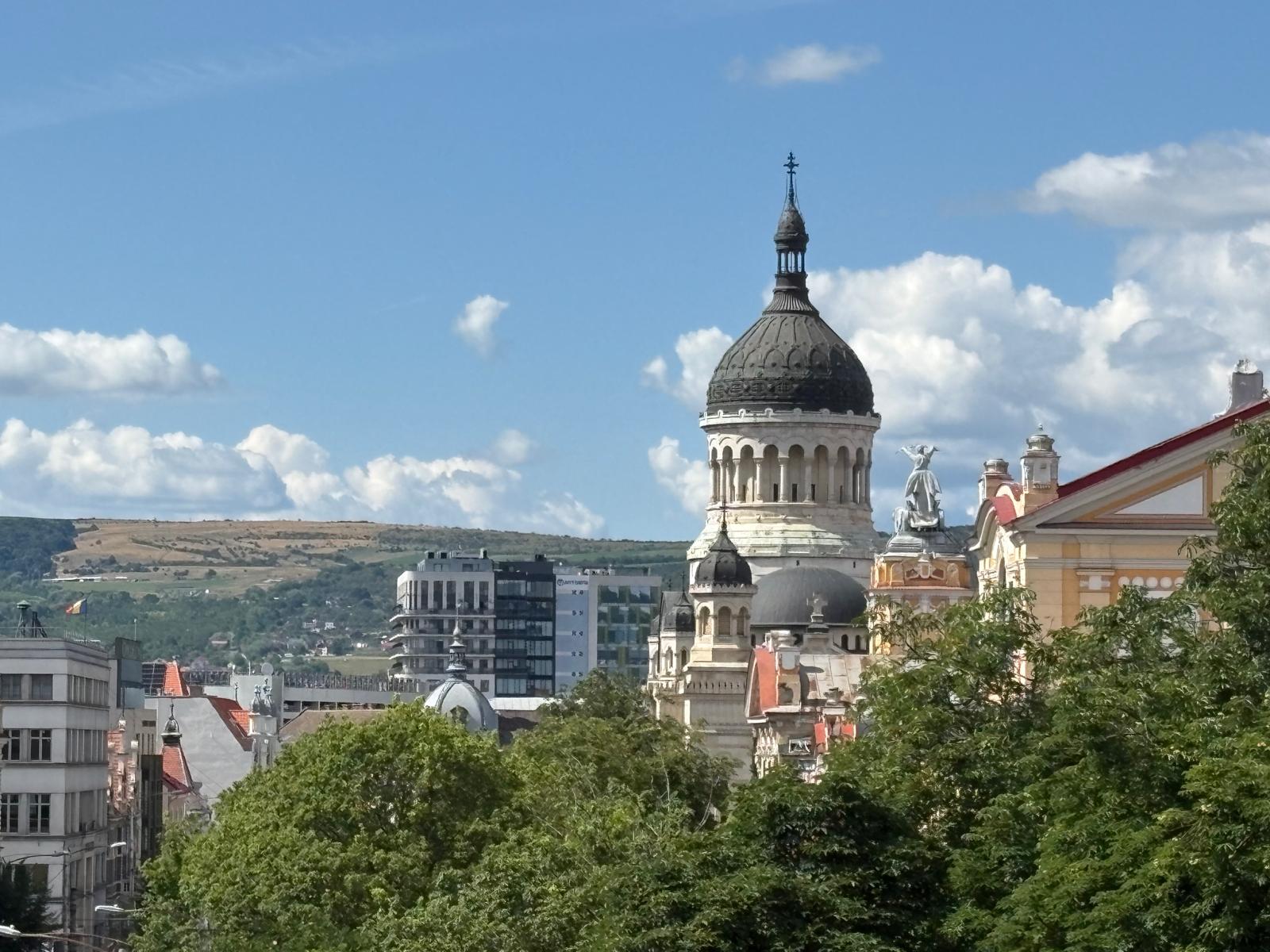
The modern office stock in Romania’s main regional cities – Cluj – Napoca, Timisoara, Iasi and Brasov – currently stands at approximately 1.08 million sq. m, while no office project has been delivered in these markets over the past two years, according to “Romania Office Report” released by the Cushman & Wakefield Echinox real estate consultancy company, quoted by Romania Journal.
As a result, the regional cities in question account for around 25% of Romania’s modern office stock, estimated at approximately 4.5 million sq. m, even though their demographic and educational potential is comparable to or even exceeds that of Bucharest. Data from the National Institute of Statistics shows a total of 197,000 students in the four regional cities, nearly 10% more than in the capital city, which hosts around 180,000 students.
Despite this strong potential, the office stock in Romania’s regional cities remains 68% lower than the corresponding one in Bucharest, highlighting a significant gap between latent demand and the current supply level.
In comparison, Poland’s regional office markets have expanded rapidly over the past decade, with the total stock outside Warsaw exceeding 6.7 million sq. m, surpassing the capital’s 6.2 million sq.m. Over the last ten years, the Polish regional cities have benefited from more than 3.2 million sq. m of new office developments, compared to just 580,000 sq. m delivered in Romania’s regional cities.
The largest office markets outside Warsaw are Kraków, Poznań, Katowice, Wrocław and the Tricity (Gdańsk, Gdynia, and Sopot) area, which together account for approximately 5.7 million sq. m of office spaces. In addition, three other Polish cities – Łódź, Lublin and Szczecin – each have an office stock exceeding that of Brasov (152,000 sq. m).
From a human capital perspective, the differences are even more pronounced. While Warsaw concentrates approximately 259,000 students, Poland’s regional cities host more than 654,000 students.
In the Czech Republic, although the gap between Prague and regional cities remains significant, development has been more balanced than in Romania when considering some demographic indicators. The combined office stock in Brno and Ostrava totals 961,000 sq. m, of which 276,000 sq. m were delivered over the past decade, compared to the 3.9 million sq. m stock in Prague. The two regional cities host approximately 90,000 students, compared with 138,000 in Prague.
Poland’s regional cities continue to attract the highest level of development activity, with more than 150,000 sq. m of office spaces under construction, followed by the Czech Republic with 95,000 sq. m. In contrast, only 23,000 sq. m are currently under construction in Romania, reflecting both developer caution and structural market constraints.
The analysis of office space density reported to the student population highlights substantial differences across markets.
In Bucharest, the indicator stands at 19 sq. m per student, compared to 24.1 sq. m per student in Warsaw and 28.6 sq. m per student in Prague. In Romania’s regional cities, density ranges from 4.8 sq. m per student in Cluj – Napoca to 6.5 sq. m per student in Timisoara, corresponding to an overall average of 5.5 sq. m per student (vs. 10.3 and 10.7 sq. m per student in the Polish and Czech regional cities respectively).
Nevertheless, Romania’s regional cities stand out for their relatively tight office availability, with vacancy rates ranging between 8.5% and 16.7%, comparable to or even lower than those seen in many regional cities in Poland, where the vacancy rates often exceed 18 – 21%. At the same time, the prime headline rents remain competitive, at €13 – 17/ sq. m/ month, below peak levels in regional hubs such as Brno or Kraków, where rents can reach up to €18 – 19/ sq. m/ month.
Mădălina Cojocaru, Partner, Office Agency, Cushman & Wakefield Echinox: “The 2026 regional office market outlook reflects a resilient yet increasingly selective landscape across Romania’s main business hubs outside Bucharest, while also highlighting their significant untapped potential. Cluj – Napoca stands out both in terms of market size and leasing activity, while Timisoara, Iasi and Brasov compete through lower occupancy costs, access to skilled talent and improving connectivity. Solid demographics – more than 1 million inhabitants and nearly 200,000 students – support long-term growth prospects, while limited development activity is expected to put upward pressure on rents”.
Over the past 20 years, Cluj-Napoca has undergone a radical economic transformation, evolving from a traditional, heavy-industry manufacturing hub into the undisputed “Silicon Valley of Romania.” Standing as the physical testament to this macroeconomic shift is the city’s commercial real estate sector. Between 2006 and 2026, the local office space market expanded from a few fragmented Class B conversions into a sophisticated, highly sustainable ecosystem exceeding half a million square metres of modern Class A inventory.
Driven by an influx of multinational IT corporations, shared service centres (SSCs), and a massive local academic talent pool, Cluj-Napoca’s office market has redefined the city’s urban topography, driving the development of entirely new business districts.
Two Decades of Growth: From Conversions to Class A Ecosystems
In 2006, the concept of a modern corporate business park was practically non-existent in Cluj-Napoca. Early tech and outsourcing companies operated out of retrofitted residential buildings, converted communist-era structures, or modest Class B spaces. The structural turning point arrived around 2012–2014, with the delivery of the city’s first large-scale, speculative Class A business parks, such as The Office and Liberty Technology Park.
Decentralization and the Rise of Mixed-Use Hubs
The spatial distribution of office spaces in Cluj-Napoca has fundamentally altered the city’s urban layout. While early developments targeted the central and ultra-central areas, causing severe traffic bottlenecks, the last decade has seen a structural shift toward regional hubs and mixed-use urban regeneration projects.
The table below outlines the three dominant office sub-markets that have emerged in Cluj-Napoca, reflecting how corporate real estate has decentralised:
| Office District / Sub-market | Key Representative Projects | Primary Architectural & Urban Focus | Strategic Advantage |
| The Central / Downtown Hub | The Office Cluj-Napoca, Maestro Business Center | Premium Class A corporate spaces integrated into the urban core. | Immediate proximity to civic amenities, public transit, and university faculties. |
| The Western / Between-the-Lakes Hub | Iulius Congress Center, United Business Center | Mixed-use retail, residential, and office integration around green spaces. | “Live-Work-Play” environment; direct integration with major regional shopping facilities. |
| The Northern / Industrial Regeneration | Liberty Technology Park, Novis Plaza | Brownfield conversion of historic factories into tech incubators and green offices. | Large horizontal layouts, lower density, and proximity to emerging residential quarters. |
The Sustainability Mandate: Green Buildings and Hybrid Realities
The office market of 2026 is no longer judged solely on square footage or location; the modern currency of commercial real estate is sustainability. Over the past five years, multinational tenants—bound by strict global ESG (Environmental, Social, and Governance) mandates—have refused to lease spaces that lack top-tier ecological certifications.
Consequently, Cluj-Napoca has become a regional leader in green building implementation. Newer developments boast BREEAM “Outstanding” or LEED “Platinum” ratings, featuring intelligent climate control systems, energy-efficient facades, rainwater harvesting, and extensive electric vehicle charging infrastructure.
Furthermore, the post-pandemic consolidation of the hybrid work model has forced landlords to redesign interior layouts. Standard open-plan desks have been widely replaced by collaborative zones, high-tech video-conferencing booths, and flexible hot-desking setups, allowing corporate tenants to optimize their physical footprint while upgrading the quality of their workplace environment.
The Outlook for the Late 2020s
As Cluj-Napoca consolidates its status as a high-value technology and research hub, the office market faces the challenge of land scarcity within city limits. The focus of development has increasingly shifted toward massive, multi-phased mixed-use projects built on the premises of former communist factories, seamlessly combining corporate offices with parks, schools, and residential units.
The 20-year journey of Cluj-Napoca’s office market is a visual timeline of the city’s modern economic history. From modest, unheated computer labs in the mid-2000s to the architectural marvels of 2026, the evolution of these commercial spaces has not just accommodated the city’s white-collar workforce—it has actively shaped the modern, cosmopolitan face of Transylvania’s economic capital.
Romania’s real estate investment volume reached approximately EUR 152 million in Q1 2026