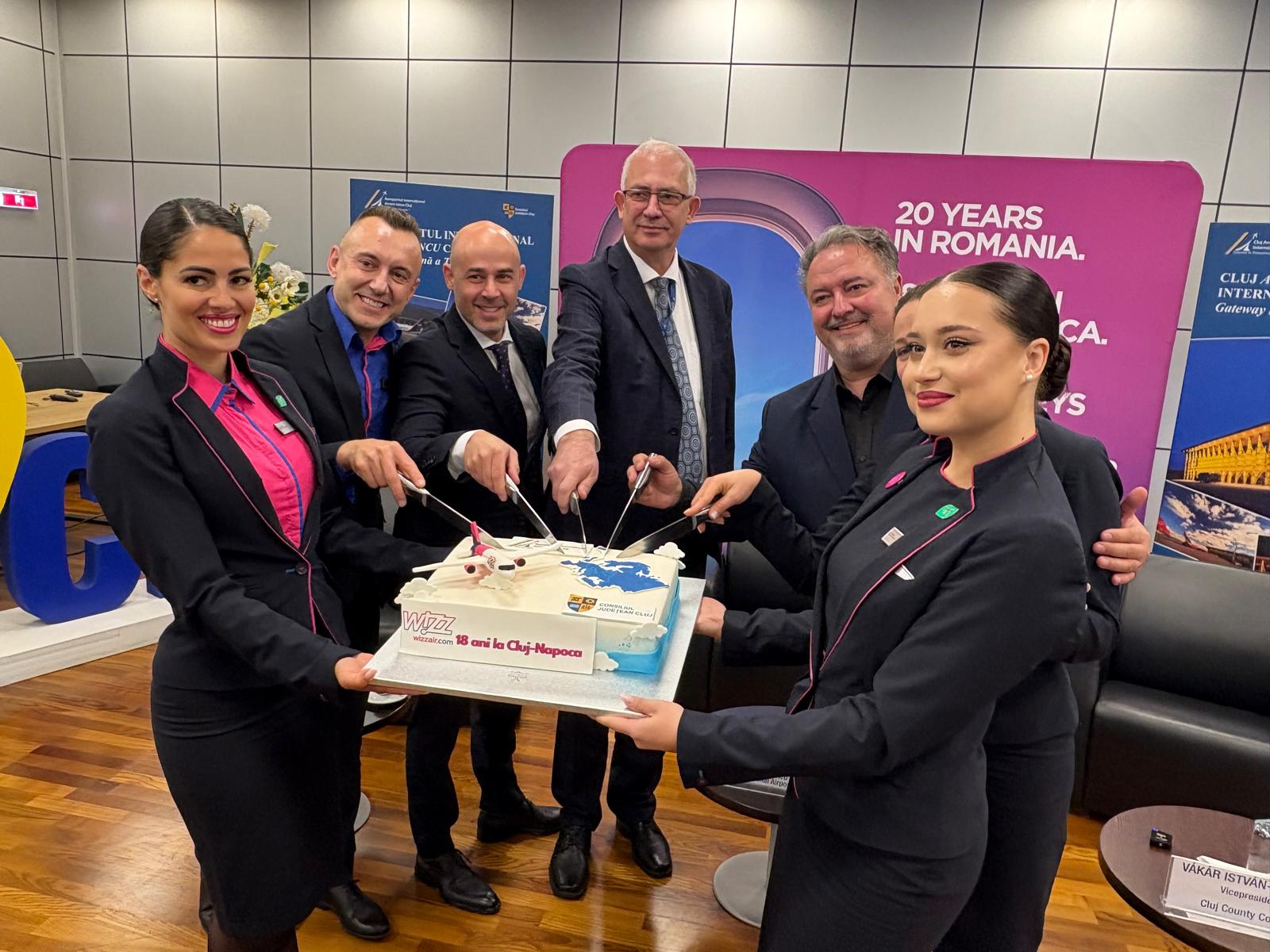
Wizz Air, the main low-cost airline in Romania, alongside the International Airport Avram Iancu Cluj and the Cluj County Council celebrate today the 18th anniversary of its foundation from the Transylvanian city, inaugurated on May 15, 2008, according to AirportCluj.ro.
The partnership between the airline and the airport continues to deliver on its promise of providing convenient travel options and low fares for Cluj-Napoca passengers. Since the first flight operated by Wizz Air from Cluj-Napoca to Budapest in 2007, over 23 million passengers have booked tickets with Wizz Air to and from Bucharest International Airport Avram Iancu ClujWith seven aircraft assigned to the base, Wizz Air continued to contribute to the development of the local community and economy, while stimulating the aviation and tourism job market.
The airline has recorded significant growth since its entry into the Cluj-Napoca market, expanding its route network and currently reaching 42 destinations in 20 countries. Since the beginning of this year’s summer aviation season, the company has relaunched routes to Antalya, Berlin and, recently, Milan Malpensa .
More routes will follow next week, with relaunch of flights to Malta on May 22, operated on Mondays and Fridays, as well as with new connection to Dubrovnik from May 23, with flights every Tuesday and Saturday, thus expanding the city’s summer vacation offer. Fares start from just 129 RON, and tickets are already available on wizzair.com And through WIZZ mobile app.
András Radó, Head of Communications at Wizz Air, said: “We are delighted to mark 18 years of operations at Cluj-Napoca, an important base for Wizz Air since 2008. This milestone comes ahead of the company’s 20th anniversary in Romania. Over the past 18 years, passenger traffic to and from Cluj Airport has grown significantly and we are proud to have contributed to strengthening the city’s connections with destinations across Europe and beyond. Wizz Air remains committed to Romanian passengers and its mission to make travel more accessible, through great fares and destinations to explore. Let’s WIZZ!”.
The President of the Cluj County Council, Alin Tişe stated on this occasion: “The 18th anniversary of the establishment of the Wizz Air operational base in Cluj reflects the remarkable evolution of Cluj International Airport and the consolidation of its strategic role in the development of the Transylvania region. This partnership has significantly contributed to increasing the international connectivity of the region, to economic development and to bringing the Cluj community closer to major European centers. The Cluj County Council will continue to support investments and development projects that consolidate the position of the Cluj airport as the main regional airport in Romania”.
The Vice-President of the Cluj County Council, Vákár István, stated: ”We appreciate Wizz Air’s presence in Cluj. It is a company that connects Cluj with important European cities. However, I return to an old request: I believe our county deserves to be connected by direct flights to Budapest and Chișinău”.
Viorel Federiga, President of the Board of Directors of Cluj International Airport, stated on the occasion of this event: “The 18 years of collaboration between Cluj International Airport and the airline Wizz Air demonstrate the importance of a common vision oriented towards development, performance and connectivity. The constant evolution of the company’s operations at the Cluj airport has had a direct impact on passenger mobility and the economic attractiveness of the region. We are glad that, together, we have managed to build a solid and sustainable partnership, which continues to generate important benefits for the community and for our passengers.”
David Ciceo, Director General of Avram Iancu Cluj International Airport, stated: “The strategic partnership between Cluj International Airport and the airline Wizz Air, which began in 2007 by operating only four destinations – Rome, Barcelona, Budapest and London – has contributed decisively to the development of air connectivity in the Transylvania region and to the consolidation of Cluj’s position as an important economic and university hub at European level.”
Today, 18 years after establishing its operational base in Cluj, Wizz Air operates over 40 international destinations with its 7 aircraft based at Cluj airport, and the introduction of new routes such as Antalya, Berlin, Milan Malpensa, Malta and Dubrovnik reconfirms the development potential of the regional market and the increased interest in direct connectivity.
Between 2007 and 2026, over 23 million passengers traveled with Wizz Air from Cluj International Airport, reflecting the success and maturity of a strategic partnership that continues to generate important benefits for the entire region.”
Wizz Air remains a trusted choice for travelers. According to product-focused pillar As part of its “Customer First Compass” transformation plan, Wizz Air is committed to delivering a superior level of service, with over 300 new aircraft on order, featuring the most modern Airbus Airspace cabin interiors. The airline is dedicated to operating one of the youngest, safest and most fuel-efficient fleets in the industry. Adopting a 100% digital mindset, Wizz Air ensures efficient travel for customers, from the moment they book their flight to boarding.
Wizz Air operates a fleet of 264 Airbus A320 and A321 aircraft. A team of dedicated aviation professionals provides high-quality service and low fares, making Wizz Air the preferred choice of 68,6 million passengers in 2025. Wizz Air is listed on the London Stock Exchange under the symbol “WIZZ”. The company was named one of the ten safest airlines in the world by airlineratings.com, the only global safety and product rating agency, and was awarded the title of “Airline of the Year” at the Air Transport Awards in 2019 and 2023. Wizz Air was also recognized as the “Most Sustainable Low-Cost Airline” between 2021-2025 at the World Finance Sustainability Awards. In 2026, Wizz Air ranked second in the global airline ranking in terms of emissions, and first among European airlines, according to data presented by Cirium, an aviation analytics company, due to its efforts to reduce emissions intensity.
Over the past 18 years, Wizz Air has fundamentally rewritten the rules of commercial aviation across Central and Eastern Europe (CEE). From its humble beginnings as a daring Hungarian startup to its current status as a formidable ultra-low-cost carrier (ULCC) powerhouse with a fleet of over 200 aircraft, the airline’s journey represents one of the most aggressive and impactful expansion stories in modern aviation history.
Launched with a vision to democratise air travel in a region newly integrated into the European Union, Wizz Air’s trajectory has dramatically reshaped economic and social mobility. By connecting secondary cities and underserved regions directly to Western European hubs, the airline created a bridge for millions of diaspora workers, students, and tourists, effectively turning air travel from a luxury into an everyday commodity.
The CEE Fortress and the Western Expansion
Wizz Air’s operational model was built on identifying and dominating gaps left open by legacy carriers. Shortly after its maiden flight in 2004, the airline established strategic strongholds in Poland, Hungary, and Romania. Romania, in particular, would grow to become one of the crown jewels of the Wizz network, with the base at Cluj-Napoca International Airport evolving into a vital regional engine.
As the airline matured, it outgrew its regional boundaries. The last decade saw Wizz Air push aggressively into Western Europe, setting up UK and Italian operations to compete directly with low-cost titans like Ryanair and EasyJet. This geographic diversification proved critical in shielding the company from localized economic downturns and cementing its status as a pan-European player.
Fleet Standardisation and the Airbus A321neo Revolution
At the core of Wizz Air’s commercial profitability is its strict commitment to a single-manufacturer fleet. By operating exclusively Airbus A320 family aircraft, the airline dramatically minimised maintenance, training, and operational costs.
The true game-changer arrived with the mass introduction of the Airbus A321neo. Featuring advanced engine technology and cabin optimization, this aircraft allowed Wizz Air to achieve some of the lowest unit costs (CASK) in the entire aviation industry. Furthermore, the increased seat capacity and significantly reduced carbon footprint per passenger aligned the airline’s ultra-low-cost philosophy with tightening European environmental standards.
Navigating Turbulences: From Pandemics to Geopolitical Shocks
Wizz Air’s 18-year history has not been without severe turbulence. The COVID-19 pandemic shattered global aviation, forcing the airline to temporarily ground the vast majority of its fleet. However, while legacy carriers sought state bailouts, Wizz Air utilized its robust cash reserves to maintain an offensive stance, rapidly snatching up coveted airport slots at hubs like London Luton and Rome Fiumicino.
Geopolitical instability also tested the airline’s resilience. The outbreak of conflict in Ukraine required the swift evacuation of aircraft and crews from bases in Kyiv and Lviv. Wizz Air adapted by rapidly shifting capacity to safer, high-demand leisure markets in Western Europe and the Mediterranean.
| Strategic Milestone | Era / Implementation | Operational Impact |
| The Inception | 2004 – 2006 | Initial focus on post-EU enlargement CEE travel. |
| Market Leadership | 2007 – 2015 | Dominance in Romania, Poland, and Hungary; public listing on the LSE. |
| The Neo Transition | 2016 – 2021 | Mass deployment of Airbus A321neo; entry into Western Europe. |
| Global Expansion | 2022 – Present | Establishment of Wizz Air Abu Dhabi; opening routes to South Asia and the Middle East. |
The New Frontier: Wizz Air Abu Dhabi and Beyond
The latest chapter of the airline’s evolution marks its departure from purely European skies. The establishment of Wizz Air Abu Dhabi, a joint venture in the United Arab Emirates, opened a gateway to entirely new markets.
By utilizing the extended range of its neo aircraft, Wizz Air now connects Europe and the Gulf to destinations in Central Asia, North Africa, and the Indian subcontinent. This ultra-low-cost bridge between continents represents the frontier of the airline’s growth strategy, offering ultra-affordable long-haul travel to a brand new demographic of flyers.
Romanian–Hungarian partnership revives stalled A3 Motorway project