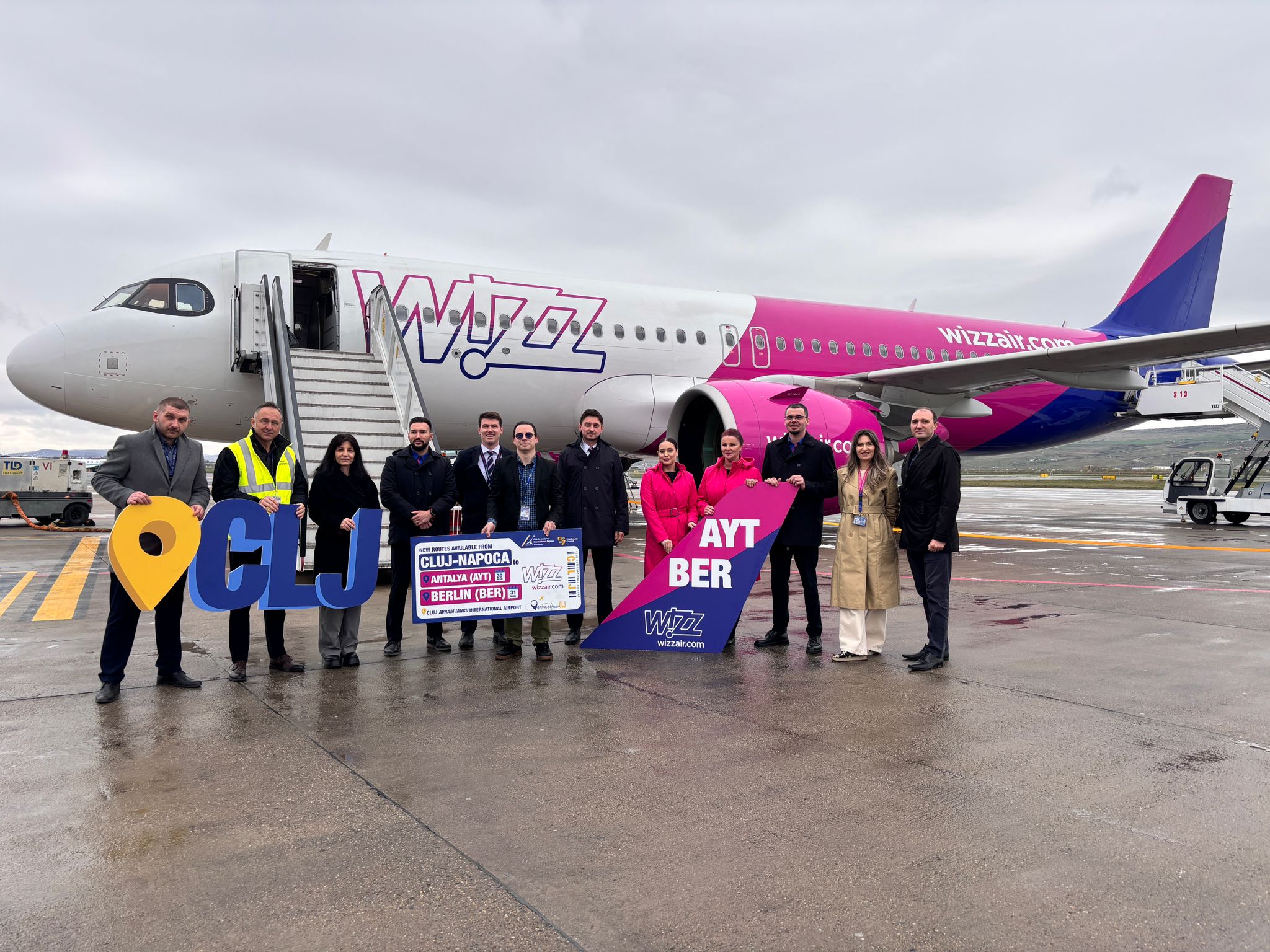
Wizz Air is expanding its network from Berlin Brandenburg Airport (BER) with the launch of two new routes to Southeast Europe, connecting Berlin with Cluj-Napoca in Romania and Tuzla in Bosnia and Herzegovina, according to Travel Wire.
Both destinations will be served three times per week using Airbus A321neo aircraft, offering increased travel options for both leisure and business passengers.
Flights to Cluj-Napoca operate on Tuesdays, Thursdays and Saturdays, with a flight time of approximately one hour and fifty minutes. Known as the unofficial capital of Transylvania, the city combines a lively student atmosphere with a rich historical backdrop.
Tuzla will be served on Mondays, Wednesdays and Fridays, with a flight time of around one hour and forty-seven minutes. The destination is known for its cultural scene and unique salt lake with a pebble beach.
The new routes are part of Wizz Air’s broader expansion at BER for the Summer 2026 season. The airline has already introduced flights to Bratislava, operating four times weekly, and continues its Bucharest service, which now runs daily.
Further expansion is planned with the addition of flights to Timișoara starting May 21, strengthening Wizz Air’s presence in Romania.
The expanded schedule highlights growing demand for travel between Germany and Southeast Europe, while reinforcing BER’s role as a key hub for low-cost connectivity in the region.
The roar of Airbus A321neo engines has become a rhythmic part of life in Cluj. What started in 2007 with a single aircraft and a handful of routes to Italy and Spain has evolved into a massive operational hub. As of April 2026, Wizz Air maintains a fleet of 7 permanently based aircraft in the heart of Transylvania, connecting the “Silicon Valley of Europe” to over 45 destinations across three continents.
The pillars of growth: infrastructure and fleet modernization
The expansion of the Cluj base was not merely an increase in flight frequency; it was a qualitative leap. The transition from the older A320 models to the state-of-the-art Airbus A321neo has been a game-changer for the local market. These aircraft offer 239 seats—the highest capacity in their class—while significantly reducing noise and carbon emissions, a crucial factor for an airport located so close to the city’s residential areas.
| Metric | 2007 (Launch) | 2016 (Mid-point) | 2026 (Current) |
| Based Aircraft | 1 | 4 | 7 |
| Annual Passengers | ~100,000 | ~1,500,000 | ~2,800,000 |
| Direct Destinations | 5 | 24 | 48 |
| Local Jobs Created | ~40 | ~250 | ~550+ |
Connectivity: beyond the “Guest Worker” routes
In its early years, the Cluj base was primarily driven by the “VFR” (Visiting Friends and Relatives) segment—mostly Romanians working in Western Europe. However, by 2026, the profile of the Wizz Air passenger in Cluj has diversified immensely.
The base now supports a robust business corridor, linking Cluj’s booming IT sector to tech hubs like London Luton, Eindhoven, and Tel Aviv. Furthermore, the introduction of leisure-heavy routes to the Greek Islands, Abu Dhabi, and Lisbon has turned Cluj-Napoca into a regional departure point for tourists from all over Northern Romania and even Eastern Hungary.
Regarding the strategic importance of the base, József Váradi, CEO of Wizz Air, recently commented during a press briefing at the airport: “Cluj-Napoca is more than just a dot on our map; it is an operational fortress. The synergy between the city’s academic prestige and its economic dynamism creates a unique demand. By basing our newest, most efficient aircraft here, we are not just flying people; we are investing in the infrastructure of Transylvania’s future.”
Economic impact: the 2026 “Airbridge” effect
The presence of the Wizz Air base has had a massive ripple effect on the local economy. Beyond the direct employment of pilots, cabin crew, and ground engineers, the “low-cost revolution” has stimulated:
-
The hospitality boom: The surge in inbound tourism from the UK, Germany, and Israel has led to a 30% increase in hotel capacity in Cluj County over the last five years.
-
Logistics and cargo: While Wizz Air is a passenger-first carrier, the high frequency of flights has facilitated small-scale express logistics for the city’s light industry.
-
The “Cluj-Arena” factor: Major events like UNTOLD or the Transilvania International Film Festival (TIFF) now rely on the “Wizz Air airbridge” to bring in over 40% of their international attendees.
Challenges: competition and sustainability
The journey hasn’t been without turbulence. The 2026 landscape sees increased competition from other LCCs and the national carrier, TAROM, which has attempted to reclaim some domestic market share. Moreover, the airport’s infrastructure—specifically the terminal capacity during peak morning waves—remains a bottleneck that local authorities are scrambling to fix with the new Terminal extension project.
Cluj International Airport marks 10 years of LOT Polish Airlines operations