


At the outbreak of the First World War, the Kingdom of Romania was a small, but respected state in the South-East European region. Romania was ruled by a dynasty of German origin, the Hohenzollern-Sigmaringen, and was bound by a secret treaty of alliance with the Central Powers, because members of the Romanian political elite perceived Russia as Romania’s main enemy. But Romanian public opinion was more favourable to France, which was part of the Antante.
For the first two years of the war, Romania remained neutral. The two military blocs each tried to draw Romania into the war on its side. The decisive factor was the bad treatment of Romanians in the Austro-Hungarian Empire. In August 1916, Romania entered the war against the Central Powers. After the first few weeks, during which the Romanian army advanced into Transylvania, Bulgaria declared war on Romania. In the autumn of 1916, the Romanian army suffered a series of defeats. Romania’s capital, Bucharest, was occupied by the armies of the Central Powers, along with Oltenia, Muntenia and Dobrogea. Romania’s Royal Family, Government, Parliament and army retreated to Moldova, where the city of Iași became Romania’s war capital.
In the spring of 1917, the Romanian army was reorganised and re-equipped with the help of the French Military Mission, led by General Henri Berthelot. As a result, that year the Romanian army was able to stop the Central Powers’ attacks and even go on the counter-offensive. But the Romanian army’s success was limited by the consequences of the Bolshevik Revolution in Russia. Communist leaders negotiated peace with the Central Powers and Romania was left alone on the Eastern Front. As a result, Romanian leaders had to call for an armistice and then negotiated a separate peace with the Central Powers. The peace was never signed by King Ferdinand I, who called for a return to war. This happened in November 1918.
1918 marked the collapse of the Ottoman, Russian, Austro-Hungarian and German empires. As a result, Romania managed to recover more territory than political leaders had hoped for when they entered the war. Bessarabia, occupied by the Russian Empire in 1812, united with Romania on 27 March 1918. Bukovina, which had been occupied by Austria in 1774, united with Romania on 15 November 1918. Transylvania, which had been incorporated into Austria in 1690 and then into Austro-Hungary in 1867, united with Romania on 1 December 1918.
For Romania, there followed a sustained effort to integrate the new provinces and gain international recognition for the union decisions. Even though the First World War officially ended with the armistice of 11 November 1918, the Romanian army had to go to battle again. In Bessarabia, there were numerous incidents at the new border on the Dniester provoked by the Bolsheviks. The Bolsheviks tried to organise an uprising in Tatar-Bunar, which was put down by the Romanian army. In the west, the army of the Soviet Republic of Hungary attacked Czechoslovakia and Romania. The Romanian army went on the counteroffensive and captured the Hungarian capital, Budapest.
At the same time, the leadership of diplomatic efforts to recognise Romania’s new frontiers was taken over by Queen Mary, who personally went to Versailles to defend the rights of the Romanian Crown.
In 1922, all these efforts bore fruit. The new system of international treaties recognised Romania’s new international status.
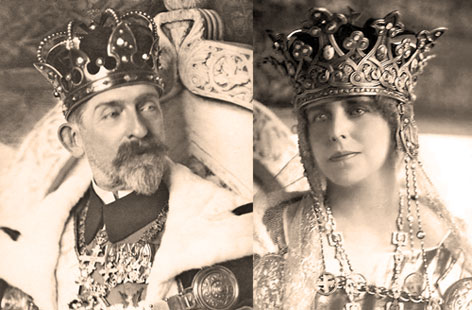
The Romanian authorities decided to symbolically mark this triumph by crowning King Ferdinand I and Queen Maria as sovereigns of Greater Romania. Symbolically, the old fortress of Alba Iulia was chosen as the site of the coronation because it had been the capital of the prince Michael the Brave, who had united the Romanian principalities for the first time in the Middle Ages.
An Orthodox cathedral was built for the coronation. It was built in just nine months. The coronation ceremony was scheduled for 15 November. The day before, the Romanian Royal Family left Sinaia train station by special train. Sinaia is home to Peleș Castle, the site of Romania’s throne. On 15 October, at 09.30, the train stopped at Alba Iulia train station. The Royal Family was welcomed by Prime Minister Ion I.C. Brătianu and other members of the Government, the heads of the two chambers of Parliament and 40 foreign guests, including the future King George VI of Great Britain.
Queen Mary recalled that when the Royal Family was welcomed with bread and salt by the mayor of Alba Iulia, the rain started. The royal cortege went to the Orthodox cathedral, where the religious ceremony was officiated by four metropolitans. The ceremony was overshadowed by the government’s refusal to hold an ecumenical ceremony, so the actual service was not attended by Romanian Greek Catholics. And it was for this reason that King Ferdinand I, who was Catholic, decided to crown himself outside the cathedral on a specially arranged podium. He placed on his forehead the Steel Crown, the symbol of Romania’s independence. This crown had been made from the steel of a Turkish cannon captured during Romania’s War of Independence in 1877 and used for the coronation of Romania’s first King, Charles I. King Ferdinand I then crowned Queen Mary. Her crown was made of gold from the Western Carpathians, worked in Paris. Official dinners followed, held in Alba Iulia, in the Sala Unirii and the theatre building. The celebrations continued on 17 October in Bucharest, when the King and Queen of Romania were cheered by 10 000 mayors from all over the country.
Comments
comments


