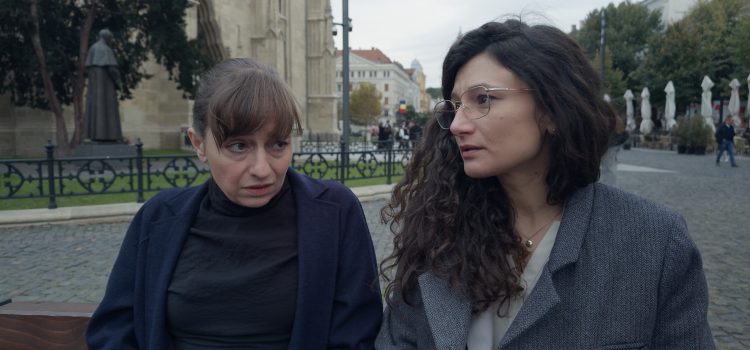
Sharp, spare, and icy to the touch, director Radu Jude’s latest indictment of modern society, “Kontinental ‘25” confronts complicity and learned helplessness within a crumbling world, says poplifestl.com.
Radu Jude’s film, which takes place in modern-day Cluj-Napoca in Northwest Romania, opens in a forested park exhibit featuring animatronic dinosaurs. The unhoused Ion (Gabriel Spahiu) scrounges for scraps of food, muttering obscenities.
Wandering around the rapidly gentrifying city looking for work, and largely being met with disdain from the populace, Ion (who used to be a famous Romanian Olympic athlete before becoming injured) is losing hope. He has been squatting in the boiler room of a building that’s slated to be torn down and replaced with a hotel called the Kontinental Boutique.
Orsolya (Eszter Tompa) is well-off, married-with-children, and working as a bailiff — she’s also Hungarian, which brings with it a bunch of cultural baggage. She is set to evict Ion from the premises with the help of her ready-for-action “ninja turtles” gendarmes.
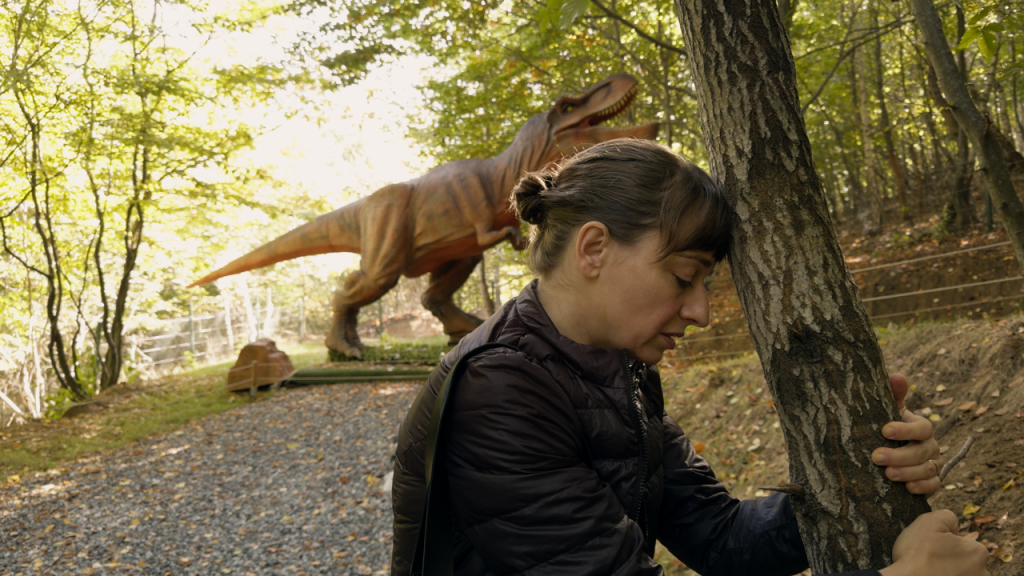
Clearly enjoying the power she has over Ion as she informs him of his imminent eviction, she gives him 20 minutes to pack his things. Ion then kills himself. Orsolya is shocked.
Even though she constantly reminds herself and everyone she talks to that she didn’t do anything “illegal,” Orsolya feels responsible for Ion’s death. She’s forced to face reality head-on, or, at least, mope around Cluj-Napoca looking for reassurance from coworkers, friends, and family while her husband and children go on vacation.
It’s a bleak premise, rendered in darkly comic fashion, with a lead character who’s equal parts maddening and relatable as she grows increasingly desperate to soothe her guilty conscience. Thanks to Radu Jude’s characteristically provocative and gutting eye, “Kontinental ‘25” takes aim at not only Orsolya’s hypocrisies but also our own. After all, Radu Jude posits, we are inhabitants of this doomed planet, going about our days distracting ourselves from horrors many believe are out of our control.

These are happy days, indeed, brought to life as Orsolya’s psychological wounds are papered over with self-serving arguments that prize comfort over actual reflection. Meanwhile, gentrification, economic inequality, and deep-seated prejudice run rampant throughout Cluj-Napoca. History is rewritten by the “victors,” as wars rage across the globe.
Radu Jude, whose previous films include “Dracula,” “Do Not Expect Too Much From the End of the World,” and “Bad Luck Banging or Loony Porn,” is unafraid to go for it and lean into his indulgences to show just how crazy modern life has become. “Kontinental ‘25” is no less fierce and biting at its core, but Jude takes a more social-realist approach this time around.
Radu Jude eschews stylistic extravagance for a stark approach that refuses to give Orsolya a heroic arc or distract from the main ideas at play — his anger and judgment practically seep off the screen. “Kontinental ‘25” is still full of acerbic wit and I-can’t-believe-they-just-said-that surprise, but the overall effect is a feeling of “tragedy of cruelty,” of how the status quo persists as time marches on.
That’s not to say the film isn’t also funny in a squirm-inducing way. “Kontinental ‘25” finds blunt ridiculousness in the matter-of-fact detachment of Orsolya’s interactions; each illuminates different ways of coping with her guilt and feelings of powerlessness.
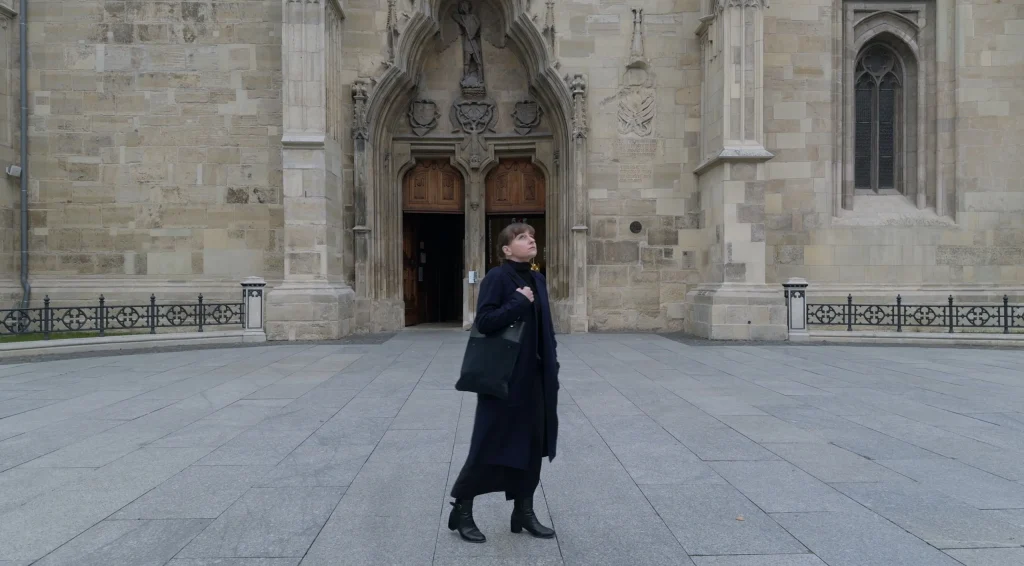
The screenplay here is biting, harsh, and deadpan, with most conversations filmed in long-takes that let us marinate in uncomfortable silences and give us ample time to put ourselves in Orsolya’s shoes and reflect on our own place in the world.
Do we donate to organizations about causes we care about in order to feel better about ourselves, or to actually make a difference? Do we let our prejudices and religious beliefs excuse happenings as inevitable? Do we indulge in drugs and alcohol to distract ourselves from our problems and avoid accountability? These are all questions that Orsolya grapples with, yet she is never quite able to assuage her existential dread or “redeem” herself.
In Orsolya’s state of perpetual stasis, “Kontinental ‘25” can sometimes feel as if it’s spinning its gears along with her. The film is less a forward-moving narrative than a series of vignettes building towards, fittingly, not much at all in terms of her character.
But Radu Jude knows what really matters here, spending the first 20 minutes of the film solely with Ion, and ending with a heartbreaking montage of the transformation of Cluj-Napoca’s landscape. It’s the ever-present march of “development” at the expense of the vulnerable; an increasingly fragmented community that still resides under the same flag. This quietly powerful conclusion stands in contrast to the mostly empty language of the rest of the film, wordlessly conveying tragedy that will take large-scale action to reform.
With his signature blend of archival confrontation, absurdist comedy, and fierce cultural critique, Romanian director Radu Jude has emerged as one of the most uncompromising visionaries of contemporary British and European cinema. In an era often dominated by safe, formulaic narratives, Radu Jude’s body of work stands as a defiant monument to formal experimentation and historical accountability.
Dismantling the Myth of the Unified Past
While the early pioneers of the Romanian New Wave built their international reputation on minimalist, kitchen-sink realism, Radu Jude chose a radically different path. Over the last decade, his films have evolved into multi-layered essayistic provocations that challenge not only Romania’s historical amnesia but also the broader malaise of Late Capitalism.
Radu Jude’s international breakthrough with Aferim! (2015)—a black-and-white Balkan Western tackling the historical enslavement of the Roma population—secured him the Silver Bear for Best Director at the Berlin International Film Festival. Since then, his gaze has grown sharper, moving fluidly between the horrors of the twentieth century and the digital absurdity of the twenty-first.
The Anatomy of a Disruptive Oeuvre
Radu Jude’s filmography resists easy categorization. He seamlessly pairs rigorous historical research into the Romanian Holocaust (“I Do Not Care If We Go Down in History as Barbarians”) with chaotic, TikTok-infused satires of contemporary labor exploitation (Do Not Expect Too Much from the End of the World).
Key Milestones and Thematic Explorations:
| Film Title | Year | Major Accolades | Core Thematic Focus |
| Aferim! | 2015 | Silver Bear (Berlinale) | Feudalism, racism, and the linguistic roots of prejudice. |
| Bad Luck Banging or Loony Porn | 2021 | Golden Bear (Berlinale) | Post-pandemic hysteria, public hypocrisy, and misogyny. |
| Do Not Expect Too Much from the End of the World | 2023 | Special Jury Prize (Locarno) | Corporate exploitation, gig economy, and digital overload. |
| Eight Postcards from Utopia | 2024 | Official Selection (Locarno) | Found-footage analysis of post-communist consumerism. |
The Aesthetic of Fragmentation: Cinema in the Digital Age
What sets Radu Jude apart in 2026 is his radical approach to form. He has largely abandoned classical narrative structures in favour of a cinema of collage. His recent works freely integrate dashcam footage, social media filters, archival propaganda, and meta-textual commentary.
By treating the screen as a digital canvas rather than a window to a manicured reality, Radu Jude captures the precise texture of modern life—the cognitive dissonance of scrolling through a war zone while watching an influencer marketing campaign.
“Cinema should not be a sedative,” Jude has frequently implied through his artistic choices. “It should be an irritant, a tool to wake the viewer from cultural somnambulism.”
The British Reception: An Unorthodox Icon
In the United Kingdom, Radu Jude’s work has found a dedicated home among cinephiles and critics alike. Distributed regularly by independent champions such as Sovereign and MUBI, and heavily featured in retrospectives at the ICA and the BFI London Film Festival, Radu Jude is celebrated by British critics for his refusal to cater to bourgeois tastes.
Where Western European cinema can sometimes slide into polite social realism, Radu Jude’s abrasive, hilarious, and deeply intellectual approach offers a refreshing alternative—a cinema that is as comfortable quoting Walter Benjamin as it is lampooning corporate team-building exercises.
A Necessary Irritant
Radu Jude remains a singular figure in world cinema. He does not seek to comfort his audience, nor does he offer easy moral resolutions. Instead, he hands the viewer the fragmented mirror of our contemporary reality and asks us to piece it together. In 2026, as cinema continues to navigate the pressures of streaming algorithms and political polarization, Jude’s defiant, unruly art is not just refreshing—it is absolutely essential.
European Business Women’s Confederation opens branch in Timisoara