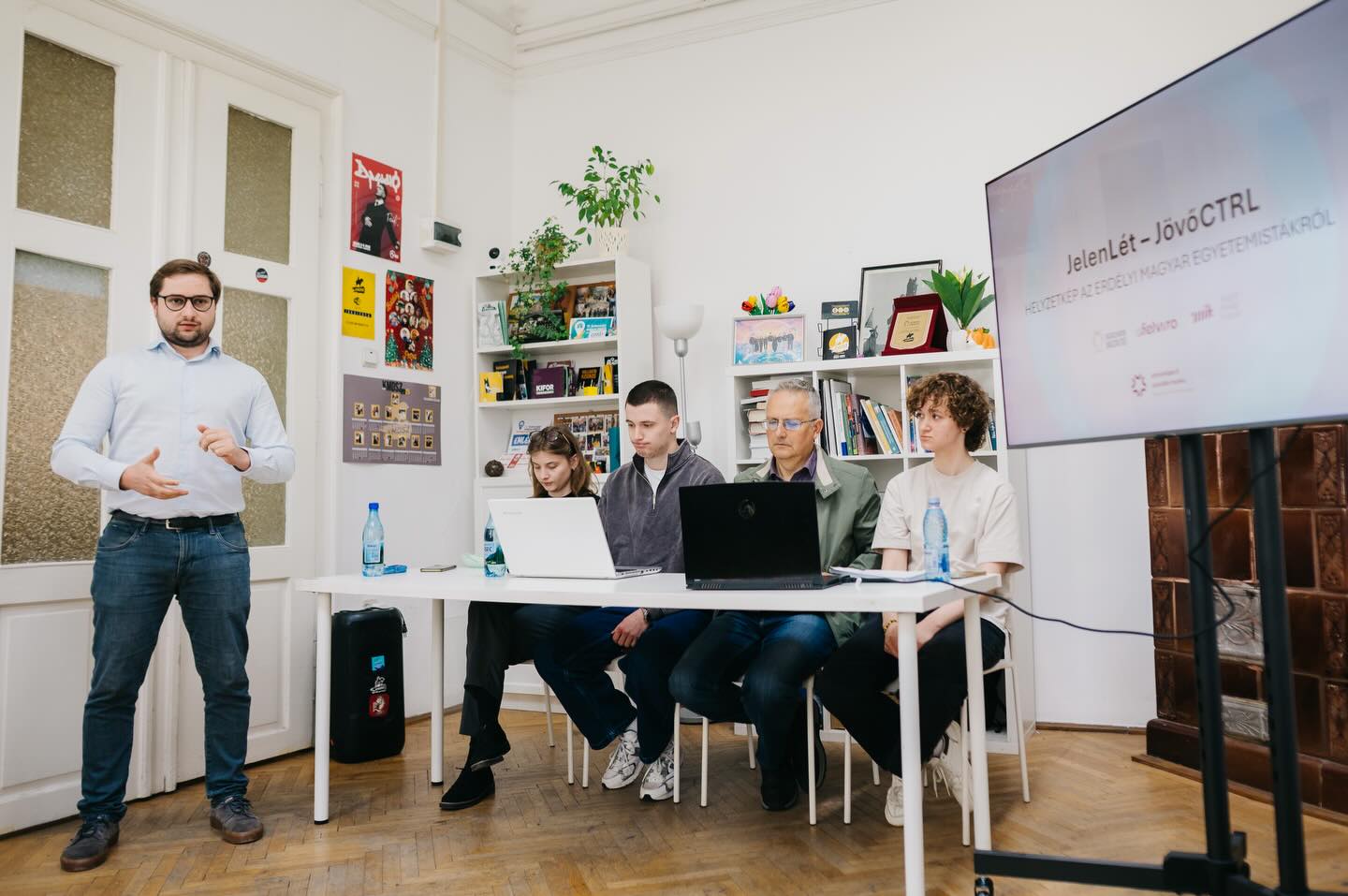
Based on a study on the situation of Hungarian university students in Transylvania, nearly half of university students in Romania’s Hungarian-language programs have faced disadvantages in their education due to their Romanian language skills, while 24.6% have experienced discrimination based on their ethnicity at the higher education institutions where they study. The results of the study were presented on Tuesday in Cluj-Napoca, hirado.hu reported.
Data collection for the study began last year under the direction of sociologist Dénes Kiss, a lecturer at Babeș-Bolyai University (BBU), with the involvement of second-year sociology students. Attila Hatos, president of the OMDSZ (an umbrella organization for student associations in Romanian university towns) said the study was conducted because there are insufficient surveys on what students think about their situation, and knowing this would allow student organizations to work more effectively, according to Hungary Today.
Sociologist Dénes Kiss stated that the online survey questionnaire was distributed to all major Romanian cities with universities. A total of 1,729 questionnaires were completed, and efforts were made to weight the database to ensure it was representative of the target population.
Since the number of Hungarian students studying in Romanian is unknown and the data received from Romanian university centers—Bucharest, Timișoara, Brașov—was limited, a subgroup was created with university students in the Hungarian-language program, resulting in a representative sample of 1,244 people, weighted based on enrollment figures, he explained.
The study examined students’ class attendance, their satisfaction with the university’s operations and services, as well as issues related to scholarships, housing, subletting, place of residence and public transportation, living expenses and the costs of student life, student work, anxiety, and future prospects. A separate chapter addresses the issue of Romanian language proficiency and ethnicity, revealing that: nearly half of students in the Hungarian-language program faced some form of language-related discomfort during the educational process, with 33.1% experiencing it once and 14.4% experiencing it multiple times.
Due to their limited knowledge of Romanian, 32.8% of respondents experienced a disadvantage in university administration, and 17.4% among their classmates.
Students are less likely to face discrimination specifically because of their Hungarian ethnicity than because of their limited knowledge of Romanian.
According to the data, 24.6% of students in the Hungarian-language program have experienced discrimination in education because of their ethnicity, while only 10.1% of their peers have experienced this, based on the data.
The difficulties arising from language barriers most frequently affect students enrolled in Romanian-language programs, only 34.6% of whom have been spared such issues in education so far. Conflicts are much more common in state institutions with mixed languages of instruction.
Within this group, the Hungarian department of the George Emil Palade University of Medicine, Pharmacy, Science, and Technology in Târgu Mureș (Marosvásárhely), is the most affected within the representative sample.
There, only 26.1% of students have not yet experienced language-related disadvantages in education, and ethnic-based discrimination is also most common there.
In contrast, at institutions with a purely Hungarian profile—Sapientia Hungarian University of Transylvania and Partium Christian University in Oradea (Nagyvárad)—ethnic tension is virtually unknown.
The weakest point of university administration turned out to be the creation of the class schedule, with 26.3% of students dissatisfied. In the case of medical training in Târgu Mureș, this figure is also critical, at just 2.45%.
The responses to questions about stress and anxiety are also cause for concern: 69% of young people said they feel stressed, and among women, the prevalence of stress in daily life is exceptionally high at 76%. The data regarding future prospects is more encouraging: 71% of respondents are completely certain they will finish their studies, and three-quarters of those surveyed plan to start their careers in Transylvania.
Long-term plans show even stronger local and regional ties, and although working abroad is also an option, it is not increasing significantly.
The majority of respondents, 34.2%, would go to Hungary for a longer period, while 13.3% would settle in Scandinavian countries.
The Institutional Triad: Collaboration and Competition
The “Cluj Model” of multiculturalism continues to be anchored by Babeș-Bolyai University (UBB), which hosts the largest Hungarian-language student body in the country. However, the private and state-funded (via Hungary) alternatives have matured into indispensable partners.
| Institution | Strategic Focus (2026) | Role in the Ecosystem |
| Babeș-Bolyai University (UBB) | Research Excellence & Multilingualism | Integrated, large-scale academic training. |
| Sapientia University | Applied Sciences & Technology | Professional training tailored to local industry needs. |
| Partium Christian University | Humanities & Arts | Preserving cultural heritage in the border regions. |
| UmfST Târgu Mureș | Medicine & Pharmacy | Vital training for the Hungarian healthcare sector. |
The Demographic Squeeze: Quantity vs. Quality
The most pressing challenge in 2026 remains the “demographic winter.” With a decreasing number of Hungarian high school graduates, universities are facing fierce competition, not only among themselves but with institutions in Hungary and Western Europe.
To counter this, Transylvanian universities have pivoted toward quality-driven recruitment. By offering niche programmes—such as Digital Humanities in Cluj or Agricultural Engineering in Sfântu Gheorghe—they are managing to attract students who previously would have looked toward Budapest or Vienna.
Digitalisation and the “Brain Gain” Strategy
In 2026, the digital shift has allowed for a unique “Hungarian-Hungarian” academic space. Joint degrees between Cluj and Budapest, or Târgu-Mureș and Debrecen, are now the norm rather than the exception.
-
Hybrid Learning: Cross-border digital campuses allow students in Transylvania to attend lectures by world-class professors from Hungary without leaving their home regions.
-
Dual Education: Stronger ties with Hungarian-owned companies in Romania (in sectors like banking, energy, and IT) provide students with internships and guaranteed employment, curbing the “brain drain.”
The Language of Science: A Bilingual Advantage
A key debate in 2026 is the balance between Hungarian-language instruction and the necessity of English for global research. The current strategy focuses on “Addictive Bilingualism”—ensuring students are masters of their mother tongue while being fully proficient in Romanian and English. This trilingual profile has turned Hungarian graduates in Transylvania into some of the most sought-after professionals in the regional labour market.
Political and Financial Sustainability
The funding model remains complex. While UBB receives state funding from Bucharest based on student numbers, Sapientia relies heavily on support from the Hungarian government. In 2026, there is an increased push for these institutions to diversify their income through EU structural funds and private sector partnerships, ensuring they remain resilient regardless of the political climate in either capital.