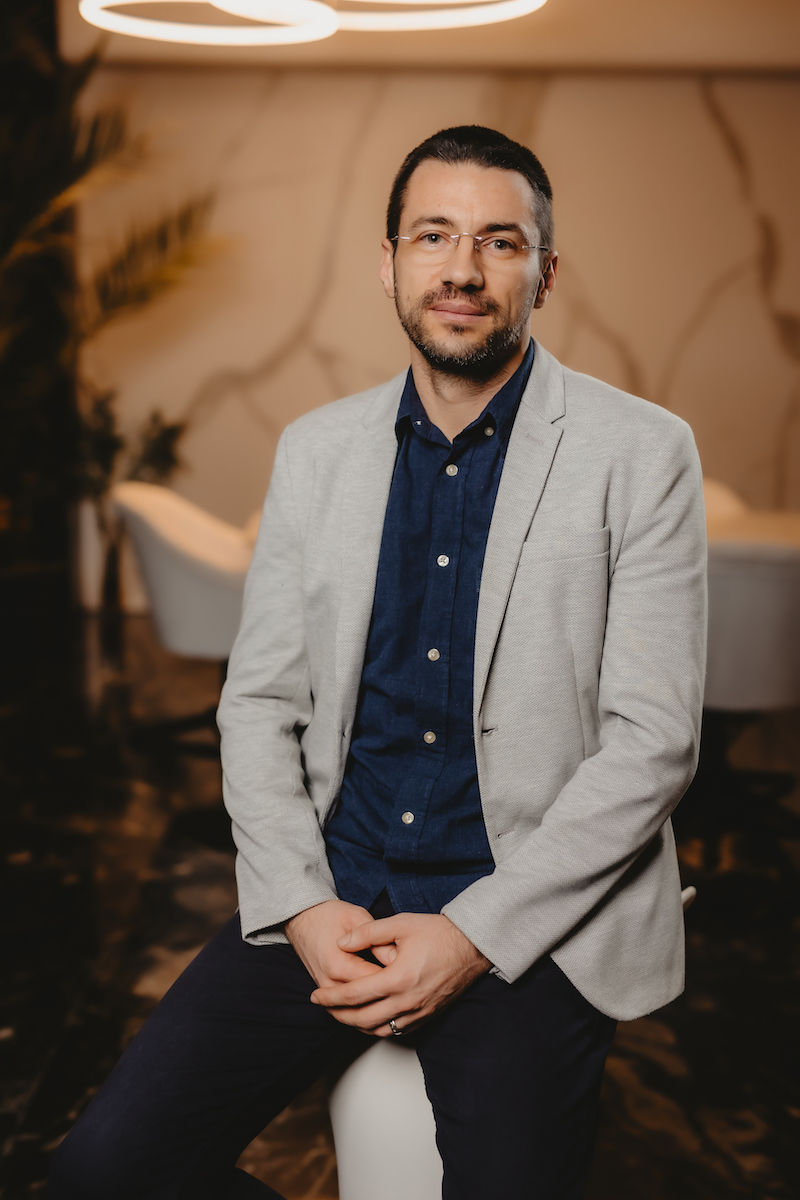
Cluj-based entrepreneur Darius Mârza is the founder of Romania’s largest family festival, Wonder Family Fest. He is also the manager of the famous Wonderland Resort. He agreed to share his story with our readers.
How did you become an entrepreneur How did you start? What were the milestones?
Chapter I. Childhood.
I.1. The first money earned from business ideas, at 5 years old & passion for computers, at 7 years old.
It’s a very long and complex story.
My openness to this field started extremely early: when I was 5 years old, I would jump over the fences of the gardens next to the residential blocks and take parsley and carrots, which I would then sell at the bus station, where I had set up a little stand. I would sit on the sidewalk. And that’s how I made money to buy what I wanted.
When I was in first grade, after school, I would go to my dad’s company and play Minesweeper. That’s how I fell in love with computers, at a time when there were only about 5-6 computers in all of Cluj. My dad was a partner at a company, it was the biggest wholesaler in ‘93. There were 7 partners at the time, and when the company was dissolved and they had to split the assets, I remember I begging my dad all summer not to take money, but to take the computer instead. That’s how I ended up getting my own computer at home, during the summer between first and second grade.
In second grade, I started taking computer science lessons with my godfather, Andrei Olariu. Two years later, when I was in fourth grade, he left to work as a software developper in Tokyo, immediately after he graduated from the Computer Science Faculty.
I.2. My first serious money, and the first dream I bought with my own money: a mobile phone
I started earning my first serious money in the last year of primary school, around 1996. I was doing a bit of everything: typing up reports, papers, and books for university professors, I was selling essays to my school mates in the fifth grade. I was also selling floppy disks containing a videoclip or a game, I was doing spiral binding, working in Photoshop, and editing. I even made business cards – I sold them to my school mates who wanted to feel more important in middle school, because I had convinced them myself that they needed a business card if they wanted to become important people :).
In sixth grade, I bought my first mobile phone, an Ericsson 318. I think there were maybe 10 mobile phones in Cluj at that time, and in the largest high school in the city, nobody else had one. When I’d take it out of my pocket and give it to a girl to hold it for me, while I played football or basketball, she would blush and hold it as if it was a royal baby.
Chapter II. High school
II.1. Attempt to set up my first company and earnings from computer science/computers
After fulfilling my first dream, that of having a mobile phone, I also wanted a CD Writer. I saved up all the money I earned, including the money my parents gave me for food, so I could buy it. It took me two years, but I succeeded. My godfather brought it to me from Japan, right on Christmas. It was a Yamaha, with a 2x burning speed, meaning that it took about 30-40 minutes to write a CD.
I started burning my first CDs, and in ninth grade, I would run from the Computer Science High School, where I was a student, to change the CDs. In the afternoons, I had people queuing for them, and I couldn’t disappoint my customers. Since then, I was very invested in delivering on time and doing everything possible to make sure my customers were satisfied so they would return. There were kids who spent all their money on my services.
That was the period when I spent the most and partied the hardest. I was going to all the clubs, buying the biggest bouquets of flowers, 60-70 roses each, from the newly opened Magnolia flower shop. A bouquet cost about 3 million lei; I think it would be equivalent to 3,000 lei now. I was only taking taxis, eating only at restaurants, and buying anything new and related to technology: the biggest and newest HDDs, the latest computers, monitors, graphics cards. I was earning much more than my mom, who was a university professor.
After a year of living like this, I took a moment and analyzed how much money I had spent. I realized that the CD business wasn’t going as it used to, because many others had entered the market, and CDs had become very cheap. I didn’t want to waste any more time, so I started thinking about what else I could invent.
In ninth grade, I also tried to set up my first company, legally, with all the paperwork, stamps, and accounting. But after a while, the advisors at the City Hall realized I was a minor and refused to issue the PFA (registered sole trader) certificate. This happened during Mr. Funar’s term.
From the second year of high school, I stopped wasting money. I stopped buying anything new and fancy, because I realized that depreciation was (and still is) extremely accelerated, and I stopped going out to clubs.
So, I started building computers. I was taking old computers and refurbishing them, or I was building new ones from parts I brought myself. I was the first on the market to sell computers in installments to friends and school mates. It went well, but I never reached the earnings I had in the eighth and ninth grade. Back then, I could have made a small fortune, but I squandered it. Luckily, I woke up in time.
The computer sales were also going well until three big companies entered the market overnight: Domo, Altex and media Galaxy. And this was exactly their slogan: “Buy the computer you’ve always dreamed of, with just your ID, within maximum 2 hours.” And that’s when I got pushed out of the market.
The following year, in eleventh grade, I started creating software programs for family doctor practices, accounting firms, and various websites, even for churches, which were very open to this because they could twin more easily and receive sponsorships. It went well for about a year, until the large multinational companies started appearing. But the first one to take my place was Alfasoft. It was located next to Castelari Coffee and pastry shop, in the Observator area.
II.2. My first investments in real estate, from tutoring in computer science
After the software business stopped working (because I was overtaken by the big companies that offered guarantees and post-guarantees, and people no longer trusted freelancers so much), I started tutoring in computer science; not just younger school mates or those my age, but also university students. I was this all the time, without breaks, working weekends from 8 a.m. to 10 p.m. With all the money I saved up, I bought my first studio apartment, my first land lot near the airport, and my first land lots in the mountains, which I then subdivided for cabins, together with several of my dad’s friends.
Computer science was clearly my passion: I was the only graduate with a perfect 10 in computer science in the whole high school (including term papers, labs, and control papers). Keep in mind that my teacher was Mrs. Rancea, the author of all the high school computer science textbooks, and the strictest teacher. Just to give you an idea, the grades in my class were as follows: I had a perfect 10, the next classmate had 8 (her mom was a computer science teacher and always helped her), the next one had 6. Half of the rest of the class had 5, and the rest had 3s and 4s. Well, they all passed with an average of 5. Mrs. Rancea was very strict, but she was extremely kind-hearted.
And I didn’t only excel in computer science: all my form masters said I was the most complex student they’ve ever had; they would brag about me in the staffroom. I was first in any physical test, I was a school olympian, and I frequently appeared in Gazeta Matematică (Mathematics Journal).
After graduating from the Computer Science High School, I sent emails to my friends and my parents’ friends to tell them that I had just been accepted at Babes-Bolyai University to study Computer Science in English, and at the Technical University to study Computer Engineering. I told them I wanted to start a software company and that I would take any challenge, even without pay, any kind of project, just to prove that I could handle it.
All my youth, I was the life of the parties. Since ninth grade, when I ended the partying lifestyle, I haven’t had a single drop of alcohol. Not even a gram. But I was going to parties, and dancing all the time.
Chapter III. Event organizing: the first step, my coming-of-age party
The next step, after my coming-of-age party: I borrowed 50,000 EUR and opened the first event hall in Cluj, marking several firsts in Romania: the first mobile bar and disco lights at weddings.
If we’re talking about independence, in twelfth grade I wanted to organize my own coming-of-age party, and that’s exactly what I did. I arranged the restaurant, set up the music, I did everything. And it was amazing.
Influenced by the success of my coming-of-age party, I thought to myself: I’ll borrow money from my godfather, Andrei Olariu: 3,000 EUR, for photo-video and audio equipment for events. I started the events company in the summer of the twelfth grade and grew exponentially. And I know exactly why: because I was eager to prove myself, I was completely dedicated to serving the customer, extremely ambitious, and, most importantly, I was the first to introduce photo-video editing on a computer. After only a few months, I was very well-known on the market and I was able to pay back the money I borrowed from Andrei after 3 months, not 6 as we had agreed.
After another 3-4 months, he returned from Tokyo (where he was a stock exchange programmer for Deutsche Bank) to Cluj, permanently. I asked him to start a software company with me, but he set one up with a friend of his who had more connections and was more open to projects.
Seeing that I still wasn’t succeeding with the software, I asked him for a 50,000 EUR loan to open my first event hall, Talisman. I did it, and I immediately signed several contracts. People were very enthusiastic from the start. Back then, there were only cafeterias, hotels, and restaurants. But I wanted something special, more disco-like, with lots of lights and fun. I was the first in Romania to introduce disco lights at weddings, and the first mobile bar at a wedding. Thanks to this event hall, I was able to convince high schools to stop organizing freshman balls in clubs and have them in my hall instead. It was 2005.
Chapter IV. The beginning of Wonderland: the land lot in 2005, the first authorization in 2012
After the first two months of activity, and considering that my event hall was located between apartment blocks, I received numerous complaints from neighbors who were disturbed by the noise. I decided, together with my father, to look for a secluded piece of land in the middle of nature, so I wouldn’t have anyone nearby. Since I can remember, I’ve been captivated by beautiful landscapes, so I chose, without hesitation, the current location of Wonderland. In 2005, I bought the first 1,500 square meters, where Grande Vista is now located. Then, I kept buying additional 500 square meters land lots, as I could find in the area. I submitted the paperwork for the PUZ (Urbanism Plan) and construction permit for Grande Vista. And I finally got it… in 2012!
Between 2005, when I submitted the request, and 2012, when I received the authorization, I experienced many ups and downs in my business. Below, step by step, each of them:
Chapter V. The most hectic period, 2005 – 2009: the sensational Havana, a fast food, economic crisis, beginnings from scratch
I bought a commercial space next to Sora shopping center, and opened an event organizing studio, Dario Studio.
In 2008, I opened Havana, the first rooftop terrace in Cluj, which had over 300 seats and an incredible view. From the opening evening, until the day I sold it, three months later, it was fully booked every day. There were dozens of people waiting in line to grab a seat. On the opening night, it was the first time that Leul parking lot, which has hundreds of places, was completely full, and there was a line of cars all the way to the roundabout in Mihai Viteazu square. Traffic in the city center was blocked for a few hours. That summer, the CFR Cluj was on fire, and everyone was always out at the terrace. On the very first night, I received two offers to sell the terrace, and I felt very insulted by that. In the end, I sold it to one of them. I learned that any business or material thing is for sale at the right price and that you should never say never.
In October 2008, I invested all my money, including the money I made from selling the terrace, in a 25% down payment to buy more commercial spaces on Eroilor street near Carpați coffee and pastry shop. The down payment was supposed to be 33%, but I didn’t have the rest of the money, so I made an agreement with the sellers to pay them over the course of a year. The remaining 66% was supposed to come from some Spaniards, but they left for Spain to get the money and never returned. The real estate crisis had already begun. At that point, I lost absolutely everything and had to start from scratch, with no money.
In the winter of 2009, after I had already sold Havana, I opened a fast-food place behind Sora shopping center. During the first month after opening, I had to focus on my bachelor degree, so my business partners handled it. After a few months, I bought out one of my partners and got to work. From daily sales of 60 lei, I reached 5,000 lei per day. It became the most profitable fast food in Cluj. Within a few weeks, we surpassed the traditional local spots, like Speed and Rosa. They eventually closed, so everyone came to us. In the two months I spent working full-time in the fast food, I made a net profit of 5,500 Euros. After I left and my wife stayed, the profit dropped to 2,000 Euros per month. Then my wife started university, and our remaining partner continued running the business. In the first month, he made a profit of 200 Euros, but then it dropped to negative, so we decided to close it after about 6-7 months of operation.
Chapter VI. The peak: The buffalo farm, the toughest test
In the summer of 2009, freshly married (since February), after selling Havana, I was at my in-laws’ countryside home with the whole family. They had four buffaloes that needed to be milked. The problem was that a specific person had to milk a specific buffalo, or else they wouldn’t give any milk. So, four people were milking four buffaloes, twice a day; no exception. I told them, “I want to build the biggest buffalo farm here, and I will do it. I’ll buy them from all the old people in the villages, I’ll make milking machines, I’ll set up a milk distribution line, etc.” They laughed at me, but I got to work the very next day. I built everything myself, worked on all the machinery, welded everything, painted, set up all the installations, and bought all the buffaloes. I loaded them onto a makeshift trailer with a single axle (because I only had a B category driving license). I managed to buy 55 buffaloes, milk them myself, clean the barns, stay with them on the pasture, and deliver the milk to the subscribers in the evening.
Keep in mind that I had hundreds of employees in Cluj (the fast food, Talisman event hall, Studio Dario where there were dozens of DJs, cameramen, photographers, decorators). And at the farm, I had no trusted help. I would get home at 1 am, and at exactly 3 am, I would leave for the farm because the buffaloes needed to be milked at 4 am and then sent to pasture at 6 am. That was my life until Christmas 2010 when I found someone to safely take the animals and made sure they wouldn’t end up in the slaughterhouse.
In this business, everything turned out just as I imagined. There was room for growth, there was demand, and people were happy. There was only one problem I hadn’t considered: there was no workforce in the rural area. I had made this move for the family because there was no income source in the area, and I thought it would be easier this way. Absolutely not! In the rural area, there is an acute workforce shortage. Not because there aren’t people available, but because those who can work, prefer social assistance.
Chapter VII. Returning to programming, the first job in the field & and the first bricks at Wonderland
After this experience, I sold everything I had, paid as much debt as I could, and still had a balance of 6,500 Euros left to pay. For a year, I lived off borrowed money and left to see the world. I visited all the capitals in Asia and America. I took a sort of sabbatical year. After that, I got back to studying because I wanted to be able to work as a programmer after an 8-year break.
I went to many interviews where I would always say the same thing: I don’t expect any salary until I settle in, I don’t want a penny if I don’t manage to bring in that money. When I become productive and bring in five times more than any other programmer here (this was in an open-space), then I will ask for a reasonable salary, just enough to be at peace knowing my work is rewarded. They hired me, and within a month, I was the best.
It so happened that my second month there was the one when evaluations were taking place, and salaries were being negotiated. They told me: you’re hired for position X, for which the salaries are 3,100 RON if you’re weak and everyone criticizes you, 3,200 RON if you’re okay and do your job, and 3,300 RON if you’re praised and creative. And I said to them: fine, but I produce five times more than others. They replied that quantity didn’t matter, only quality and qualification did. But I told them: if I have two pizza makers, and one makes 5 pizzas an hour and the other makes 25, of course, I’ll give the second one a bonus, the amount of another salary, because I earn five times more from his work. In IT, the difference in productivity was directly influenced by how much time they spent on YouTube or Facebook. Given this situation, I told them I would produce exactly what was required, and only the tasks assigned to me by the management. To give you an idea, I would arrive at work at 6 a.m., and by 8 a.m., I’d finish everything. The team meeting was at 8:15 a.m., and by 8:30 a.m. I was already leaving to handle the authorization for Wonderland.
I started the works at Wonderland with 500 euros in my pocket
I started reading the permits that others had received and figured out the pattern, so I sold my car for 12,000 euros, I managed to get in touch with the person who had the largest number of approved permits and asked him to resubmit my project. He asked for 10,000 euros, which I paid immediately, and with the remaining 1,500 euros, I bought a Dacia Logan MCV. I used that car when building the first event halls, even transporting the roof and installation pipes with it because the window was broken, and I could take them out through the back. I was left with 500 euros in my pocket, and I used it to start building the first entrance bridge to Wonderland.
- How many projects/businesses are you involved in, as an entrepreneur? Which ones do you own, and which ones are you a shareholder in?
The only project I’m currently involved in is Wonderland. Because it consists of many elements: the event halls, the sports base, the à la carte restaurant, the terraces, the pizzeria, the shawarma place, the dinosaur park. To manage them more efficiently and easily, I grouped them together.
- What plans do you have in this direction?
My dream, and it’s not just a dream, but a clear direction, is for Wonderland to become a place as well-known in Europe as Disneyland. Not necessarily to surpass them, but to be as close as possible.
- What hasn’t worked during all this time? Or, what projects have you shut down?
At Wonderland, I have always started projects and developed them. I’ve never shut down anything. Although there are some things that require additional support and that I strive to make profitable. Not all of them are yet profitable because they are so closely linked to one another. The core remains the events – where I have vast experience, having organized them for 21 years, and because I dedicate myself entirely to each one that I organize.
- What have you given up to be an entrepreneur?
I don’t feel like I have given up anything. I never liked shopping or spending recklessly. I don’t watch TV, I don’t drink alcohol, I don’t smoke. I’ve never smoked. I have four children, I work 22 hours a day, and I manage to accomplish everything I set out to do. I haven’t sacrificed anything because I’ve done what I love. And I loved (and still love) making people happy. I want to help (in the most concrete way possible) as many people as I can.
- What was the biggest challenge in managing a business as complex as Wonderland? How did you overcome it?
I can say without hesitation that the hardest time was during the pandemic, which we overcame only with trust in God and a lot of hard work. For two years, we worked just to keep the employees. Another challenge is something we all know: bureaucracy.
In addition, we innovated and shifted towards tourism, camps, activities like horseback riding, and many outings with horses. So, during that time, I focused on the equestrian center and tripled the revenue from horse-related activities. But after a year from the pandemic, it declined again when I started to focus more on events.
- What are the main lessons you’ve learned from managing this project?
Honestly, I learned my lessons before this project. God toughened me, refined me, and prepared me in other previous projects. After the experience I had with the farm, everything else seemed like a piece of cake. I have learned, and I continue to learn, lessons from fighting bureaucracy and the difficulties I sometimes face with authorities. These are unique experiences in my life, which have made me wiser.
Experiences and Uniqueness
- What activities or facilities in Wonderland do you consider unique, that your competition doesn’t have?
I believe that “a man makes the place.” I also believe that our employees are truly dedicated to the idea of “the customer is our master.” Wonderland is an extremely complex resort: we have the largest Adrenaline Tower (hexagon) in the world, the best 5-star hotel in Europe, a fabulous 3,000 sqm swimming pool with an additional 10,000 sqm beach, we have Dino Park with dozens of animatronic dinosaurs, and a horseback riding center with 30 horses. We have the only monocycle in Europe, and the only tubing tracks with a ski lift. All in the same place.
Not to mention the unique and spectacular view of a fabulous city, Cluj, and the location near the forest. Essentially, we are just a few hundred meters from DN1, but when you arrive at Wonderland, you feel like you’re hundreds of kilometers away from traffic.
What I wish is to make Wonderland the most appreciated resort in the world, both in terms of variety and quality. And the guarantee of success is the fact that for 21 years I have been organizing parties and events, a market on which I have been the undisputed leader for a decade.
- Have you received recognition, awards, or distinctions that could support your positioning as an industry leader?
Absolutely, YES! The market share and preferences regarding Cluj residents’ event intentions show that 80% of them prefer Wonderland. The location on second place has 9.5%, and the rest of the locations combined have 10.5%. These are official surveys. After two years with the same results, no more surveys were conducted because they no longer seemed necessary, especially since we continued to grow and innovate.
- How do you plan to improve the customer experience in the coming years?
I intend to create a magical story, similar to Disney’s. I want to work more on safety, and I want to add two more attraction points. Perhaps some bumper electric cars – they were very appreciated at Wonder Family Fest.
Innovation and the Future
- Do you see opportunities for digitization or automation in managing the complex? (e.g., mobile apps for reservations or interactive guiding)
I am constantly working on this aspect. I have collaborated with three different software companies. With every passing month, I hope to get closer to my goal.
- Have you considered expansion options, such as franchising or opening other locations under the Wonderland brand?
Yes, in the mountains, in the Muntele Băișorii resort, to ensure continuity during the slow months. I’ve been dreaming of this for 30 years. That’s where I learned to ski. The cabins there are 27 years old. Right now, I’m waiting to sign the contract to take over the ski slope. I’ve already purchased the only hotel in the area, Alpin Hotel.
And I also want a mini-Wonderland in an equatorial area, which I have been searching for 20 years, and where I can retire when I’m old. That’s all I want.