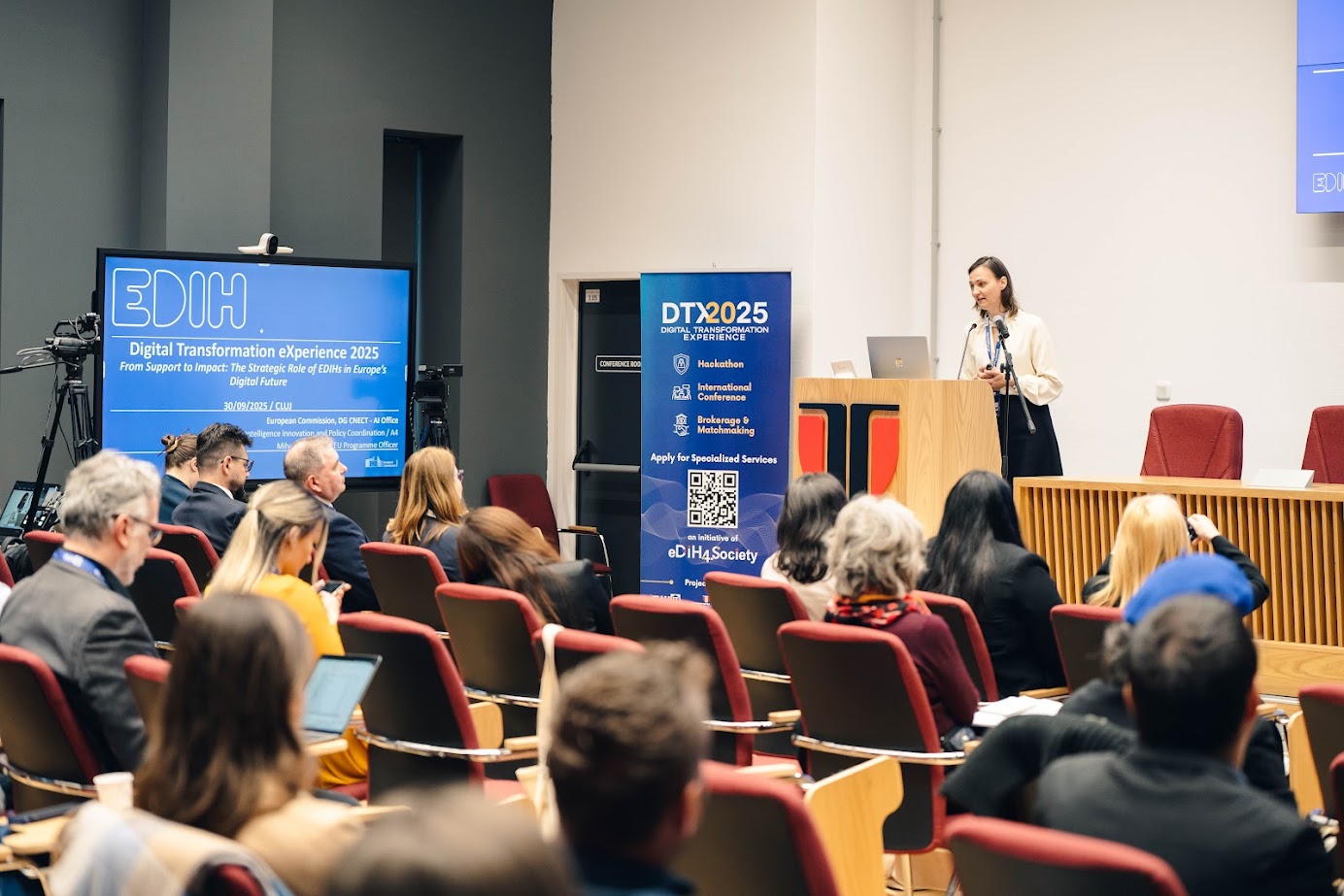
The Digital Transformation Experience (DTX 2025) event, organized by Cluj IT Cluster under the auspices of the Digital Innovation Hub for Society (DIH4Society), with the support of the European Commission and the Romanian Government, took place at the UT Hub within the Technical University of Cluj-Napoca (UTCN) between September 29 and October 1, 2025.
The event brought together opinion leaders, specialists, and practitioners in the field of information technology. The topics covered were varied and included subjects such as digital innovation centers as pillars of the European digital future, reconfiguring governance in the digital age, cybersecurity, and AI for society: From emerging technology to everyday impact.
In this context, Professor Stelian Brad, Dean of the Faculty of Industrial Engineering, Robotics, and Production Management at UTCN and also President of the Cluj IT cluster, believes that the digital transformation process can lead to the development of economic verticals.
He mentioned, for example, drones, robotics, and green energy. Professor Stelian Brad points out that there is no alternative to the digital transformation of society and says that Romania must mobilize its resources to accelerate this process.
“We wanted to organize this event precisely to discuss and raise awareness of the importance of digital transformation for the local community, both for private organizations and for public administration and universities. Digital transformation is precisely the phenomenon whereby digital technology helps us to be more efficient; at the same time, it benefits everyone involved in this process,” said Professor Stelian Brad.
DTX 2025 brought representatives of the European Commission, who came specially from Brussels, as well as experts from digital innovation hubs in countries such as Slovenia, Bulgaria, and Poland, and people interested in this field from countries such as Moldova, Italy, Romania, and Belgium to the heart of Transylvania.
More than 250 people participated in the three-day event, says Andrei Kelemen, Executive Director of the Cluj IT cluster. The first two days were dedicated to a hackathon focused on cybersecurity, which brought together over 40 university and high school students. To everyone’s surprise, the hackathon was won by a team made up of students from the “Tiberiu Popovici” Computer Science High School and the “Emil Racoviță” National College.
“We prepared some challenges for them, including the hardware they would be working with, and we had 15 teams from several universities across the country, as well as from high schools in Cluj. I was pleasantly surprised by the young people’s enthusiastic involvement in this competition, which encourages us to undertake similar initiatives in the future. It is vital for our society and for Romania’s economy to equip young people with all the knowledge and skills they need for a future in which digital technology will dominate all aspects of our lives,” said Andrei Kelemen.
The second day featured an international conference, which also brought together representatives of the Romanian Digitalization Authority, who emphasized data security. Participants highlighted that members of the European Commission have allocated €7.6 billion to support the Digital Europe program, and representatives of the private sector said they want a European cloud with pan-European supercomputers capable of transforming the European Union into a relevant player in the field of Artificial Intelligence.
On digital transformation at European level
“In fact, we are discussing how to explain this in simple terms; it is like electricity, so without digital means, many processes would not be possible. Of course, we need to digitize, so this is already our way of being and acting, so it is vital. We also need to be European in terms of using this type of electricity, digitization, with European solutions, infrastructure, data, algorithms, and skills, with Europeans working in this field (…),” said European Commission representative Mihaela Lafont.
The third day of DTX 2025 featured a session of presentations by companies and solutions in innovative fields, such as electric car charging station management and cyber data protection, followed by two workshops. The first was dedicated to the use of Artificial Intelligence in organizations and businesses, and the second was dedicated to cybersecurity.
The event at UT Hub was organized by Cluj IT through the DIH4Society project, implemented in partnership with the Technical University of Cluj-Napoca, the University of Oradea, and the Chamber of Industry and Commerce of Bistrița-Năsăud.
DIH4Society is a regional initiative that provides free digital transformation services primarily for the North-West Region of Romania.
Companies and institutions interested in applying for digital transformation services through DIH4Society can consult the open calls on the hub page: https://dih4society.ro/
Desired by CFR Cluj, Hakim Ziyech receives another transfer offer