

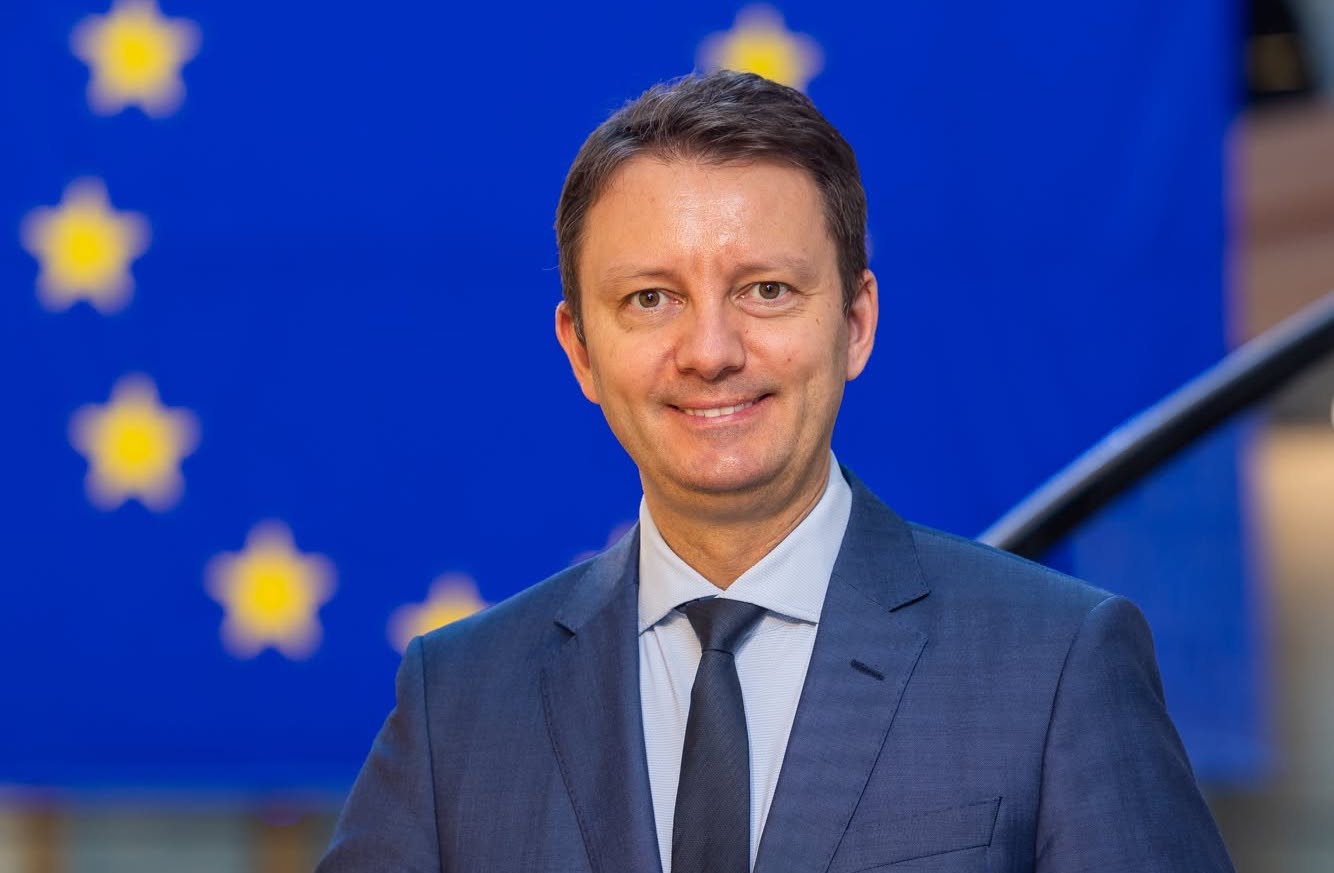
The proposed minority government now faces committee hearings and a difficult confidence vote amid opposition from the Social Democrats and AUR. Romanian prime minister-designate Siegfried Mureșan submitted his governing programme and full cabinet list to Parliament on Saturday, September 26. The programme contains 372 measures prepared by experts from the three parties supporting him, namely the National Liberal Party (PNL), Save Romania Union (USR), and the Democratic Alliance of Hungarians in Romania (UDMR), according to Romania Insider.
“In just five days, together with colleagues, experts and specialists from the three parties supporting this government, we managed to submit a detailed and comprehensive programme containing 372 concrete measures,” Mureșan said, as quoted by Agerpres.
He described the proposed ministers as “capable, responsible, and serious.”
Among the programme’s pledges are reducing the number of MPs in line with the latest census, limiting the number of state secretaries in each ministry, and banning the simultaneous receipt of a state pension and a public-sector salary. It also proposes reforms at state-owned companies and tax authority ANAF, alongside a single public service point for identity documents, passports, driving licences, and vehicle registrations.
Siegfried Mureșan also said his government would not increase VAT and would seek to return the rate to 19% when Romania’s fiscal position allows it. The existing flat income-tax system would also be maintained.
Plus, the programme includes a new savings and investment scheme called the “Future Account,” which would allow parents to open an account in their child’s name during the first year of life. The funds would be intended to provide starting capital for education and training.
Other priorities include accelerating the absorption of EU funding and motorway construction. In the justice system, the proposed government wants to end discretionary temporary appointments and promotions, ensure stable judicial panels, and guarantee the random allocation of cases.
The proposed cabinet would have three deputy prime ministers, each heading a ministry. These are Mircea Abrudean of PNL at the Interior Ministry, Radu Miruță of USR at Defence, and Tánczos Barna of UDMR at Agriculture.
The other nominees are independent Andrea Chiș for justice, Alexandru Nazare of PNL for finance, Oana Țoiu of USR for foreign affairs, Oana Gheorghiu of PNL for health, and Cătălin Drulă of USR for transport and infrastructure.
Cseke Attila of UDMR was proposed for development and public administration, Raluca Turcan of PNL for labour and family, Dragoș Pîslaru of PNL for European investments, and Irineu Darău of USR for economy and digitalisation.
Meanwhile, Diana Buzoianu of USR was nominated for environment, Sebastian Burduja of PNL for energy, Bulcsu Koppány Ötvös of UDMR for culture, and Mihai Dimian of PNL for education and research. Dan Reșitnec was proposed as secretary-general of the government, with ministerial rank.
The Parliamentary committee hearings for the proposed ministers are scheduled to begin on Monday at 14:00 and conclude on Tuesday at 20:00. The joint session of the Chamber of Deputies and Senate for the confidence vote is expected to take place on Wednesday.
Siegfried Mureșan needs at least 233 votes to secure Parliament’s confidence. The Social Democratic Party’s national leadership is due to decide its position on Monday, although its permanent bureau has already recommended voting against the cabinet and party leader Sorin Grindeanu has repeatedly said the Social Democrats will not support it. The far-right Alliance for the Union of Romanians (AUR) has also said it will vote against the proposed government.
President Nicușor Dan nominated Mureșan on September 17 after consultations with parliamentary parties. Romania has been governed by Ilie Bolojan’s caretaker administration since the previous cabinet was dismissed in a no-confidence vote in early May.
A veteran in European politics and a prominent figure within the National Liberal Party (PNL) and the European People’s Party (EPP), Siegfried Mureșan brings a lot of international experience, fiscal expertise, and institutional backing from Brussels at a time when Romania faces pressing economic and governance challenges.
The decision reflects a strategic effort to bridge national administration with European Union priorities, ensuring fiscal discipline while maximizing foreign investments and EU fund absorption.
Candidate Profile & Key Political Background
| Dimension / Indicator | Details & Profile Specifications |
| Name | Siegfried Mureșan |
| Political Affiliation | National Liberal Party (PNL) / European People’s Party (EPP) |
| Current Role | Member of the European Parliament, Vice-President of the EPP Group |
| Core Expertise | EU Budget, Financial Regulation, Economic & Monetary Affairs |
| Key Accomplishments | Chief Negotiator for the EU Budget (2018, 2024), Co-rapporteur for the Recovery and Resilience Facility (RRF) |
A Career Anchored in European Fiscal Governance
Siegfried Mureșan has built an extensive career within the European Parliament, earning a reputation as a pragmatic negotiator on budgetary and financial matters.
-
Mastering the EU Budget: As the first Romanian MEP to serve as chief negotiator for the European Union budget, Siegfried Mureșan played a pivotal role in shaping multi-billion-euro funding packages, prioritizing economic resilience, border security, and energy independence.
-
Architect of Recovery Funds: As a co-rapporteur for the Recovery and Resilience Facility, he helped design the structural framework through which EU member states—including Romania—access funding for green and digital transitions.
-
Eastern Partnership Advocacy: Serving as the Chair of the EU-Moldova Parliamentary Committee, Siegfried Mureșan has consistently advocated for the stabilization and European integration of the Eastern Neighborhood.
Priorities for the Mandate: Fiscal Stability and European Integration
Mureșan’s nomination comes at a juncture where Romania must navigate fiscal consolidation, administrative modernization, and tight deadline commitments under its National Recovery and Resilience Plan (PNRR).
Key agenda items for a potential Siegfried Mureșan-led cabinet include:
-
Accelerating EU Fund Absorption: Leveraging deep expertise in Brussels mechanisms to unlock delayed tranches of European funding and streamline infrastructure projects.
-
Fiscal Discipline and Inflation Control: Implementing prudent fiscal policies to curb public deficits while protecting investment-driven economic growth.
-
Strengthening Euro-Atlantic Alliances: Reinforcing Romania’s geopolitical standing as a reliable NATO ally and key EU partner on Europe’s eastern flank.
Parliamentary Dynamics and the Road to Confirmation
While Mureșan’s appointment signals confidence to international markets and European partners, the immediate focus shifts to parliament, where he must build a stable governing coalition and secure the vote of confidence.
If confirmed, Siegfried Mureșan’s premiership will represent a landmark transition toward a technocratic, European-centric leadership style aimed at modernizing public administration and securing Romania’s long-term economic stability.
Romanian authorities strive to bring online Cernavoda nuclear power plant
Comments
comments


