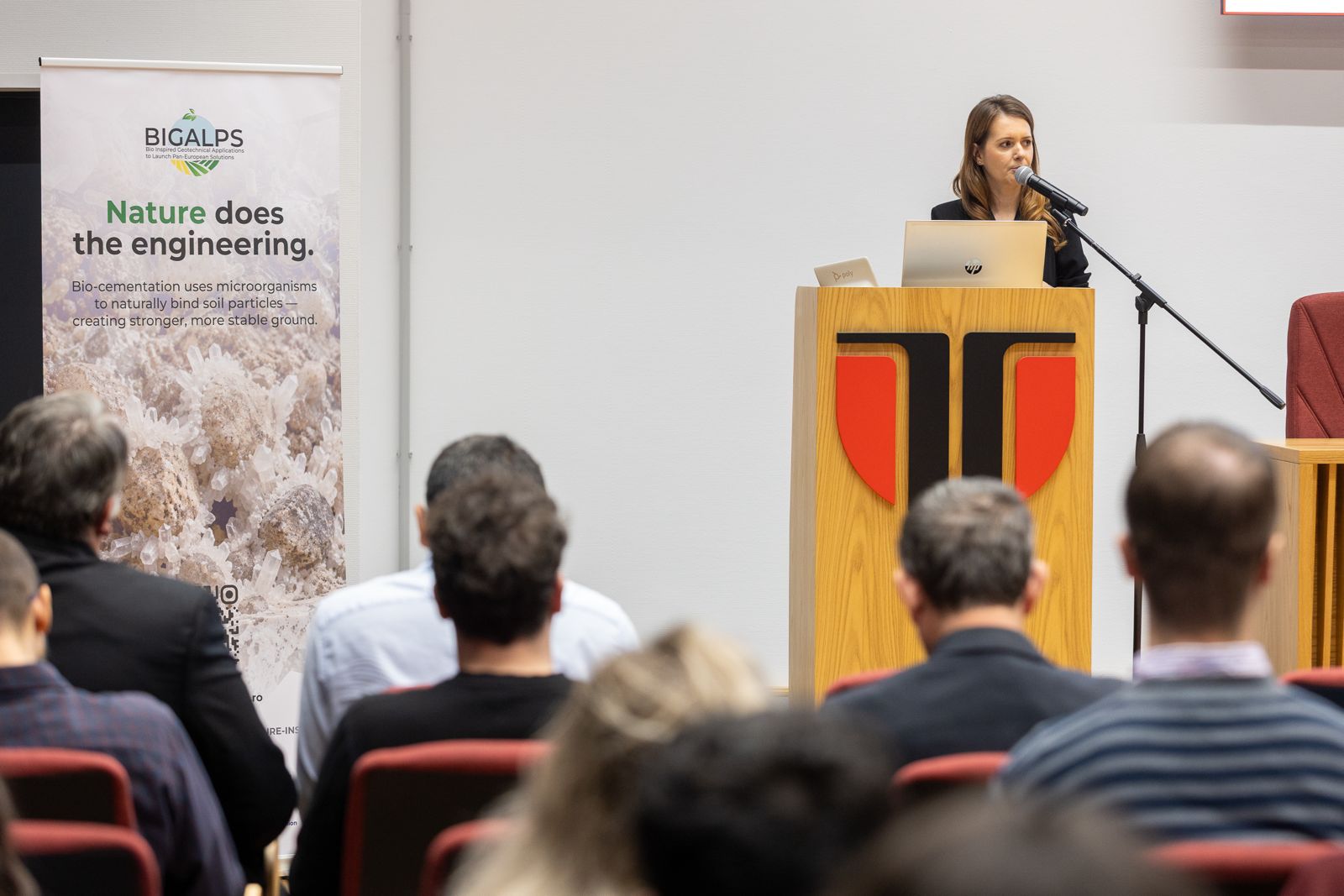
The Technical University of Cluj-Napoca (UTCN) announces the completion of the international project BIGALPS – Bio Inspired Geotechnical Applications to Launch Pan-European Solutions, a research and innovation initiative that, over the past three years, aimed to develop and validate a sustainable biocementation solution for soil stabilization.
Carried out over three years (October 1, 2023 – September 30, 2026) and funded through the Horizon Europe – European Innovation Council program and SERI, the project was coordinated by UTCN in partnership with prestigious institutions: EPFL (Switzerland) and INRAE (France).
What is Biocementation and How Does it Work? The BIGALPS project proposes a green alternative to traditional soil consolidation methods. The technology uses microorganisms that, through controlled biological and chemical processes, generate crystals at the soil particle level. These crystals act as a natural cement, bonding the particles together and significantly increasing ground strength.
“In BIGALPS, right from the beginning, we aimed to find the necessary solutions so that this technology could also function in a real field environment. The completion of the project actually represents the beginning of a new phase: the gradual transfer of technology to the market. We have demonstrated the potential of biocementation, tested the solution in real conditions, and built, alongside our international partners, the scientific and technological foundation necessary for the next steps. We now aim to continue development together with the private sector through pilot projects and concrete applications, so that this technology can become a real and sustainable alternative for the construction industry,” states Lecturer Dr. Iulia Prodan, Principal Investigator of the BIGALPS project at the Technical University of Cluj-Napoca.
Field Results and Practical Applicability Unlike theoretical research limited to laboratory testing, BIGALPS took the decisive step toward practical application. The technology was field-tested both in Romania (in Cluj) and in France, proving its effectiveness under real environmental conditions.
The primary targeted application areas include:
-
Resolving foundation ground issues;
-
Preventing and stabilizing landslides;
-
Mitigating soil erosion phenomena.
Next Step: Collaboration with the Private Sector
The completion of the research phase marks the beginning of the technology transfer process. The project’s principal investigator, Lecturer Dr. Iulia Prodan, emphasized that the team is already in discussions with public authorities and private companies to launch larger-scale pilot projects. The ultimate goal is for biocementation to become a widely adopted, sustainable alternative in the construction industry.