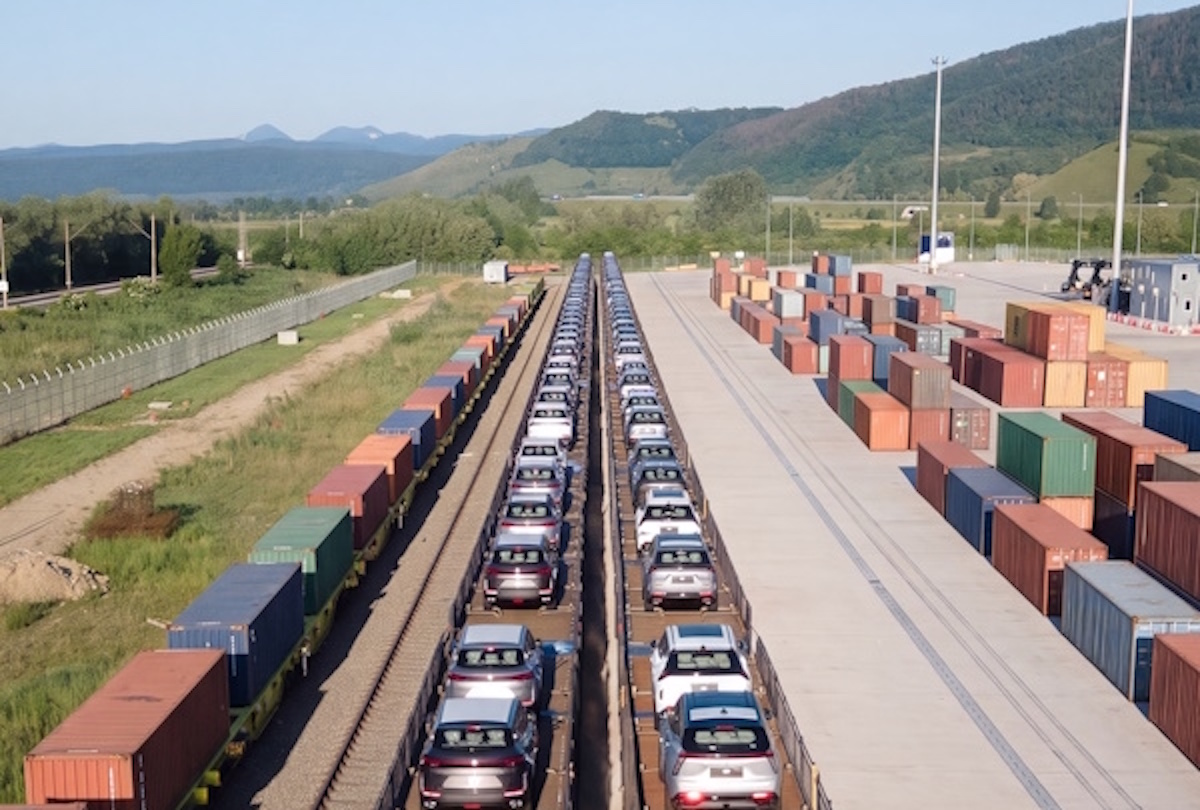
DP World has completed the first rail shipment of fully assembled vehicles between the Belgian port of Zeebrugge and its terminal in Aiud, Romania, thereby inaugurating a new intermodal corridor between western and south-eastern Europe, according to Railway Pro.
The final destination of the first shipment was Chișinău. The cars were transported by rail to Aiud, from where they continued their journey by road to the Republic of Moldova. According to the company, the operation is the first rail transport of vehicles in Europe managed entirely by DP World.
The global terminal and logistics services operator intends to transform the Aiud terminal into a regional car distribution centre, serving both the Romanian market and neighbouring countries.
Two trains a month in the second half of the year
The service between Zeebrugge and Aiud is currently a pilot project, but DP World is preparing to introduce a regular service. Two services a month are planned for the second half of 2026.
The company also aims to connect the Aiud terminal with other European ports. Among the options being considered is the port of Koper in Slovenia, one of the main entry points for cars imported into Central and South-Eastern Europe.
“Companies in the automotive industry are seeking to reduce their reliance on long-distance road transport. By combining rail and road transport into a single integrated service, we offer customers greater reliability, lower emissions and a solution that can be scaled up as European trade flows evolve,” said Dragoș Călin, director of freight transport for the Balkans region at DP World.
Carbon emissions reduced by up to 55%
According to the company, shifting part of the journey from road to rail can reduce carbon dioxide emissions by up to 55%, compared with carrying out the entire journey by long-distance road transport.
Using rail also limits operators’ exposure to cost fluctuations caused by new European regulations, rising road tolls and administrative procedures encountered when crossing borders.
“Our strategy is to build a better-connected European logistics network, create new trade corridors and offer our customers more options for freight transport. Aiud is a key component of this strategy, establishing new links between ports in Western Europe and markets in the south-east of the continent,” said Svitlana Balaban, Managing Director of DP World Romania.
EUR 21 million terminal in Aiud
The multimodal logistics terminal in Aiud was inaugurated in 2024, following an investment of EUR 21 million by DP World.
The facility covers an area of 180,000 square metres, is located near the A10 motorway and has direct access to the national rail network. The terminal offers container handling and storage services, customs clearance and freight forwarding.
Nestled along the Belgian coastline, the Port of Zeebrugge stands as one of Europe’s most strategic and versatile maritime gateways. Operating today as a crucial northern hub of Port of Antwerp-Bruges—the unified entity formed by the merger of the two Belgian ports—Zeebrugge continues to play an indispensable role in international logistics, automotive distribution, and energy supply chains.
Unlike inland ports that require lengthy river navigation, Zeebrugge’s position directly on the North Sea offers deep-water access with virtually zero detour time for ocean-going vessels, making it a preferred call for major global shipping lines.
Key Pillars of Zeebrugge’s Maritime Economy
| Sector | Strategic Role |
| Automotive Logistics | World-leading Roll-on/Roll-off (RoRo) hub for finished vehicle handling and distribution |
| Liquid Natural Gas (LNG) | Critical European energy entry point housing the Fluxys LNG terminal |
| Short-Sea & Deep-Sea Shipping | High-frequency connections across the UK, Scandinavia, the Baltic, and Asia |
| Cold Chain Logistics | Specialized infrastructure for temperature-controlled food cargo and perishables |
The Global Capital of Automotive Logistics
Zeebrugge is internationally renowned as a global heavyweight in the transport of finished vehicles. Handling millions of cars annually, the port serves as a primary assembly, storage, and processing center for leading global automakers.
Equipped with expansive terminal space and specialized Roll-on/Roll-off (RoRo) berths, vehicles arriving from manufacturing plants in Asia, the Americas, and across Europe are inspected, customized, and dispatched toward their final markets via short-sea feeder lines, rail, and road transport.
A Cornerstone of European Energy Security
Beyond automotive and containerized cargo, Zeebrugge plays a vital role in Europe’s energy grid. The Fluxys LNG terminal located at the port acts as a major gateway for liquefied natural gas entering the continent.
With advanced regasification infrastructure, storage tanks, and direct connections to the European gas pipeline network, the terminal provides essential energy flexibility, enabling natural gas to be redistributed across Western Europe or reloaded onto LNG carrier ships.
The Merger Advantage: Port of Antwerp-Bruges
The integration of Zeebrugge with the inland Port of Antwerp created an economic powerhouse capable of competing with Europe’s largest maritime complexes.
Under the unified Port of Antwerp-Bruges framework, the two sites complement each other’s strengths: Antwerp excels in container handling, chemical clusters, and hinterland rail connections, while Zeebrugge provides direct deep-sea access, superior RoRo capacity, and green energy infrastructure.
Driving Green Logistics and Future Innovation
As global shipping faces tightening carbon emissions standards, Zeebrugge is actively adapting its infrastructure for the energy transition. Current developments focus on expanding onshore power supply (cold ironing) for docked vessels, developing infrastructure for green hydrogen import, and expanding automated intermodal rail links to reduce heavy truck traffic along European highways.
FedEx Study: Nearly 8 in 10 Romanian Exporters Plan Global Expansion Beyond Current Markets