

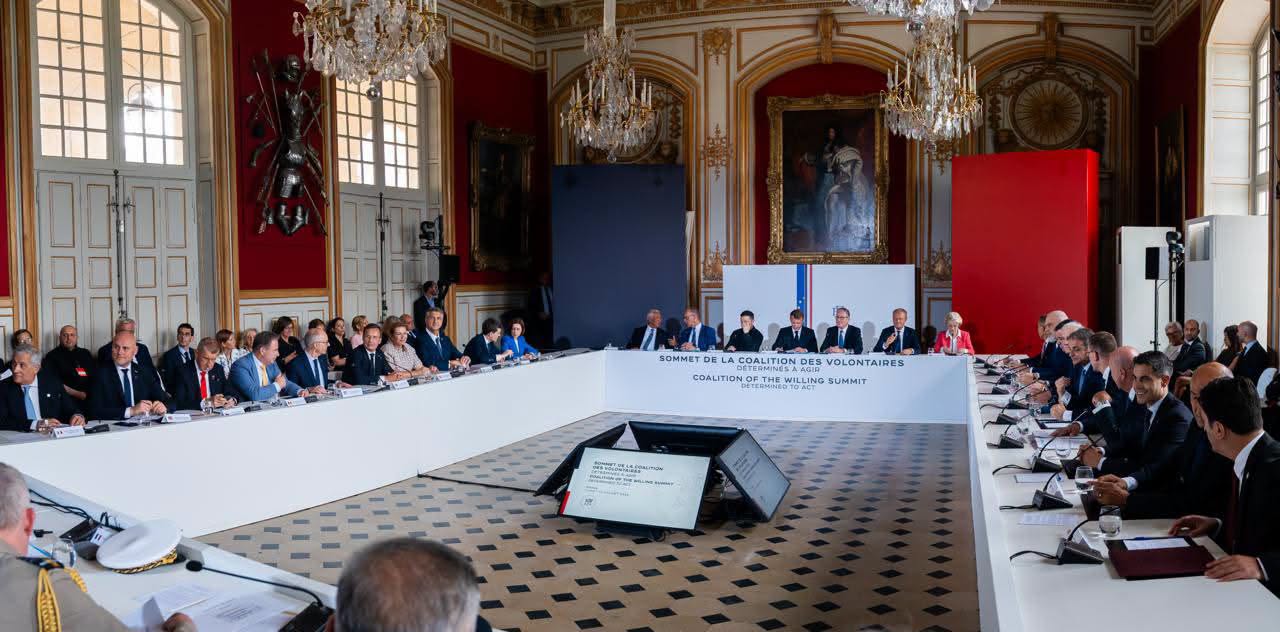
President Nicușor Dan said Romania will continue to support Ukraine and regional security efforts, arguing that investing in Ukraine’s defense is also an investment in Romania’s own security. His remarks came after attending a meeting of the Coalition of the Willing in Paris on Monday, July 13, hosted by French leader Emmanuel Macron, according to Romania Insider.
In a Facebook post, Nicușor Dan said discussions among coalition members reaffirmed the need for Europe and its partners to remain engaged in building a strong framework of security guarantees for Ukraine.
“As we move forward with concrete actions and coordinated planning, our joint efforts must remain focused on achieving a ceasefire and, ultimately, a just, lasting and sustainable peace,” the Romanian president said.
He added that Romania would continue to act as “a responsible ally and a reliable partner” in support of that objective.
“Our immediate priority remains ensuring freedom of navigation and protecting commercial shipping routes in the Black Sea,” Nicușor Dan said.
He then added, “Investing in Ukraine’s defense and security is an investment in our own security, and Ukraine must be able to negotiate peace from a position of strength.”
The president also said he had once again called for greater attention to the security of the Republic of Moldova, welcoming the country’s first participation in the Coalition of the Willing and its formal accession to the initiative.
In separate news, interim defense minister Radu Miruță said Romania had made progress in discussions with Ukraine on a joint drone production project financed through the EU’s SAFE instrument. Speaking to TVR Info, as reported by News.ro, he said the Defense Ministry had already submitted the operational and technical requirements for the drones, while the Economy Ministry is responsible for localization criteria under the project.
Radu Miruțǎ said that 15 Ukrainian drone manufacturers have expressed interest in partnering with Romania to produce drones domestically. According to the minister, the project is scheduled to be completed by 2030, although Romanian authorities want production to begin as soon as possible.
The defense minister said the preferred option is for the joint production to take place in Romania, at facilities operated by the Defense Ministry.
Sharing a border of over 600 kilometers with Ukraine, Romania found itself on the front lines of a geopolitical crisis following the Russian invasion on February 24, 2022. While initially viewed as a quieter partner in the international coalition compared to highly vocal allies, Bucharest has systematically emerged as one of Kyiv’s most crucial strategic, logistical, and humanitarian lifelines. From facilitating the transit of millions of tons of Ukrainian grain to offering key military-technical support, Romania’s multi-layered assistance has played a vital role in Ukraine’s resilience.
This multi-dimensional support has transformed Romania from a regional NATO outpost into a central hub for Eastern European security and cross-border logistics.
The Humanitarian Response: Open Borders and Civil Mobilization
In the immediate aftermath of the February 2022 invasion, Romania’s northern and eastern border crossings—most notably Siret, Isaccea, Sighetu Marmației and Halmeu—became gateways of refuge. Within weeks, a massive wave of Ukrainian women, children, and elderly citizens crossed into Romanian territory.
While the state mobilized emergency resources, the initial response was defined by an unprecedented wave of civil solidarity. Thousands of Romanian volunteers, NGOs, and local churches set up tents at the border, providing hot food, medical aid, translation services, and free transportation.
The humanitarian efforts can be summarized by several key pillars of long-term support:
-
The Suceava Humanitarian Hub: Established in March 2022 with the support of the European Commission, this secure distribution center allowed EU member states to centralize, store, and dispatch medical equipment, food, and shelter supplies directly into Ukraine.
-
Access to Social Services: Romania integrated Ukrainian refugees into its national systems, offering free emergency healthcare, direct access to the local labor market, and establishing specialized Ukrainian-language school classes to minimize educational disruption.
-
The “Solidarity Blue” Initiative: Dedicated rail and bus corridors were set up from border stations to major Romanian cities, helping refugees travel onward to Western Europe or settle comfortably within local communities.
Economic and Logistical Lifelines: Keeping Global Markets Afloat
As Russia blockaded Ukraine’s Black Sea ports in 2022, threatening global food security, Romania stepped forward to solve the logistics crisis. The Port of Constanța—located on the western coast of the Black Sea—rapidly transformed into the primary maritime gateway for Ukrainian agricultural exports.
The table below highlights the crucial logistical corridors and infrastructure upgrades executed by Romania to facilitate the flow of Ukrainian goods:
| Logistical Corridor | Infrastructure Actions Taken | Strategic Impact |
| The Port of Constanța | Rapid dredging of berths, expansion of grain terminals, and round-the-clock customs processing. | Transited over 25 million tonnes of Ukrainian grain and agricultural products, preventing global supply chains from collapsing. |
| Danube River Ports (Galați & Brăila) | Reactivation of the historic broad-gauge railway line directly to the Galați port terminals. | Allowed Ukrainian freight trains coming through Moldova to unload cargo directly without changing wheelsets, cutting transit times by days. |
| Sulina Canal Modernization | Implementation of 24/7 navigation systems and recruitment of additional maritime pilots. | Doubled the daily vessel traffic capacity along the Danube branch, ensuring a continuous alternative export route. |
Security, Training, and Military Synergy
While Bucharest has maintained a policy of operational discretion regarding the specific details of its direct military transfers to Kyiv, Romania’s contribution to NATO’s eastern flank and Ukraine’s defense infrastructure is highly significant.
The security relationship has evolved through several key initiatives:
-
The F-16 Training Center (EFTC): Established at the Fetești Air Base, this state-of-the-art facility was built specifically to train Ukrainian pilots alongside NATO allies on F-16 fighter jets, representing a major step toward modernizing Ukraine’s air defense capabilities.
-
Patriot Missile System Transfer: In a decisive move to protect Ukrainian cities and energy infrastructure from relentless aerial bombardment, Romania officially approved the donation of a fully operational Patriot air defense system to Ukraine, prioritizing regional airspace security over its own immediate inventory.
-
NATO Enhanced Forward Presence: By hosting thousands of multinational allied troops (including the US Army’s 101st Airborne Division and a French-led NATO Battle Group), Romania secured the physical rear-guard of the conflict zone, ensuring that humanitarian and logistical corridors remained stable.
Looking Ahead
As the conflict continues, the relationship between Bucharest and Kyiv has matured into a strategic partnership. In late 2023, the two nations officially upgraded their diplomatic relations to a Strategic Partnership, solidifying cooperation on cyber defense, border security, and energy integration.
Romania’s sustained support since 2022 has proven that regional stability relies on quiet, efficient, and unwavering solidarity. By bridging the gap between Western aid and Ukrainian needs, Romania has cemented its position as an indispensable pillar of European security.
”Kontinental ’25” is a wry satire of modern living from Romania
Comments
comments


