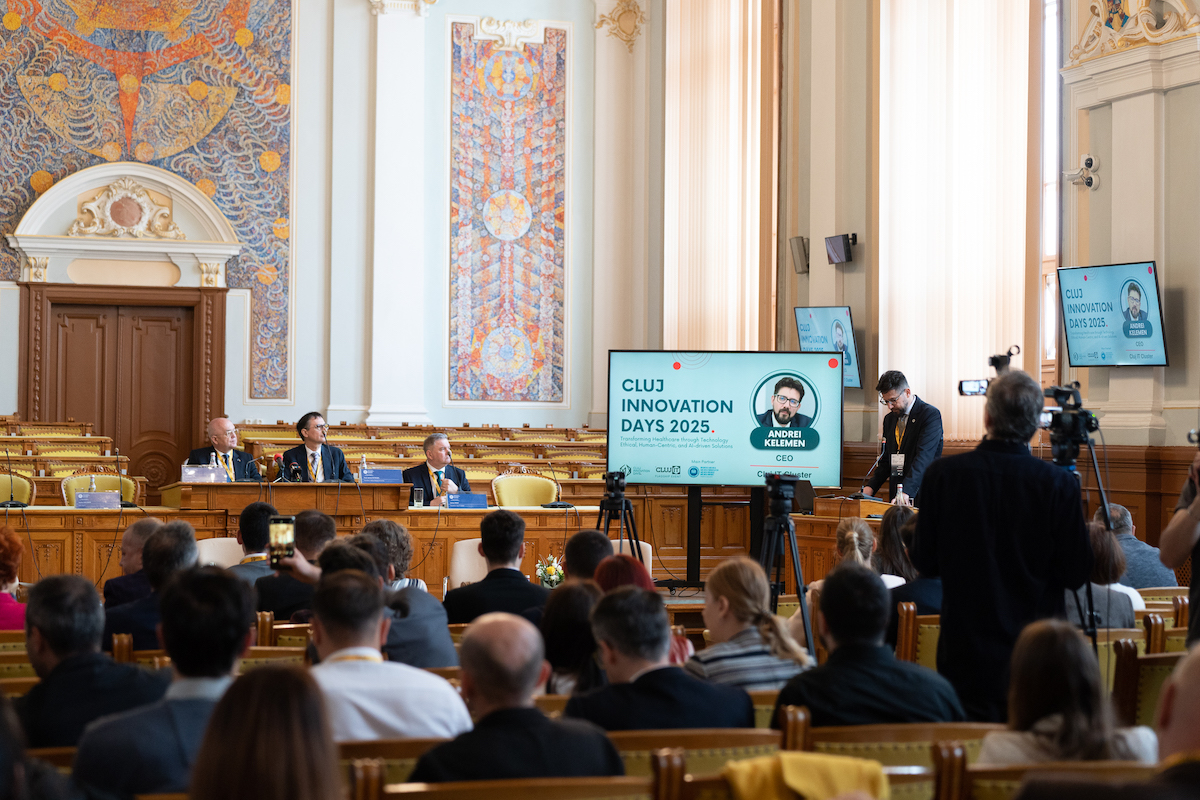
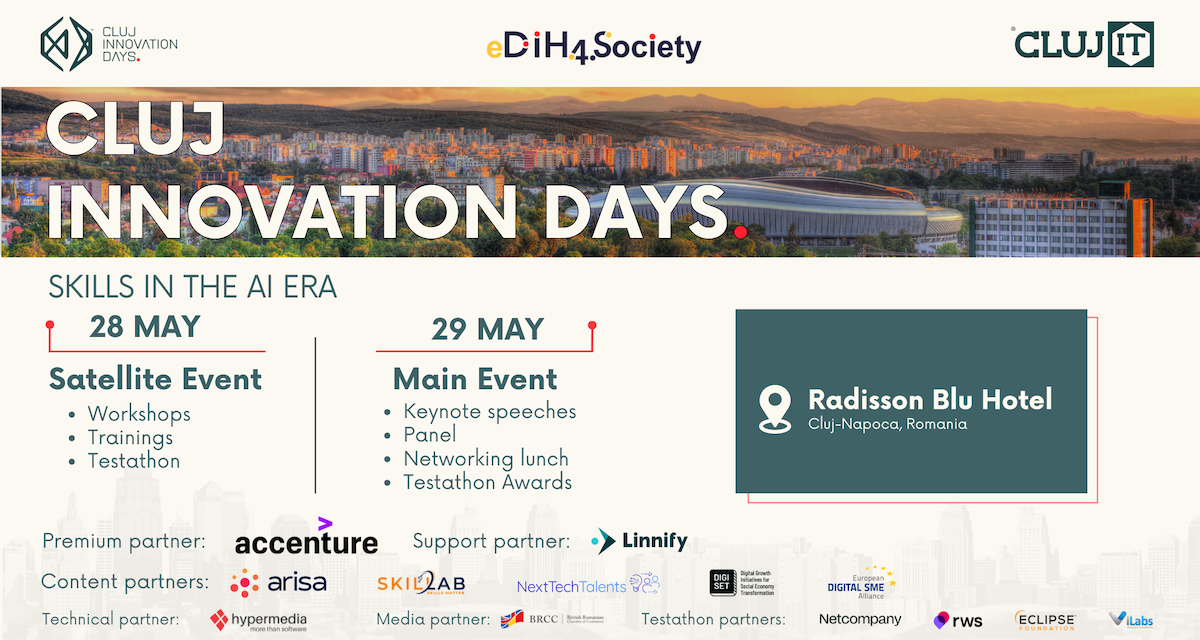
Cluj is ready for its most prominent innovation event. This year’s edition of Cluj Innovation Days is dedicated to the attributes required in the Age of Artificial Intelligence. The event is organised by the Cluj IT cluster, Romania’s foremost community dedicated to information technology and the orchestrator of the eDIH4Society initiative—a successful project backed by the European Union and the Romanian Government, which promotes the digital transformation of society by delivering free services to companies and public institutions. The international event, Cluj Innovation Days, is scheduled to take place on 28–29 May at the Radisson Blu Hotel in Cluj-Napoca. The event will be a sell-out, as all available places have already been reserved by guests and those interested in the topic.
Cluj Innovation Days 2026 will reconfirm the status of the municipality of Cluj-Napoca as a dynamic regional hub, a space of convergence where technological innovation is closely interwoven with the strategic development of the community. Over the course of two days, leaders from education and technology, policymakers, researchers, and top entrepreneurs will analyse how Artificial Intelligence is reshaping the labour market. They will propose solutions for human adaptation to the new technological wave.
The President of the Cluj IT cluster, Professor Stelian Brad, notes that it is vital to adapt to the transformations produced not only by Artificial Intelligence, but also by other technologies impacting society: “History shows us that humans have faced disruptive technologies before and managed to adapt, albeit at the cost of what was, at times, considerable effort. It is the same with Artificial Intelligence; it is one thing to discuss the generation currently evolving, which will adopt it natively and organically, and another to look at those of a certain age who are now facing the challenge of adopting Artificial Intelligence. It is as if someone told you that you need to lift 100 kilograms and you feel fragile. In this case, your first reaction is to say it is impossible and you will want to reject it. On the other hand, if you are told to lift 5 kilograms, then 10, and then 20, you accept it more readily. We react the same way when faced with advanced technology. We must transform our cognitive architecture to truly utilise this technology.” In this context, Professor Stelian Brad also used the concept of “brain engineering” to culturally connect with other fields of knowledge.
For his will, the CEO of the Cluj IT cluster, Andrei Kelemen, stated: “The main day of the event, 29 May, brings together guests from across Europe and the country, experts, and decision-makers who will be engaged in what we hope will be a relevant dialogue for the participants. On the preceding day, 28 May, we have event segments dedicated to several sectors: academic, business, and young people with a passion for innovation. The latter will also have the opportunity to win significant cash prizes, should they prove worthy, in an international hackathon organised by us and several European partners. On this occasion, we also mark the conclusion of the first three-year phase of eDIH4Society and bring to public attention the main milestones for the next 3 years, for which funding has already been secured.”
Satellite Events Day: Applied Workshops and Major Competitions
The first day of the forum, 28 May 2026, will be dedicated to satellite events, offering a hybrid approach and dedicated workshops. While academia and students will benefit from specialized training delivered by Ivar Grimstad (Eclipse Foundation) on the use of open-source software in research, a central component of the day will be the Skillab Testathon and Innovation Challenge. This international hackathon will bring together teams working on real datasets to generate innovative solutions capable of measuring skills gaps, predicting the dynamics of future jobs, and supporting the integration of young people into the labour market. The competition will be assessed by an elite international jury featuring experts from Greece, Germany, Denmark, and Romania.
Concurrently, on the stage dedicated to debates in Romanian, the eDIH4Society project will bring to the fore the success stories from the first generation of projects supporting the activity of European Digital Innovation Hubs (EDIH) in Romania. This represents the solid bridge built between technological expertise and the real needs of SMEs and public administration. The day will conclude on a highly practical note with an interactive AI discovery workshop coordinated by Radu Orghidan (CoRAI Labs).
Main Conference: The New Social Contract and Talent Transformation
On 29 May 2026, the community’s attention will shift towards understanding how the emergence of Artificial Intelligence affects our professional lives and how we can prepare for the impact and an as-yet uncertain future. The official opening will be delivered by Andrei Kelemen, CEO of Cluj IT, followed by strategic addresses from the Mayor of Cluj-Napoca, Emil Boc, Denisa Cristache, Talent & Organization Delivery Lead – Europe at Accenture, and the General Director of the National Institute for Research and Development in Informatics, Victor Vevera. One of the key moments will be the presentation given by the Rector of Babeș-Bolyai University, Daniel David, on the theme of the new “social contract”. This will address the impact of AI not only from an economic perspective, but also through the lens of how technology will reconfigure learning and the deeply human experience.
The final part of the conference will provide an occasion for a dynamic fireside chat between journalist Florin Zubașcu and the renowned researcher Cristian Presură, focusing on the source of transforming ideas from research laboratories into successful deep-tech startups. The event will end festively with the award ceremony for the winning teams of the Skillab Testathon, with trophies presented by industry leaders such as Janos Égly on behalf of Accenture.
Cluj Innovation Days 2026 demonstrates that the response to the expansion of artificial intelligence is not the fear of replacement, but the embracement of an accelerated strategy for lifelong learning. The 14th edition will outline a clear vision: real innovation will occur where cutting-edge technology meets a defined human purpose, and the future will belong to communities capable of upskilling their workforce with agility and ethical responsibility.
Cluj IT is an innovative cluster founded in 2012 that brings together technology companies (software, hardware, services), universities, research institutes, and public institutions alongside catalyst organisations. It is one of the strongest business networks in Eastern Europe, holding the European-recognised “Gold Label” cluster status. Its primary role is to stimulate innovation and competitiveness within the Romanian tech sector. Cluj IT acts as a catalyst for R&D projects, supports the internationalisation of local businesses, and facilitates dialogue between academia and the private sector to align education with labour market demands. Through its initiatives, the cluster promotes the digital transformation of society and public administration, positioning Cluj as a major hub for digital innovation.
DIH4Society is an initiator of digital transformation and innovation located in the North-West Region of Romania. Established in 2015, it is recognised by the European Commission as an official hub of the European Digital Innovation Hubs network (edihnetwork.eu).