

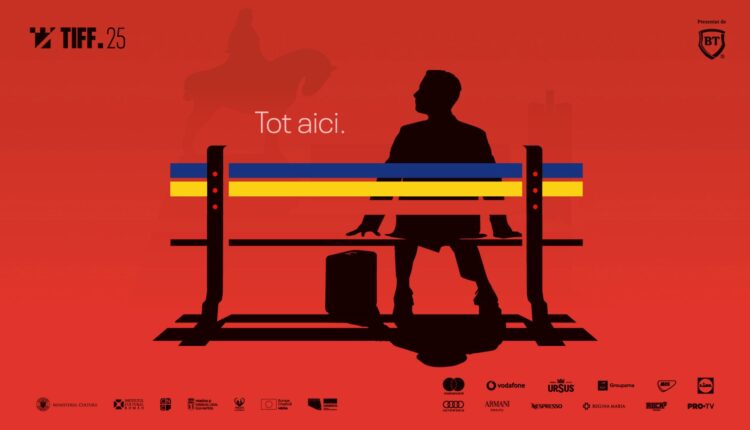
The bench is a direct and ironic reference to the urban furniture that marked Cluj in the early 2000s — a statement made in paint, visible and striking. Those benches no longer exist. But the mentality that produced them…?
TIFF was born in the same city, at the same time. Twenty-five years later, the festival remains a landmark: it has weathered crises, pandemics, and shifting paradigms, continuously reinventing itself and bringing new worlds, languages, and perspectives to the screen. The silhouette in the poster sits with a packed bag, but does not leave. It is the figure of someone who has seen everything, never pretended otherwise, and chose to stay. Right here.
The poster was created by the festival’s Art Director, Péter Árpád Loránt.
What started in 2002 as a daring experiment in a country with a collapsing film industry has matured into a cultural phenomenon. The Transilvania International Film Festival (TIFF) is no longer just a local event; it is a vital stop on the global festival circuit, blending radical cinematography with the medieval charm of Transylvania.
Every June, the Unirii Square in Cluj-Napoca transforms into one of the most spectacular open-air cinemas in the world. As the sun sets behind the Gothic St. Michael’s Church, thousands of spectators gather to witness the magic of the “seventh art.” In May 2026, as the city prepares for its 25th-anniversary edition, TIFF continues to push boundaries, proving that cinema is a collective experience that can redefine a city’s identity.
A launchpad for the Romanian New Wave
TIFF was born at a critical juncture. In the early 2000s, Romanian cinema was struggling for air, with theaters closing and funding drying up. The festival provided a platform that helped propel the “Romanian New Wave” onto the international stage. Directors like Cristian Mungiu and Cristi Puiu found an early, appreciative home here, where their minimalist and gritty storytelling was celebrated long before it conquered Cannes or Berlin.
The festival’s top prize, the Transilvania Trophy, has become a prestigious mark of quality, often awarded to bold, debut or sophomore directors who are not afraid to challenge conventional narratives.
Beyond the screen: the “TIFF experience”
What sets TIFF apart from clinical, high-brow festivals is its unique atmosphere. The festival is famous for its unconventional and breathtaking screening locations:
-
Bonțida Bánffy Castle: Known as the “Versailles of Transylvania,” this semi-restored castle hosts cine-concerts where classic silent films are accompanied by live orchestras or electronic bands under the stars.
-
The Piatra Corbului Quarry: Dramatic natural landscapes serve as backdrops for screenings, merging nature with narrative in a way that traditional theaters cannot.
-
Local Courtyards and Churches: Traditional spaces are repurposed, turning the entire city of Cluj into a sprawling, living multiplex.
Industry and innovation: The Transilvania Pitch Stop
TIFF is not just for audiences; it is a powerhouse for industry professionals. The Transilvania Pitch Stop (TPS) has become a crucial laboratory for filmmakers from the region (Romania, Bulgaria, Greece, Turkey, and beyond). Here, scripts are polished and co-production deals are struck, ensuring that Eastern European stories have the financial backing to reach global audiences.
| Festival Pillar | Description | Goal |
| Official Competition | Dedicated to 1st and 2nd-time directors. | Discovering new global talents. |
| Romanian Days | A showcase of the latest domestic productions. | Promoting Romanian cinema to international critics. |
| EducatiFF | Film workshops and screenings for children. | Building the audience of tomorrow. |
| Full Moon Script Contest | A focus on genre films (horror, thriller). | Encouraging diversity in storytelling. |
The 2026 Perspective: sustainability and digital frontiers
As we look at the festival in 2026, TIFF has embraced the dual challenges of the modern era: sustainability and technology. The “Green TIFF” initiative has significantly reduced the event’s carbon footprint, while new sections dedicated to Virtual Reality (VR) and AI-assisted storytelling explore the future of the moving image.
Yet, despite these technological leaps, the heart of the festival remains unchanged: a glass of local Fetească Neagră, a warm Transylvanian evening, and a story that makes you see the world differently.
Comments
comments


