The oldest museum in Romania hosted the Potato Festival. The Brukenthal Palace in Sibiu thus provided the perfect setting for an exploration of Transylvanian cuisine. This is fitting, given that potato cultivation was brought to this region by Baron Samuel von Brukenthal, the founder of the Sibiu palace and governor of the Grand Principality of Transylvania for a decade. The event took place under the auspices of Historic Cafes Route, according to ClujToday.ro.
On Saturday, August 30, the courtyard of the Brukenthal Palace hosted a unique cultural event: the Potato Festival, which brought together gastronomy, European heritage, and the visionary spirit of Baron Samuel von Brukenthal in an exceptional Baroque setting.
 Organized by the Brukenthal National Museum, in partnership with the European network Historic Cafés Route, the event took place as part of the Council of Europe’s Cultural Routes program and offered the public a fascinating insight into the history of the potato—a plant brought from the New World, but which over time has become an essential part of Transylvanian culinary culture.
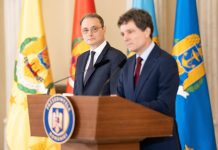
The president of Historic Cafés Route, Arnold Klingeis, gave an emotional speech during the official ceremony: “It is our duty to cultivate and pass on this history. Let’s carry it forward—not just in museums or archives, but also in our gardens, schools, restaurants, and festivals. The potato may not have the glamour of the Mediterranean olive or the mystery of oriental spices – but it has fed entire generations and strengthened people’s connection to their land. I invite you to see this simple potato for what it truly is: a root of Transylvania.”
 Through this initiative, Historic Cafés Route and the Brukenthal National Museum reconnect the past with the present and offer the public an experience that combines history with taste and living culture.
The potato is one of the most appreciated foods in human history. Its genetic origin has been identified in the Andes Mountains of South America. This plant was brought to Europe around 1540 by the Spanish.
At first, in Europe, the potato was cultivated as an ornamental plant. Only potato tubers were used for cattle feed. A French pharmacist enlisted in the army, Antoine-Augustin Parmentier, was taken prisoner by the Prussians and, during his captivity, was fed boiled potatoes every day. Upon his return to France, he began to promote potato tubers as food.
In this endeavor, he enjoyed the support of King Louis XVI, who wore potato flowers in his buttonhole. The King of France also had the potato fields on the outskirts of Paris guarded during the day, and at night, the inhabitants of the French capital were encouraged to steal potatoes. In 1771, the Paris Academy of Medicine concluded that this plant was not harmful to humans.
In the same context, Arnold Klingeis sent a message of congratulations to the local administration in Sibiu: “On behalf of the Council of Europe and the Cultural Routes Program, we extend our congratulations and admiration to the administration of the Municipality of Sibiu and the Sibiu County Council for this special distinction. In a competition that brought together thousands of European cities with valuable heritage and traditions, Sibiu was designated a model city for the promotion of cultural and sustainable tourism.”
”This recognition is all the more significant in the context of the Council of Europe Directive – Sibiu 2019: Cultural Routes FOR Cultural Tourism, which reaffirmed Europe’s commitment to the sustainable development of tourism by promoting shared heritage. Sibiu exemplifies this European vision, becoming a living space for intercultural dialogue, innovation in responsible tourism, and the promotion of cultural heritage in a way that inspires the whole of Europe,” added Arnold Klingeis
The Brukenthal National Museum is the oldest museum in Romania and one of the oldest in Central and Eastern Europe, officially inaugurated in 1817. Based on the collections of Baron Samuel von Brukenthal, governor of Transylvania in the 18th century, the museum is housed in his former Baroque palace, located in Sibiu’s Piața Mare. The Transylvanian baron’s art collections could be visited as early as 1790, four years before the opening of the Louvre Museum in Paris. Today, the museum brings together remarkable collections of European art, Romanian art, rare books, history, and natural sciences, and is an essential cultural landmark of Transylvanian and European heritage.
The interim director of the Sibiu museum, Raluca Teodorescu, made a statement during the official ceremony in which she extended an invitation to the management of the Cultural Routes Program in Luxembourg to visit the Brukenthal National Museum in Sibiu: “We are pleased to recall, in this context, that the Brukenthal National Museum was recently included in the Council of Europe’s Historic Pharmacy Routes—an international recognition of our unique heritage and cultural contribution. At the same time, we look forward to the future and the possibility of becoming part of the Habsburg Route, another prestigious European cultural route, which would bring our museum into an even wider network of values and collaborations.”
“In this spirit, we extend a warm invitation to Mr. Rui Gomes, Secretary General of the Council of Europe’s Cultural Routes Network, to visit the Brukenthal National Museum and join us in these efforts that honor our common European heritage,” added Raluca Teodorescu.
We are pleased to mention, in this context, that the Brukenthal National Museum has recently been included in the Council of Europe’s Historic Pharmacy Routes—an international recognition of our unique heritage and cultural contribution. At the same time, we look forward to the future and the possibility of becoming part of Via Habsburg, another prestigious European cultural route, which would bring our museum into an even wider network of values and collaborations,” added the interim director of the Sibiu museum.
“We extend our heartfelt thanks to Historic Cafés Route and all the partners who have joined us in this endeavor, strengthening cultural and European bridges that give meaning to our common heritage,” concluded Raluca Teodorescu.
The atmosphere of the event was complemented by a tasting of special potato-based recipes, created by Marius Rafa (Pardon Café, member of Historic Cafés Route), who demonstrated the culinary versatility of this ingredient and highlighted the Transylvanian gastronomic heritage in a contemporary form.
In this context, Marius Rafa, organizer of the culinary presentation at the Brukenthal National Museum, mentioned: “The potato is an ingredient with a modest history, but with incredible culinary power. Through this festival, we are not only celebrating its taste, but also its historical journey—from suspicion to its ubiquitous presence in every kitchen. We wanted each recipe presented here to tell a story: of the land, of the people, of tradition. Cooking on iron stoves in the courtyard of a Baroque palace is a return to the past, but with a taste that speaks of the present and the future. Cooking is, after all, a universal language – and the potato is a dialect that everyone understands.”
The festival also marked a cultural premiere: the first event in Sibiu held as part of the European cultural routes under the auspices of the Council of Europe in a museum, reflecting the city’s commitment to promoting heritage and intercultural dialogue.
The Avrig painter Mircea Codrea ennobled the event with a gesture of artistic depth: the presentation, in front of the guests and visitors of the Brukenthal Museum, of a plastic reinterpretation of Vincent van Gogh’s famous work “The Potato Eaters.” This artistic intervention complemented the theme of the event, paying visual homage to the modesty and symbolic power of the potato in European history—not only as a food, but as an element of cultural identity.
Currently, there are over 5,000 potato varieties worldwide. Approximately 3,000 of these are found in the Andes. Over 200 wild potato varieties can also be found there, which are of great genetic value for improving cultivated varieties and adapting them to climate change.