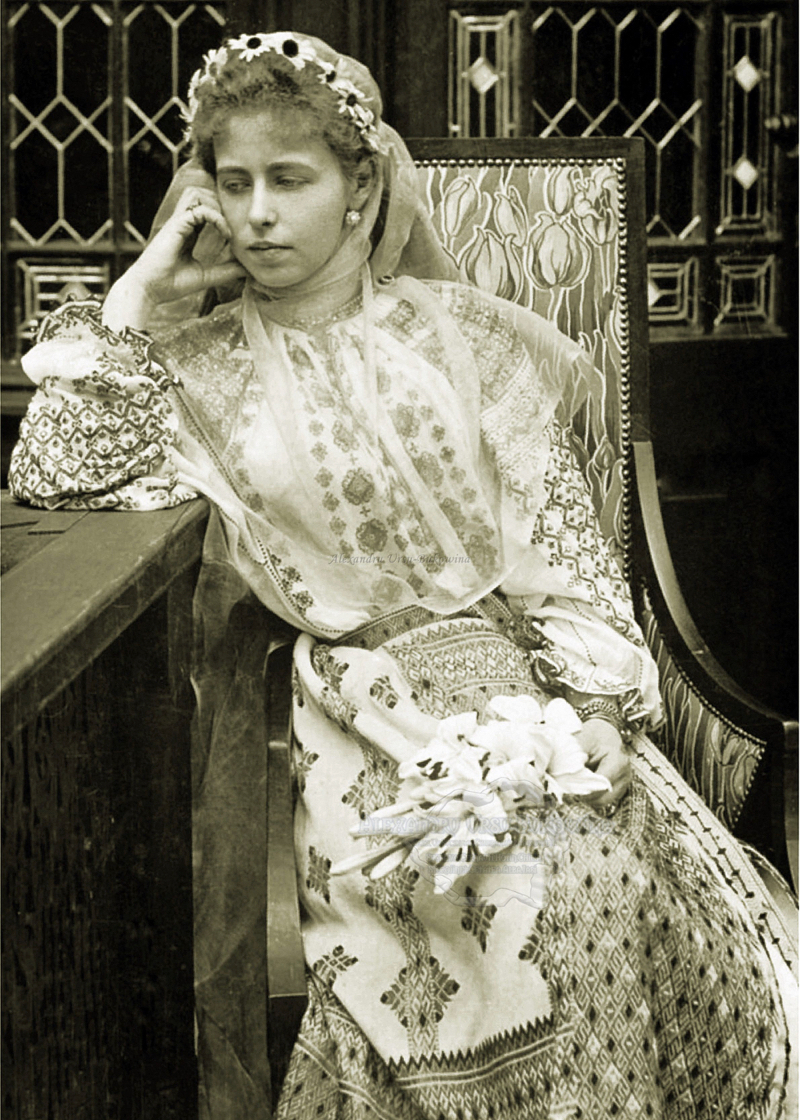
 The ”royal ie”, recreated after the design of an ie (Romanian folk blouse) worn by Queen Marie of Romania, is one of the most requested pieces of clothing of this kind at a textile traditions workshop in Alba Iulia, opened ten years ago with European funds by ethnographer Petruta Pop, according to Agerpres.
Involved in the preservation and valorization of the intangible cultural heritage of Alba county and wile doing research for her PhD thesis on the evolution of traditional costumes, Petruta Pop found out in the field the story of an ie, with reference to Queen Marie of Romania.
According to the ethnographer, it was Queen Elizabeth who adopted the fashion of the traditional Romanian folk costume at the Royal Court.
”Until then, the ladies of the Romanian high aristocracy dressed only from abroad and considered that traditional clothes were only to be worn by the Romanians. Instead, the queen, who received a gift of a traditional folk costume when she arrived in the country, fell in love with the traditional Romanian celebration clothing and, by the power of example, brought them back to the attention of the world. Queen Marie would do the same. Fashion-conscious and attentive to new trends, Queen Marie was always looking after her wardrobe. A regular customer of the great European fashion houses, Marie also wore Romanian folk costumes. Every time she visited the country, the queen wore folk costumes specific to each area and dressed her daughters and sons in the same way”, says Petruta Pop in her doctoral thesis published last year under the title ”Traditional costume in Alba County – Evolution, history and tradition”.
In her field research, the ethnographer also went to Saliste, Sibiu County, where she found, in an old house from 1841, a uniquely ornamented ”ie”, with long black strings accompanied on either side by the insignia of the royal crown. The owner of this ie recounted that she found out from her grandmother that Queen Maria would have received in 1919 a traditional folk costume, whose ie was made exactly like the one she had.
”The year 1919 brought to Salistea Sibiului the visit of King Ferdinand I and Queen Marie, as part of a special itinerary organized in the liberated Transylvania. Although the inhabitants were reluctant that the royal family would also pass through their village, the day of June 1, 1919 was to give them an unforgettable historical memory. The press of the time reported in detail the event in Saliste. The women in Saliste presented Queen Marie and Princess Ileana with a host of gifts, and the queen thanked them by coming amidst them and talking to the women, in particular about the beauty of Saliste folk costume and the sewing of the chosen stitches. (…). After the visit of the royal family, it seems that some skillful women continued to sew this royal pattern out of love and esteem for Queen Marie. In addition, the press of the time tells us that the Queen was given a folk costume as a gift. Queen Marie already knew the folk costume from Saliste as she had received a whole costume from Maria Sore Peligrad, at the beauty contest organized in 1906, in Filaret Park, Bucharest, when she was a princess”, mentions Petruta Pop.
In 2022, to mark the 100th anniversary of the coronation in Alba Iulia of the sovereigns of the Greater Romania, Ferdinand and Marie, the textile tradition workshop made the first ”royal wedding dress”, a reconstruction of the one found in Saliste, whose model is the same as the one given to Queen Maria.
Petruta Pop told AGERPRES, that the ”royal ie’ is the model for which most have opted in recent years, those who want to don a traditional attire. These include King Mihai’s nephew, Nicholas de Roumanie Medforth-Mills, and his wife, Alina.
Read more HERE