


Nutzungsrecht: Frei
Prime Minister Viktor Orbán declared his simple but ambitious plan: make Hungary one of the best countries in Europe by 2030. During his 2018 Tusványos speech, he outlined the steps needed to make this vision a reality. He focused primarily on connecting Hungary’s transport networks to the neighboring countries, effectively creating a well-connected Central European transportation network. To this end, the government has announced several large railway projects over the years. Hungary Today has researched tirelessly to determine what stage the current projects are in and just how realistic they are, according to HungaryToday.hu.
“Our proposal can be summed up by saying that, at last, we should connect our countries together – once and for all, and with serious intent. Let us connect our major cities with high-speed rail and road links. It is shameful that there is no such link between Debrecen and Nagyvárad [Oradea], between Kassa [Košice] and Miskolc, between Nyíregyháza and Szatmárnémeti [Satu Mare], between Eszék [Osijek] and Pécs or between Kolozsvár [Cluj-Napoca] and Budapest,” the Prime Minister said last year.
The biggest project is the Budapest-Belgrade railway
Improving the connection between Serbia and Hungary does not just serve the interest of the two countries involved; it is also part of the One Belt, One Road – OBOR initiative. Therefore, the main reason for the development is to enable Chinese goods to reach European markets via the port of Piraeus in Greece. The main cargo transportation route already goes through the line of Kelebia, but the average speed is just 60 km/h.
Before the Trianon peace treaty, it was a double-track railway line, but the Allied powers made Hungary demolish one of the tracks. Also, this line suffered the most from the last 30 years of the development policy. Due to the lack of development, the line has been downgraded.
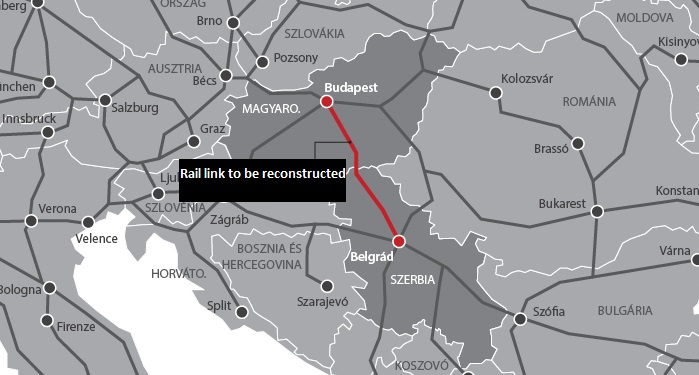

In 2011, the Ministry of National Resources said it successfully lobbied the line into the Trans-European transport network. As a result, Hungary has to renovate the line using EU funds.
The Commission’s official documents still show that the line needs to be upgraded. The document titled “Core network corridors of the Trans-European transport network (ten-t)” describes the Kelebia-line: studies and works for reconstruction and modernization of the existing line and construction of second track from Novi Sad to the border with Hungary.
Sources from the Commission claim that the link from Budapest to the Serbian border is not on any Trans-European (TEN-T) Core Network Corridor (neither the Rhine-Danube nor the Orient-East Mediterranean). Nevertheless, it is part of ‘other sections’ of the core network and would be eligible through CEF (depending on the annual call boundaries) for study. The Core network in the Western Balkans is also eligible for Instrument for Pre-Accession Assistance (IPA) funding and benefits from Western Balkan Investment Framework (WBIF) as a blending facility.


It is not clear why Hungary and Serbia are seeking resources from China given that EU funds are still available. We asked transportation expert Gergely Andó about the possible reasons behind the Chinese investment. Andó believes there will be just one financial cycle before 2030. And since Brussels seems to have finished the preliminary developments, the chance of pushing the BP-BG reconstruction into the next EU financial cycle is low.
Disputes over the economic payoff
Many argue that Chinese investment would not be profitable for Hungary. According to calculations published four years ago by Figyelő, the investment would return in 2400 years.
Hungary Today asked Sándor Kusai, Hungary’s former ambassador to China and China-expert, about the project and its possible outcomes. Kusai said the usual calculations are made based on the current size of cargo traffic. However, we can only estimate how the line will increase the degree of the exchanged goods. Kusai highlighted the complexity of the investment’s returns: “If the previous governments would have calculated with the actual traffic, the highways would not have been built in the last 15 years. And without highways, there would not be BMW or Mercedes.” He also explained that this type of transit corridor would increase the trust and investment rate between China and Hungary.
Last December, Hungary’s government decided to launch a new public procurement procedure for the upgrade of the Hungarian section of the Budapest-Belgrade railway line. The estimated cost of the project has since increased by about ten percent.
The projected cost of upgrading the 152-km section between Budapest and Kelebia on the border with Serbia was 578 billion forints (EUR 1.79bn) in May 2018. The best offer made since then has been 693 billion forints. As the government is unwilling to shoulder an overshoot, it has launched a new public procurement procedure.
Read more HERE
Comments
comments


