

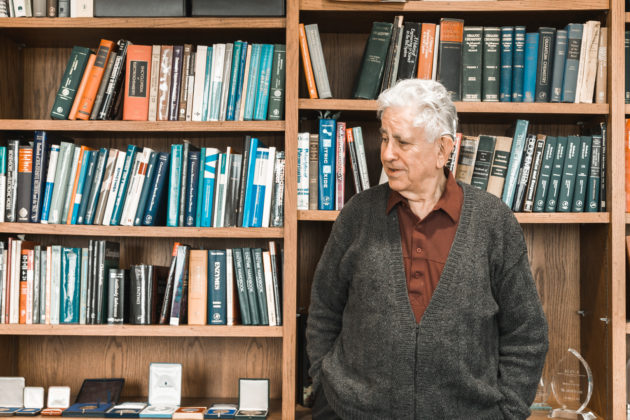

The 84-year-old professor emeritus holds more than 260 U.S. patents and has 392 pending, and counts the National Medal of Technology and Innovation—the most prestigious technology award in the United States—among his many awards. His latest project might be his most innovative yet. OraFuse, which is aimed at helping Parkinson’s patients and which Heller developed with his son, Ephraim Heller, is the first device to continuously deliver drugs into the mouth at a controlled rate. Underdosing in a Parkinson’s patient can cause them to freeze; overdosing can cause uncontrolled movements. OraFuse is a custom fit retainer that works by steadily delivering drugs to the back of the mouth, so they can be easily swallowed.
Heller is also credited with co-developing the first painless glucose monitoring device—a game-changer for those living with diabetes—and one of the earliest lithium batteries, which were later used in solar cells, medical systems, and are now used mostly in defense systems. But that’s not why students showed up in droves on their lunch break to hear from Heller last year. The professor, who is quick to laugh—often at his own dry jokes—and still speaks with a thick Israeli accent, looked momentarily taken aback at the size of the crowd. “I’m delighted to see so many of you here. I didn’t expect that there would be so many,” he said, before launching into his lecture, “The Holocaust: A survivor’s story on accountability, responsibility, and authority.”
Heller was born in 1933 to Jewish parents in Cluj (a Romanian city now known as Cluj-Napoca) before being forcibly relocated in May of 1944—along with his family and more than 18,000 other Jews—to the Cluj Ghetto, from which nearly all were transported to be gassed and cremated in the German extermination camp of Auschwitz. But Heller and his immediate family met a different fate. They ended up on the “Kastner Train,” 35 cattle trucks that left the Ghetto in June, first for Budapest, then in July for the German concentration camp Bergen Belsen, from which he and 1,684 Jews were released in December 1944 to Switzerland. Heller eventually landed in Israel.
As he recounts the details of his story and its grim details, the students visibly react, many of them in tears. But Heller insists that the lecture—one of the only two times in the past 20 years he has spoken publicly at UT about his Holocaust experience—is meant to inspire. “I’m not coming here to tell you that terrible things happened and that you should feel sorry. I’m coming here with a single message. You will soon be managers of the American industry,” he said to the students, most of them engineering majors. “And every day, I want you to think about what your responsibility is, what your accountability is for, and what your authority is over.”
Read more HERE
Comments
comments


